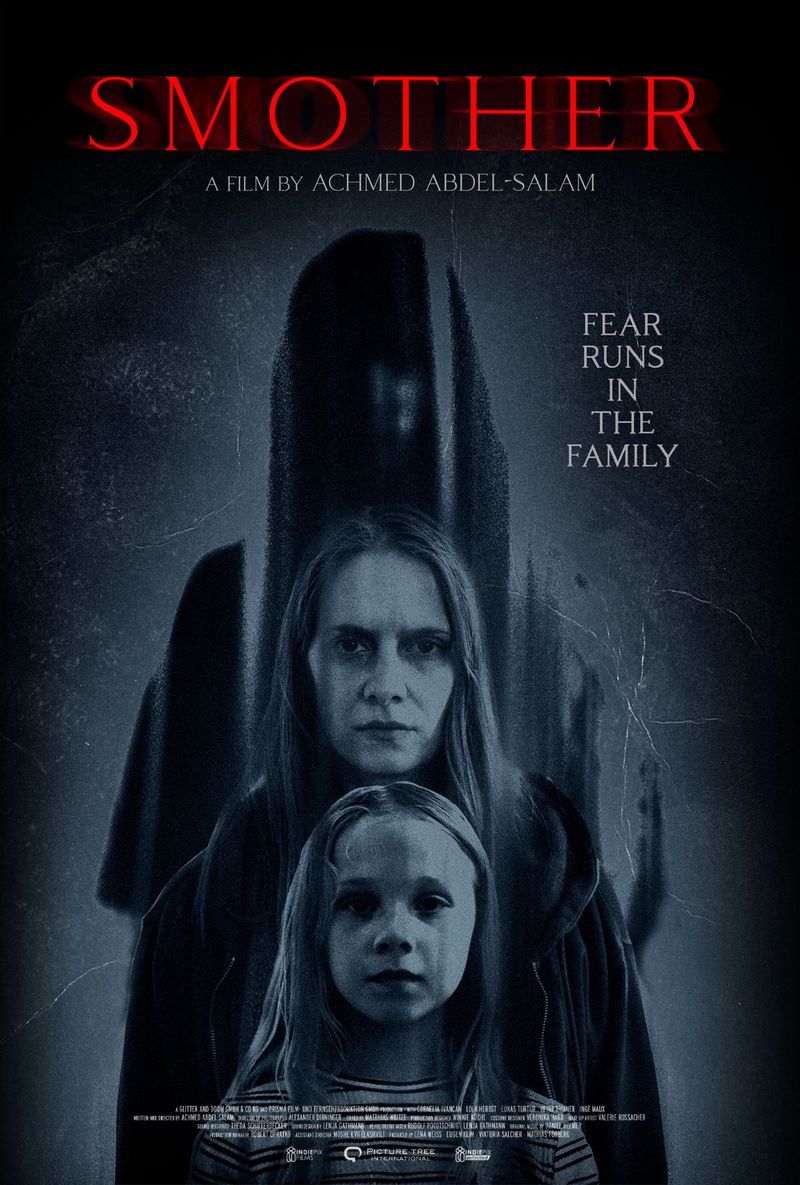

“Smother” (2023), originally titled “Heimsuchung” in German, which means visitation, affliction, or visitation of plague/misfortune, is about Michaela, nicknamed Michi (Cornelia Ivancan). Her daughter, Hanna (Lola Herbst), is not speaking to her, and her husband, Alex (Lukas Turtur), has become their daughter’s default parent. When Michi’s dad dies, she inherits her childhood home and decides it is the perfect time to spend more time with Hanna while Alex returns to work. It is already challenging to be a parent on a normal day, but while trying to wrap up her father’s affairs, confront the past, face neighborhood gossip about her family, and stay sober, Michi may be setting herself up to fail. Will she continue the family tradition? As a drama and character portrait, it is decent, but for horror fans, it is psychological horror so unless you loved “The Babadook” (2014), keep it pushing.
If you follow me, you know that I am sick of psychological horror, especially if the horror is weak. The horror works here not because it adheres to a traditional horror genre, but it is the frightening idea of relying on a caretaker, especially a mother, who is a danger to themselves and others regardless of the intent. The horror theme in “Smother” or “Heimsuchung” is that everyone is ill-suited to caretaking and abusing the ones that they are supposed to protect. The movie is not graphic, but the implication of the abuse is more incidental than malicious, not that it helps. If you are expecting the catharsis of revenge, turning tables or outside intervention, it does not follow those beats, which could be a problem for a lot of horror fans. If you are someone more inclined towards forgiveness, understanding and empathy towards an abuser because of love when they were more themselves without any comorbidities, then it may be the movie for you. I would rather that someone made a drama with horror elements, which is basically what writer and director Achmed Abdel-Salam did, but it is classified as a horror. He uses the heightened emotion of stressful situations and repressed memories to realize the horrific elements. It is his sophomore writing feature and his directorial debut.
The cast is perfectly ambiguous and seamlessly breathe life into their roles. Abdel-Salam just throws the audience into the middle of a generational family problem at a critical turning point. Michi is an interesting unlikable character. Every moment is about her loss of status: her husband not trusting her to mother alone, her daughter rejecting her, her role as the estranged daughter. There is never a sense that she wants to be a better person for them, but something flintier as if she should have a certain status because of expectations, not performance. “Smother” or “Heimsuchung” never reveals exactly why she shuns her dad, but she does not have many childhood memories. Returning home means dealing with the stares, whispers and judgment that comes with her family history. Abdel-Salam shows and does not tell the backstory through a prose dump disguised as dialogue. It is effective, and Ivancan pulls off an underwritten role. Some may find the dearth of context frustrating.
Hanna is a foil for her mother or rather an image of how Michi reacted as a child to her mother’s behavior. While Michi mostly perceives Hanna’s behavior as negative, Herbst plays the role in a nuanced way that shows while she is trying to hurt her mother, she is actually wounded at the idea that her mom is possibly unwilling to get better for her. Why is alcohol more valuable than Hanna? Now as viewers, this idea is ridiculous, but it is the correct math for a child’s mind. Flashbacks of Michi as a child (Iva Hopperger) and her mother (Franziska Rieck) never use this equation but imagine the dynamic as more terrifying and dangerous. Before you get your hackles up at another movie with an abusive mother, don’t. It feels as if it is unpacking the cursed legacy of bad mothers. Is Michi self-medicating because she is trying not to face her mother? “Smother” or “Heimsuchung” does not spell it out, but the performances are substantial enough to pull it off.
Even though Alex is the good parent, I would gently push back on that idea. Alex knows that Michi is in no condition to watch Hanna. Even though he is a good parent to Hanna, he is white knuckling it in a less obvious way. That stress emerges in his scenes with Michi and his articulated observations of Hanna’s behavior. Plus, he is dealing with an ailing handbag business, so they are tight on money. It is not crucial to the story, but why is Michi not working, why is his business failing, why does he have a business instead of a job, is the business inherited, a passion, etc.? When Michi demands alone time, he resists verbally but he is missing in action for the rest of the “Smother” or “Heimsuchung.” He knows better yet still puts the burden of dealing with an insecure mom on a child who needs protecting because that child is exhausting. That is literally the job description of a parent and spouse. Similarly, the story of Michi’s father is completely missing even though his death kicks off the movie.
Peppi (Heinz Trixner), her father’s friend and the only one not to enter the receiving line at the funeral, initially appears to be an ominous figure. That image is reinforced when Michi visits his house, and she hears screaming and crying from a woman. Cries dominate the audio in the first act, and Abdel-Salam’s commitment to sound conveys the horror because the cries are always from the helpless. Michi looks concerned. He lies and says that the woman is asleep. Michi does not challenge his claim. Later Gerti (Inge Maux) is revealed to be a mother figure to Michi and is protective of Hanna, mistaking Michi’s daughter for Michi as a child because she suffers from a form of dementia; thus, Peppi becomes a father figure as well. Gerti’s well-intentioned concerns and protectiveness shape the ominous events that occur within “Smother” or “Heimsuchung.” These figures continue the theme of flawed caregivers. Not because Michi gave Hanna to them, but at some point, Gerti oversees Hanna,. Naturally Hanna winds up in more danger as a result.
The exception to problematic caregivers is Michi’s former babysitter, Agnes (Gisela Salcher), who is still killing it with Michi even though her charge is an adult. While in the area, Agnes is doing more for Michi and Hanna than her husband, who also has his hands full, but he signed up for this rodeo. Agnes appears to be the only single and happy person in the movie. Correlation is not causation, right?
The tension of “Smother” or “Heimsuchung” is what will Michi do to herself and/or her daughter. Does this legacy continue? The horror is the visitation or manifestation of this legacy of bad caretakers that can only be exorcised if caretakers’ frustration does not exceed the joy between mother and daughter. Abdel-Salam conveys the mystery of such relationships with kid drawings and an image of a tenebrous figure lurking around the area. Unfortunately, because most people will stream this film and not see it on the big screen, the effectiveness of the terror in the nighttime scenes may vary depending on which device you use. I was checked out using an iMac. No idea if it is better on a television or a mobile device. Movies are not meant to be seen this way, but Abdel-Salam should not feel too badly considering that the makers of “Game of Thrones” did know better, had more resources and still fumbled the ball with nighttime scenes. Contemporary filmmakers need to make movies for the big screen but check their work on smaller devices to ensure that nothing gets lost in translation.
Considering my newfound disgust over psychological horror and the technical challenges, “Smother” or “Heimsuchung” still kept me engrossed thanks to a minimalist story that conveys a nuanced human view of caretaking without falling into a binary of saint or sinner. The cast does a terrific job with the material even when it is flawed. Visually what I did see was well shot and evocative. The underlying emotional truth of the story makes it worth watching despite the inherently disturbing subject matter, which is not exploited and treated with sensitivity and decorum.