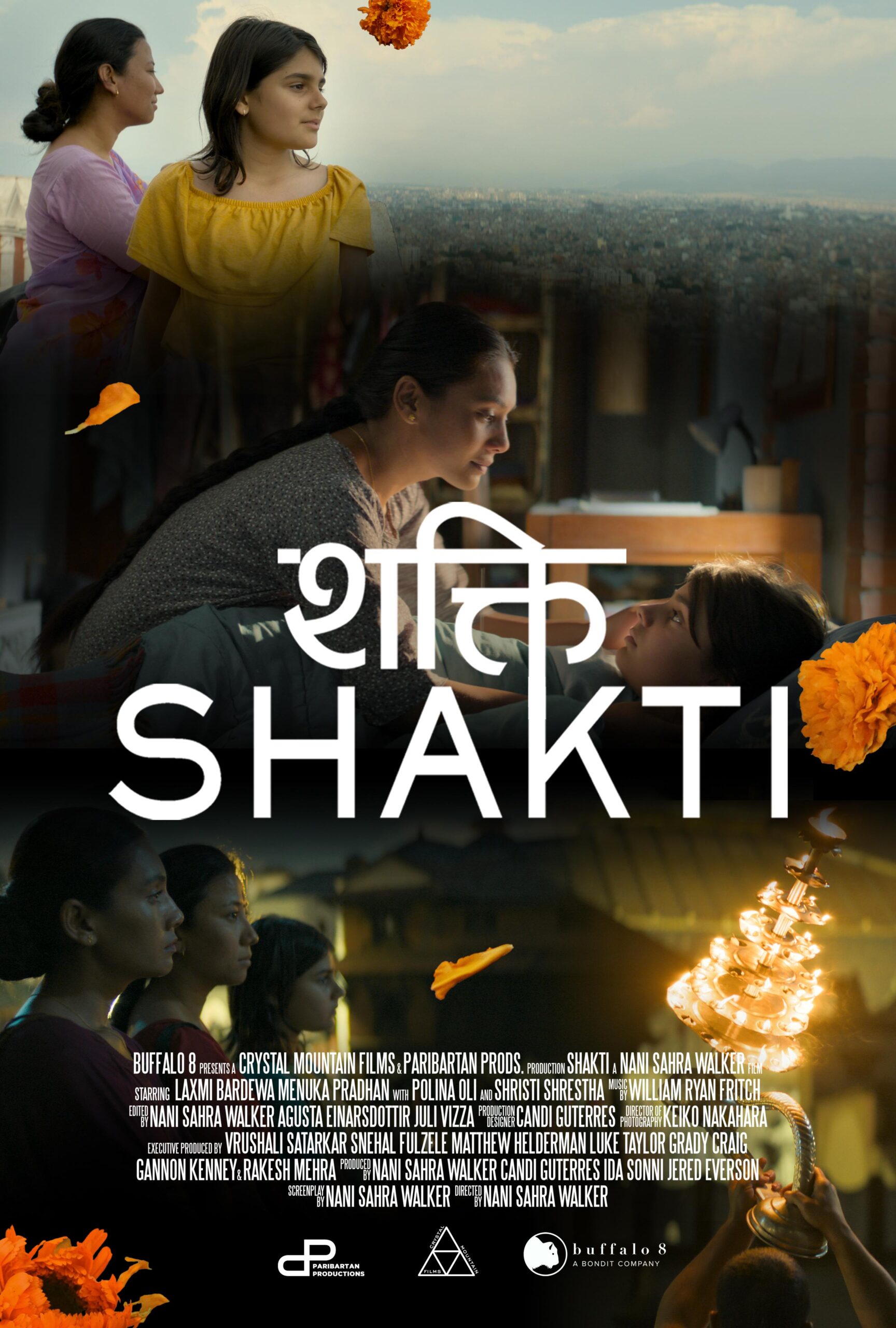

Set in contemporary capital city, Kathmandu, Nepal around the Tihar festival in autumn, “Shakti” (2026), which means power, focuses on a family of three as they try to adjust to life after recently divorced Durga (Laxmi Bardewa) becomes a single mother to her gifted, energetic nine-year-old daughter, Lila (Polina Oli), nicknamed Li, with the help of her sister, Maya (Menuka Pradhan). When a teacher, Miss Joshi (Shristi Shrestha), suggests that Lila channel her spirit into creative pursuits, Durga takes Lila to Hartul Art Academy to learn how to paint, which turns out to be the worst thing to happen to Lila and is the final event that radicalizes Durga. It is unclear whether the film works because it depicts an unfamiliar world for most audiences thus is innately fascinating to look into another’s quotidian experience in a different culture, religion, nation and/or if writer, director and coeditor Nani Sahra Wallker makes a sensitive, nuanced, character driven instructional film that is a refreshing contrast to the Afterschool Special or American approach to depicting child sexual abuse while tackling other hot button issues.
The opening sequence is economical and lyrical in a Terrence Malick way as “Shakti” wordlessly introduces Durga’s biography before diving into present events. Walker, cinematographer Keiko Nakahara and co-editors Agusta Einarsdottir and Juli Vizza are deft at romanticizing every moment throughout the film, but this sequence’s warm, soft and color truly sets the tone for the kind of life that was promised, savored then disrupted for Durga and what she is trying to maintain now that her husband, a Westerner possibly from North America, has left his family. The switch to present life is more peopled and colder but still possesses the color and warmth of better times. Bardewa is an understated, subtle, powerful actor who finds the gentlest ways to depict honest, white hot anger without theatrics. She delivers such a naturalistic performance that it may be challenging for movie goers to remember that they are not watching a documentary.
Lila is a normal little girl who displays a sense of adventure and asks the right questions while everyone accepts conventional standards. It is obvious that she came from a good home because of how she navigates the world with an openness and curiosity without any sense of fear or deference. In her introductory scene, she is picking guavas, but the school staff frame it as stealing. While her fellow friends, two boys, Kiran (Daniel Pradhan) and Tej (Pranjal Khatiwada), beg for mercy, she asks, “Tell whoever you want. Why can’t we pick a couple of fruits?” These early scenes reflect her fascination with birds, flying and drawing. Everyone pathologizes her behavior, and while she does not seem to register it because her behavior does not change, when her demeanor alters, people regret their admonishments as she isolates, stops engaging in activities that she enjoys and withdraws from interacting with most people. Occasionally there are still flashes of the defiant Lila working hard to save others and escape the abuse. Lila is Oli’s first role, and she knocks it out of the park. Because of the way that her character is written, her character disappears for a lot of “Shakti,” and it feels like losing a crucial leg of the chair, which is emotionally the correct note to strike, but also makes it feel like a dangling thread. Costume designer Nuzhat Qazi does a lot of heavy lifting in the way that she styles Lila initially in unisex clothes to shorts then after the abuse starts, in baggier clothes like sweatpants.
Whispers about being lower caste swirl around mother and daughter. They never react so it is unclear if Durga or Lila even hear the comments, but gradually as the danger around Lila grows, the problem rises to the forefront. Though it is never explicitly addressed, there are some complex, unspoken intersectional dynamics occurring. Are Durga and Lila accustomed to more freedom because of the privilege that proximity to Durga’s ex and Lila’s father, Chris (Ian Scott Clement), offered them? They are judged for what the men in their lives do based on a man not being in the home, Durga needing to work at Patan Hospital, their caste, etc. There is no judgment on the men for their actions. At some point, “Shakti” transitions from being about women’s rights and turns into an interrogation about caste and the failure of Western institutions such as the law and medicine even when a practitioner is progressive.
“Shakti” depicts Durga’s radicalization by showing her reaction to Attorney Karuna Shakya (Riva Thapa) appearing on television either during a press conference or on television. Reactions to this content provide more reliable results than a Rorschach test when Dr. Kailash Naren (Jiban Bhattaral) resonates with Shakya’s message. (Disclaimer: do not try this at home. Words are not as important as actions). When Lila falls ill, Durga brings Lila to him, but other than a fever, there is no diagnosis. Here is when the movie takes an unexpected turn which Western audiences, especially with a Christian background will find challenging, but is nevertheless the exact reason that movies are made: to learn about others’ lives and empathize with them.
Maya suggests taking Lil to a Shaman (Sarita Giri), which Durga views with skepticism. During “Shakti,” there are lots of unfamiliar religious practices occurring so for an outsider, it is hard to discern whether a religious practice is mainstream without a frame of reference. Buddhism and Hinduism are practiced side-by-side without conflict. There is goddess worship, which the dialogue pointedly notes is hypocritical considering the treatment of women. The Shaman scene may remind one of Acts 16:16 as a woman visiting her gets accused of wrongdoing and upbraided then expected to be part of Lila’s treatment. It feels abusive to the accused woman.
Considering all the news reports and high statistics regarding child sexual abuse, it does not take a genius to guess what is ailing Lila, but it does require a stranger with pattern recognition and a willingness to see and say the obvious. People are more likely to believe someone with a sense of authority than a random woman. Real or not, placebo cure or not, the shaman gets the ball rolling, and maybe mysticism is just a way to sidestep the Cassandra effect and dismissal of women. It also seems linked to an interesting precipitating event when Lila speaks for the first time after a snake startles her. The Shaman serves a Serpent God. Even without any understanding of the broader religious and cultural context, this scene changes the trajectory of “Shakti” so Lila can recover, and Durga can become strong enough to raise her voice and seek justice.
If there is any criticism of “Shakti,” the story should have devoted more time to the supporting characters and getting to know them since everyone had such a riveting presence and seemed like three-dimensional individuals even if they did not have many lines. Why did Maya choose such a different life from her sister? Is Mali Dai (Maotse Gurung) their ultra chill super, landlord or just a neighbor who does not mind doing favors every day? Does Prem (Norbu Tsering) have a crush on Maya and would have loved to hear more about what he noticed and thought. On the other hand, it may have detracted from the overall movie.
“Shakti” is one of the rare films that you will not want to end because you are so invested in all the characters. If it became a television series, the story could expand, and it could offer another slice of Nepalese life. It is easy to see why Nepal is considered such a happy place despite the story’s subject matter. It also offers a valuable lesson: do not try to solve problems that are not there because the solution could become the real issue, and you could pay for your daughters to be destroyed.