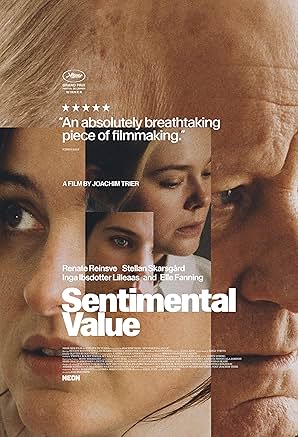

“Sentimental Value” (2025) is the critics’ foreign film fave though not this one. Maybe if I saw it on the big screen. It is the first in a series of 2025 films about men struggling with and hoping to be found not guilty for choosing their career over their family based on their great artistic talent. After years of estrangement and the death of the family matriarch, aging art house director Gustav Borg (the iconic Stellan Skarsgård) reenters the lives of his daughters, older daughter, serious theater actor Nora Borg (the great Renate Reinsve), and younger daughter, historian, wife and mother, Agnes Borg Pettersen (Inga Ibsdotter Lilleaas) with mixed results. He hopes to make a feature film, but when Nora rejects his offer of the lead, his hopes are dashed until internationally famous Hollywood actor Rachel Kemp (Elle Fanning) takes an interest in his work thus resurrecting his career. His movie begins to have legs, but everything is just askew and not coming together as everyone hoped. What will make this family and movie work? Don’t let the trailers fool you. There are subtitles, and it is neither an English language film, nor a film about Nora and Gustav. It is predominantly a film about the latest links in a Norwegian family chain that intertwines the art of storytelling, generational family trauma and grasping for a way to overcome individual limitations.
Depicting characters and relationship dynamics should not be conflated with approval of that character or relationship. Gustav is a severely flawed character, but an instantly recognizable one. He understands that he is only good with relationships on set, not in between, so his offer to make a film with Nina, who is fresh off a limited television series success, is not just cynical, but an olive branch to reconnect in the only way that he socially understands. He is a bit of a bastard. Note how he uses paper towels (a physical gag also used brilliantly in “Is This Thing On?”) His worst moment free from family history complications with former friend and cinematographer, Peter (Lars Väringer). All his artistic principles fly out the door and his ableist bias walks right in because Peter is everything that he is running away from: age, mortality, oblivion. He wants to stay in the director’s chair, and he will compromise everything to do it. The guilt in Skarsgård’s eyes as he withdraws his offer with bureaucratic excuses is devastating. If you want to understand how good Skarsgård is in this role, watch some clips of Anthony Hopkins talking about his estrangement from his daughter and critiques of his veneer of acceptance while attacking private rejection in public. Gustav does a better job of evading judgment from his daughters, and in the case of Nora, is determined to prove her wrong about his film not getting made and being a has been. The most subversive twist is that he does not get a prettier, younger wife, but a more famous, younger daughter substitute with Rachel Kemp and succeeds in making Nora a bit jealous.
Kemp is his soul daughter. She is as ambitious, yearning for greatness, all about business and art, two necessary elements for movie magic. Fanning crafts the image of an affable, eager, sincere young woman filled with integrity but is also a savvy mover and shaker. Fanning has a gift for being successful, strong while simultaneously innocent and amateurish. The serendipitous timing of the release of “Sentimental Value” with “Predator: Badlands” (2025) makes the role seem autobiographical. She understands what she lacks and is the only character who assesses her flaws then course corrects, but she can never be Gustav’s daughter—her nationality, the resemblance, the family history, and the acting jobs. Rachel is a woman of integrity who understands the gap between her ambition and talent. Gustav loves the attention and the ability to play the great man without facing any derision. He is protective of her in a way that he fails with his daughters. Kemp brings out his best self because he can just be Gustav the director with her and nurture her as an actor.
Nora is probably the most complex, unknowable character to the audience and herself. Reinsve is a great actor who can play inscrutable characters who carry the presence of a colossus. Cowriter Eskil Vogt and cowriter and director Joachim Trier introduce her as a hot mess, who is such a great actor that people are willing to put up with her neuroses that threaten to sabotage every production. In an ocean of praise, she is also the only one able to confront Gustav. He cruelly deflects by blaming her anger, her singleness, her childlessness, comparing her to others and finding her lacking instead of considering that his absence played a part in her development. The movie uses the metaphor of the family home to suggest epigenetic trauma dating back to the Nazis as the decisive factor for this crack in Nora’s psyche, which is a real scientific possibility, but sidesteps addressing Gustav’s contribution to his daughters’ issues. The house has its own biography and is a separate character. (Side note: I was mad at the house’s makeover.)
“Sentimental Value” is not seamless. If “Sentimental Value” felt schmaltzy, it was the rhythm of the narration, not the content. It is the closest that Trier came to embracing his inner Terrence Malick, but he lacked the confidence to only show it and felt the need to show and tell. The house becomes a literal embodiment of the crack in the family’s mental health foundation with Erik (Øyvind Hesjedel Loven), Agnes’ son, predestined to be the second coming of Gustav as the only surviving heir of his generation except he has a leg up with having two stable, present parents. Agnes is the only storyteller who delves into the past using archives, not leading with her memories or emotions. Another flaw of the film is the fact that Agnes feels as if her story should be expanded. She chose not to be an actor after working with her father and unlike Nora, had the experience of having a present father as an auteur then resented that just being a family member was a demotion, yet that resentment remains separate from her ability to coexist with her father and appreciate his work. She is fascinating for not resenting how Nora and Gustav use her as a go between and volunteering to perform that function for the family’s past and present. Agnes’ husband, Even (Andreas Stoltenberg Granerud, who has an expressive face and almost no lines), and Rachel’s scene partner, Ingrid (Lena Endre), almost exist as punchlines, not people.
“Sentimental Value” is a love letter to siblings, specifically sisters, with Nora and Agnes’ relationship parallelled with their grandmother and grandaunt, Karin (Vilde Søyland) and Edith Irgens (Mari Strand Ferstad). By making a joyful noise, Edith avenges Karin and harms the neighbors who betrayed her family. Edith is depicted as gay (literal and metaphorical) and childfree. Did Trier secretly get some Marvel money because the flashbacks of a younger Gustav (Knut Roertveit and Nicholas Bergh) resemble a younger Skarsgård? Gustav’s latest movie idea makes everyone think that he is talking about his mother, which he denies, but he never spells out that he is trying to change history and save Nora. His unyielding preference for movies over theater and television gradually seems less about being an art snob or an unsupportive father trying to control his daughter, but a tacit understanding of what makes her tick as an artist reflecting on his mother, seeing echoes in her and trying to remove the neuroses from her art. He cannot be a father, but he can be a director.
It is a concept that becomes clearer as the movie unfolds, and “Sentimental Value” speaks to a dismaying truth. Even if a man does not raise his children, does not spend any meaningful time with them, he can also completely understanding them because of some visceral, biological, instinctual truth that they share that cannot be shaken or separated even if they want to. It is an inconvenient truth that Vogt and Trier probably should have developed more. For instance, in separate scenes, show how they have similar habits or behaviors that they do not know that the other does. It is the glue that keeps Nora and Gustav tied to each other even when they cannot help but hurt each other.
Can a man be an acclaimed artist and use that art to exculpate his neglect of his family? “Sentimental Value” is more realistic and nuanced than the glossy “Jay Kelly” (2025) or primal pre-Raphaelite “Hamnet” (2025) while somehow being more optimistic. In Trier’s film, a dad can have it all, but the highs are not as high while the lows are really low. No easy resolutions here, but some pulled punches that take it easy on dad in a day and age when older daughters are becoming forces of nature who make art and heal while showing no mercy.