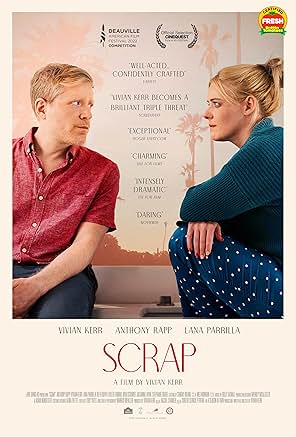

Beth (writer and director Vivian Kerr) lives in her car and is hoping that she can get back on her feet before anyone figures it out. Her big brother, Ben (Anthony Rapp), can sense something is up and is trying to figure out what, but he has his own problems. He and his wife, Stacy (Lana Parrilla from “Once Upon A Time”), are going through fertility treatments with no luck. Neither sibling can get it together no matter how hard they try. When will they give up pretending that they are in control? Kerr’s debut feature, “Scrap” (2024), is a breath of fresh air. Imagine a movie that is just about people: no action, no sci fi, no psychological horror, no grand agenda, no gimmicks. Just people. Make a realistic scenario (more or less) then tell the story straight.
Kerr has a talent for making three-dimensional characters who are relatable, flawed and realistic then putting them in scenarios that will keep you absorbed the entire runtime and create relationship dynamics that feel familiar without tumbling into tropes. It sounds as if pulling off that hattrick should be a prerequisite for filmmakers, but it is not, and you are lucky when the credits roll if you do not have a CVS receipt sized list of negative notes. Side note: she made two films that year! Both solid originals and not photocopies of other movies. You know who else did that in 2024? No one. (Any year? Woody Allen, 1987, but Kerr is not in the news headlines as a bad actor of a different sort, so she still wins.) As an actor, she pulls off a character that could be dismissed and judged, especially because Beth is entitled and not a good mom, but it is impossible to do so even as she repeatedly makes bad decisions.
Beth is fighting for her life. She is homeless, and Kerr litters “Scrap” with expected images of homelessness: a line of tents pitched on a sidewalk, a man begging outside Beth’s gym and possibly a disheveled woman ranting at a bus stop. Without any grand pronouncements, Kerr addresses homelessness for an individual, and it remains a personal struggle for the character. The specificity makes it more universal than descending into the common imagery. Beth is keeping up appearances but is another, once unexpected, valid image of homelessness. It becomes a movie because she has affluent people in her life that are willing and able to help Beth, and they are accessible to her. Even then, she is perched on the edge of oblivion as she reaches credit card limits, does not land the job, is not paying bills and keeps dealing with the threat of losing her car. Even at the end of the story, it feels very possible that she can lose everything again. How did Kerr capture that opening shot that makes it look as if Beth is sleeping in a huge, comfortable bed in the interior of a car?
The casting is outstanding. Rapp and Kerr do look similar. Ben is a striver, a bit of a pushover and resigned to his lot in life because it is pretty good. He is successful and has a smart, gorgeous wife. Rapp has good chemistry with Parrilla, and if there are any complaints that can be levied at “Scrap,” it is not getting to see what kind of lawyer Stacy is. You know that Stacy is the one that sends back the orders if they are wrong, and Ben just wants to eat it without causing trouble. She is making TikToks bullying people to let her husband talk about Billie Holiday. Instead, Kerr gets Parrilla out of her comfort zone, and Parrilla knocks it out of the park in her silent and emotive depiction of a woman completely hurt at performing mother duties while not being allowed to have final say in decision making, often being undermined as a caretaker and not being able to be a mother. Beth has a five-year-old daughter, Birdy (Julianna Layne), that she left in Ben and Stacy’s care, and in Stacy’s eyes, Beth breezes in for the fun stuff and is irresponsible. If she is not cursing her out, it is for Ben and Birdy, not Beth.
As the family history gets revealed, it becomes obvious that Ben is not just a brother, but a parental figure, which makes it especially painful that he cannot have his own kids when he finally is ready. Beth casually says some mean things along those lines, and Kerr never writes dialogue about Ben confronting Beth on her cruelty. Instead, she takes the path less travelled. Beth is at her most immature around Ben, which explains why she initially hesitated from accepting help because she does not want to regress and wants to imprress. Rapp must do the harder thing and convey how Ben swallows it, emotionally regulates and focuses though it would be the understandably human to rip her to shreds in that moment, but that is not what parents do. It also explains why Stacy loves him.
“Scrap” has real stakes. Beth needs to stop behaving as if she is delusional, accept help and live in the real world. Ben also must stop trying to control the uncontrollable, give up positive thinking and assess his options. Based on their respective prospects, Beth must think a little more modestly, and Ben must think bigger. There are moments in the narrative that feel extraneous and if cut or done another way, the same beat could be achieved in a sharper way. For instance, Beth’s reunion with a former coworker gives Kerr an opportunity to catch the audience up with Beth’s progress. There is a storyline that feels as if it dragged the momentum slightly. It is a mixture of realistic and fantasy as gobs of money are thrown at her, and she keeps turning it down. (Side note: you can accept money and tell a person to GTFOH.)
I’m still on the fence about one character: potential love interest, Marcus (Khleo Thomas). On the one hand, Beth is a complete mess, and the last thing that she needs is a date, which Beth acknowledges. On the other hand, it feels as if Kerr is doing more than Celine Song in portraying men that do not check the conventional boxes of what someone wants from a partner. Song wants to have her characters fall in love despite money in “Materialists” (2025), but still makes it seem like the worst idea. Marcus is a good guy who accepts when Beth turns him down and still can maintain cordial contact with her. Movies do not often depict that dynamic, and because we are in the worst timeline, apparently, we need to have more countercultural examples of positive masculinity: a normal guy with no red flags.
Movies like “Scrap” are becoming rare. It is a refreshing to have a drama with good acting and without sensationalism. Yes, there are times when the exit ramp from poverty seems too convenient, but it happens, and it is a movie. More movies need to show that success is not always making a lot of money or gaining a lot of fame, but having better relationships and feeling fulfilled.