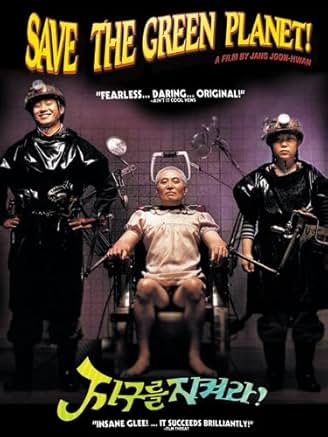

“Save the Green Planet!” (2003), is the South Korean film that Yorgos Lanthimos adapted in English and called “Bugonia” (2025). Byeong-gu Lee (Ha-kyun Shin) enlists his adoring, acrobatic and somewhat dim girlfriend, Su-ni (Jung-min Hwang) to kidnap Man-shik Kang (Yoon-shik Baek), the husband, father and CEO of Yuje Chemicals, whom Lee believes is an alien from Andromeda who may destroy Earth. Lee believes that in seven days, a lunar eclipse is the time when the Andromeda prince can be contacted. The kidnapping sets off a police investigation to find the CEO, which exposes the ineffective bureaucracy and the flawed outsider with a lead. Korean writer and director Joon-hwan Jang’s feature debut is an off kilter, disorienting and bonkers movie that somehow makes Yorgos Lanthimos feel respectable and comforting in comparison.
Lee seems like a nutjob serial killer who cannot be stopped more than his American counterpart whom Jesse Plemons played. Initially the character is played for laughs, but once at home, the notebooks and décor scream psycho killer with a torture chamber. His countermeasures to alien biology is more like torture than humiliation with a sexual sadistic component. It is kind of hard to watch and is reminiscent of J horror “Audition” (1999) style techniques. He builds mannequins, which adds to the creep factor atmosphere of “Save the Green Planet!.”
Unlike the American story, the political undertones of Lee’s pathology are not obvious to an American viewer so a Korean critic would have to elucidate you on that issue. Lee includes a fantasy sequence that shows how Lee imagines himself. This scene was disorienting as a viewer because it is a one off. This story feels more about a bullied kid getting revenge against his employer and desiring dreams of adulation for saving the world. The film poignantly reveals how all elements of society beat and failed Lee, so he seems driven to madness, not innately pathological. Lee plays him as a bug-eyed, crazed person so it is impossible to root for him, but his past makes it impossible to dismiss him. Also, his ability to show genuine warmth and connect with people even makes Kang shed a tear when he reads his journal. If the deck was not stacked against Lee, he could have had a beautiful life.
The rhythm of “Save the Green Planet!” is impossible to anticipate, and one way to relate to Kang is feeling as if it is impossible to escape Lee’s warped mind. Unlike his American counterpart, Kang has no redeeming qualities. His first interaction with a driver gives clues regarding whether there is an element of truth to Lee’s accusations. Kang is not Japanese, but he seems more modeled after Japanese businessmen with his drunken, wild carousing that makes him an easier target. Baek plays him as an unrepentant power player who uses his words to inflict as much emotional damage as possible and relishes reminding Lee of all his past trauma. Unlike Stone’s character, he does not care about optics. He is just one in a long line of bullies, and when he kicks Lee when he is down, Jang uses an x-ray scene to tip the scale back in Lee’s favor.
The main aspect that distinguishes “Save the Green Planet!” from “Bugonia” is the police investigation. Lanthimos uses the police to elaborate on the torturer’s painful past in a folksy way that initially makes the sheriff seem bumbling, friendly and in over his head. Often in Korean films, the (in)effectiveness of the police is the way to critique the government. Most of the cops are just a bunch of blowhards that are not good at their job and care more about rewards than justice. Inspector Chu (Jae-yong Lee) is a disgraced cop who no longer works as a cop but in a restaurant. He has a natural talent and drive to solve crimes and does so for fun much to the consternation of Squad Leader Lee (Ju-bong Gi).
It is a classic case of incompetent people caring more about job security and not wanting actual talent to outshine them, so they undermine them. An educated cop and admirer, Inspector Kim (Ju-hyeon Lee), works under the official squad leader, but is secretly feeding information to Chu and trying to learn from him. Chu and Kim are easy to root for, and my dumbass thought that the story was going to take a more conventional crime solving tour, but this is a South Korean film. There are no easy answers, and no one, even the viewer, is getting off that easy. Even in the best-case scenario, there is no reward for good work. In the end, even though Lee is wrong, there is condemnation over law enforcement not taking his side and the inequity of all the suffering that led Lee to that moment having no legal remedy, but only his wrongdoing has consequences.
The major difference between “Bugonia” and “Save the Green Planet!” is the last scene that Lee and Kang share. It is a much more primal, less comical affair, especially regarding who is present during the final showdown and how they react. It definitely delivers the vibe of the unrelenting killer who cannot be stopped but is also bittersweet. It also had a “Power Rangers” aesthetic.
Jang’s film feels like an homage to sci-fi, crime, horror and underground, grunge culture with magazine cutouts for letters in the credits. It is a tenebrous, twisted and demented ride where there is no one to root for even when Jang briefly makes an unlikeable character sympathetic. Jang reportedly wanted to remake “Misery” (1990) and spend more time focusing on the captor’s mindset. Jang clearly admired either Arthur C. Clarke’s short stories and/or Stanley Kubrick’s “2001: A Space Odyssey” (1968) in his mythology of humankind’s origin story. His aesthetic choices feel reminiscent of Terry Gilliam’s work with the cobbled together machinery and surveillance setup. Su-ni’s complicitness in executing Lee’s plan seems like an homage to Pris (Daryl Hannah) and her final showdown against Decker (Harrison Ford) in “Blade Runner” (1982). These homages still result in an original story almost as demented as the captor. There is even a clip of a painting that references the Bible story of Babel but reframes Bible stories as man trying to rise against aliens. The soundtrack has a Danny Elfman scoring for a Tim Burton movie quality.
It was hard to watch “Save the Green Planet!” because it felt genuinely disturbing about human existence and not just the state of our country. “Bugonia” felt like Lanthimos throwing his hat in the ring along with Ari Aster’s “Eddington” (2025) and Paul Thomas Anderson’s “One Battle After Another” (2025). The Korean film is just so oppressive and unrelenting that there is no right answer, and everyone is awful to some extent.
S
P
O
I
L
E
R
S
The aliens seem less benevolent and are as problematic as human beings, but the theme of bones, slaughter and the suicidal impulse of humanity felt like a fair condemnation; however, since the aliens created them, it feels like a variation on “Frankenstein.” If Lee is Earth’s best and brightest hope, it is not a great reflection of humanity or their creators. Lanthimos’ resolution is restrained and hopeful in comparison because at least everyone is not punished for humanity. Also stay for the credits where a tube television shows clips from Lee’s life and reflects his best self.