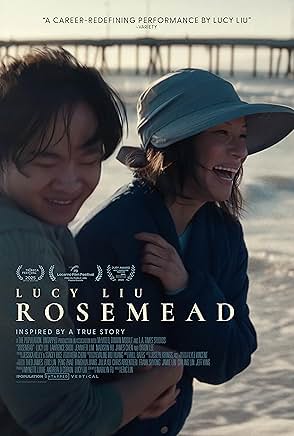

“Rosemead” (2025) is based on true events, but the less that you know about the true story, the better. This shocking, heartbreaking and unpredictable story is about a loving mother and her teenage son who hide things from each other to protect each other, but wind up exacerbating a tragic situation. Irene Chao (Lucy Liu) has cancer, and Joe (Lawrence Shou) has schizophrenia, but they are getting treatment and are optimistic about their chances for improvement. Unfortunately, events outside of their control create an artificial deadline for them to improve, and they are running out of time.
Schizophrenia is a neurodivergent condition, and “Rosemead” may be the best film to depict what it is like for someone to have that mental health issue and how the outside world, including the people who love that person the most, sees that person. The film correctly makes the point that people with mental health conditions are not more likely to be violent, but it does increase the risk of victimization, including from relatives and acquaintances. Shou has a heavy load to carry, especially considering it is his first time in a feature film, but he humanizes a person with a condition that is often pathologized. More importantly, he always appears as a child, not a threatening young man.
Joe would have a hard life without the condition. He lost his dad, Charles (Orion Lee), and fears losing his mom. His friends try to relate to and support him, but he never reveals to them what is happening to him. He also must deal with model minority bias and majority culture entitlement. He is also terrified of a mass school shooting, and the drills exacerbate his paranoia. He jumps into hypervigilance to figure out how to defend himself, which others misinterpret as Joe preparing to be an offender. So, when his well-intentioned mom gaslights him and denies that what he sees is not true, it compounds the problem because people with schizophrenia already have a hard time discerning the difference between reality and hallucinations. Director and cowriter Eric Lin’s feature debut contrasts what Joe sees with what others see so it is impossible to denigrate people who fear him because it is a reasonable response considering the context. Apparently, the real-life case was worse. Congratulations to Lin and editor Joseph Krings for not taking the cheap way out and turning to horror to depict schizophrenic hallucinations. While horror can be an effective metaphor for real life ailments, mental health issues need to be faced more directly without sensationalizing.
A lot of movies promote actors with the tagline “like you’ve never seen them before,” but it is an accurate way to describe Liu’s acting in “Rosemead.” Usually Liu evokes a glamorous, powerful, no nonsense, badass style. She departed from her usual work to be one of the best parts of a disappointing movie, “Presence” (2024), to showcase her dramatic chops, which were never doubted, but here, she is in deep waters and in her first leading role! Liu is first generation American, and she adopts a Mandarin accent for the role. Will there be controversy over this choice? Irene says to a well-intentioned Dr. Hsu (James Chen), “just because you have a Chinese face doesn’t mean you understand us.” It feels as if those lines are not just insightful, but the first line devoted against a possible attack. Liu is not doing it for laughs or in a derisive, mocking tone. It is integral to the character, and Irene’s mindset when addressing her family’s health problems, navigating appearances in the community and dealing with authority figures.
Potential controversy aside, Liu makes Irene’s love for Joe undeniable. Normally in these cases, a little healthy skepticism about whether the caretaker is actually an abuser behind closed doors is warranted, but “Rosemead” is seamless with its story and reveals no Achilles heel. Irene even begins to loosen up and encourages Joe to have fun. There is ableism at play, but also general reluctance to ask for help. Irene also experiences shame over her son’s diagnosis and fear of what could happen to Joe once she no longer can determine the course of treatment. “Rosemead” balances this depiction with obvious signs that neither mother nor child are fully complying with treatment plans, which is fairly and sadly common with mental health issues. It is hard to distinguish bureaucratic treatment when Joe is in trouble versus receiving help, and as calls barrage Irene, it is obvious that the stressors are too much. Liu does some grade A acting here and completely disappears into the role.
If “Rosemead” works well, it is because there are no villains. Almost every main supporting character is well-intentioned. Kai-Li (Jennifer Lim), Irene’s best friend, snaps at any worthless gossipers and rejects cultural norms if they mean erasing human beings that she loved. Joe’s friends, Jeannie (Madison Ju) and Stan (Anzi DeBenedetto), try to relate to him, but also make him feel lonelier because they do not get it and by reporting his behavior, inadvertently further isolate him. There is one scene when DeBenedetto is slouching to appear younger than he is, and it was laughable considering that Ju and DeBenedetto otherwise seemed convincingly young.
There is one controversy that “Rosemead” cannot skirt.
S
P
O
I
L
E
R
S
Did “Rosemead” consult with Anti-Filicide advocates before adapting the real life story? Normally they would not want someone to use the murderer’s name or express any sympathy with the murderer out of justifiable fear of copycats. Irene is the main character, but there is no way to depict the victim when the murderer is their mother, they live together, and there seem to be no obvious red flags.
“Rosemead” gets a lot right. Joe is humanized. Plenty of services are offered but rejected. His death is not sensationalized. Does the film do enough to challenge the idea that it is better to be dead than disabled? I don’t know, but I lean towards no because it primarily focuses on how it hurts Irene, not Joe. He was so terrified of gun violence that it seems particularly cruel to die that way. The only one who has a right to decide how he should die is Joe though the law would disagree, so the act of abuse is the murder. On the other hand, the film does everything in its power to pose the question of would not it be better to do anything than shoot your only child, and the answer feels like yes. It is the central tragedy of this story that it is easier to get a gun and shoot your child than tell everyone your business.
There are no easy answers. “Rosemead” tells a true story, which may have been diluted in favor of the victim, not the murderer, unless the investigation and reporting pulled punches at the time that everything happened. It is important to take away the stigma of mental health and show how it is better to be open and get help than dead, but will everyone take away that lesson or will they relate? If there is a real lesson, it is stop worrying about your child making the wrong decisions when they become adults and make sure that you do not make the wrong decisions while they are children.