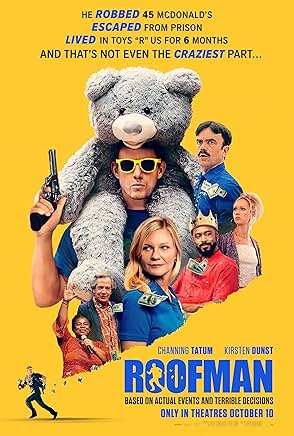

Jeffrey Allen Manchester was convicted in North Carolina of robbery with a dangerous weapon, kidnapping, malicious use of explosives to damage property, arson, breaking and entering, possession of a firearm by a felon and prison escape. Director and cowriter Derek Cianfrance interviewed Jefrey Allen Manchester around eight hundred thirty-two times over the course of four times per week for four years. Set in 2004, “Roofman” (2025) casts Channing Tatum, whom most people attracted to men adore, as Manchester, who is the narrates his story, about how such a nice guy like him wound up at the Polkton prison. The movie is not only a character study about a man, but a profile of a community and what Manchester’s story tells the moviegoer about society.
With all due respect to everyone on and off screen, “Roofman” may remind some of how people framed Ted Bundy as intelligent and handsome, but when you see actual footage of him, he seems like a crazed mad man and the only reason that the State of Florida was able to execute him was because of his ludicrous levels of pride and stupidity for firing his attorney who was winning. When a movie depicts a phenomenon, it should not be conflated with approving of it, and in this film, it toes the line. At times of financial chaos, it is the perfect time for movies where people who commit property crimes can be seen as underdog heroes, but Cianfrance and cowriter Kirt Gunn refrain from fully surrendering to that impulse.
Tatum plays the character as loquacious, good with children and wanting to be a provider. Manchester also needs the admiration that these behaviors elicit. The “good morning team” directed at employees working at the establishments that he is robbing is cheerful bullying if it comes from a person brandishing a gun. He knows what he plans to do, but they do not know his intentions. His claims of being a good guy are balanced with his statement “they forget you are in there for a reason,” i.e. prison, and the closing credits details how he behaved in prison after law enforcement recaptured him. He is an unreliable narrator, but are moviegoers able to pick up on the subtle signals that Cianfrance and Gunn offer when Tatum is flashing his abs casually while taking off his sweater at the park or running around naked in a department store? It may be a big ask to demand critical thought in that context.
“Roofman” interrogates the idea of anti-social behavior, and which types are acceptable or not. The lady doth protest too much when he proclaims himself to be a good guy. Manchester is at his most credible as a good guy when contrasted with ordinary, law-abiding people who are depicted as less compassionate than a criminal. Mitch (Peter Dinklage), the Toys ‘R Us manager, is shown as caring about money more than people, not accommodating people with families, not charitable and a bully. Mitch and his employees’ story arc is also interesting because they get humanized in proportion to their proximity to Manchester. In a blink and miss it scene, Mitch does get rehabilitated through his story arc with Otis (Emory Cohen). Facing a criminal temporarily erases hierarchy. It is interesting that the writers correctly intuited that the audience would be charmed at a man falling for a woman while living at her workplace watching her secretly then essentially follow her outside to eventually start a relationship. In the movie, it seems charming, but on the page, he sounds like a creepy stalker. Fortunately, in real life, Manchester’s girlfriend never worked at Toys ‘R Us.
While “Roofman” depicts Manchester mostly in a favorable light with the thumb on the scale once Tatum was cast in the titular role, the story subtlety pokes holes into his niceness persona. His escape is initially framed as wanting to return to his daughter, but that possibility is eliminated early as impractical, yet he is determined to stay out so it is not for her, is it? His months living in a Toys ‘R Us sometimes resembles a prison, and his treatment of inanimate objects reveal a scarier, destructive man, especially at a Tickle Me Elmo display. In one scene, he is test driving a car with his love interest, Leigh Wainscott (Kirsten Dunst), and her two daughters, Jade, nicknamed De (Kirana Kuic), and Joselyn (Gabriella Cila). He decides to speed despite the protests of the used car salesman (Jimmy O. Yang) and having allegedly everyone that he cares about in the backseat. It depicts a dissonance between what Jeffrey says with what he does. Reckless driving with loved ones is a red flag in relationships which usually signals potential for abuse by deliberately frightening the passengers, exerting control and showing lack of concern for anyone’s safety. It is a sign of coercive control to punish behavior, namely Joselyn humiliating him in public even though the kids are not alarmed. Later more obvious examples happen when he is committing criminal acts that are shocking and violent. A subtle moment is when Jeffrey tries to encourage Leigh to quit her job, which would result in her and her children being financially dependent on him even though he did not do that for his own children and does not have the capacity to do so legally. It is not about him wanting her to run away with him, but to make her easier to control. If you find yourself reasoning away these examples of dangerous behavior, it may be time to reflect on why and how you have been groomed to accept behavior that harms you and asks you to sympathize with the person harming you.
Christians mostly come across as earnest and kind, which is especially surprising because thespian Ben Mendelsohn usually plays villains, but he plays Pastor Ron as a welcoming warm person with his wife, Eileen (Uzo Aduba). There is no story of secret corruption or hypocrisy. There is some diffuse insensitivity over finding humor over a news story that is actually about Jeffrey, who introduces himself to the church members as John Zorn. Because of the culture’s value towards eliminating singleness and making maleness into an innate value, John is seen as a prize even though there are many alarms blaring. If someone says that they are a secret government agent, either they are bad at their job or lying. Instead, he is the belle of the ball. Everyone rebukes anyone who expresses reasonable concern and encourages suppression of instinct by labeling it as not nice. Joselyn’s valid concerns are dismissed as a sullen teenager’s grumblings. Fellow parishioner, Sally (Katherine Scheimreif, the real-life police sergeant who caught Manchester), is ignored even though she presumably has known everyone longer than John, but he is treated as more credible.
A lot of people may walk away from “Roofman” with very different conclusions about Manchester as an every man who has modest aspirations towards the American dream, but he is not Robin Hood exactly. To steal from the rich, he must get through people like him and inflicts physical and psychological damage, which he resists. He elevates intent over effect. Ask yourself how he would have fooled you and start battening the hatches.