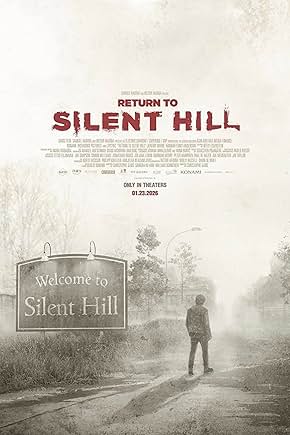

The third film in the “Silent Hill” franchise, “Return to Silent Hill” (2026), mostly faithfully adapts the 2001 video game “Silent Hill 2,“ and technically you do not have to see the prior two movies to watch this film. It may be better if you do not because director and cowriter Christopher Gans, who directed the first film, breaks my heart and returns to the well only to quench our thirst with psychological horror. Booooooo! Just make an artsy fartsy movie about a man who struggles with supporting his girlfriend when he discovers details about her traumatic past and coping with the likelihood that their relationship is over. Well, it is easier to get funding for a sequel than a standalone movie about heart break and being a supportive partner. James Sunderland (Jeremy Irvine) returns to Silent Hill to find his girlfriend Mary Crane (Hannah Emily Anderson), the daughter of a prominent member of the community. Unfortunately, he cannot find Mary, and the whole town seems to be going to hell. Will James be able to move on if he cannot find her or let the darkness win? I’m tired of psychological horror, but if you are not, maybe you will enjoy it. Just think of it as “Silent Hill” flavored sad boy drama.
James is an underwritten, underwhelming character. He is handsome, drives a Mustang with Massachusetts license plate and is a painter. He appears to have no friends and family. It is never convincing that he is deeply in love with Mary. Why was he in Silent Hill? Where was he heading? How come he could drop everything and let his life revolve around Mary? The chemistry feels forced. The meet cute feels weird on both sides and more like a series of red flags. Sunderland would make a better Winchester from “Supernatural,” but as a protagonist, he is functional but not riveting. As he learns more about Mary’s past, James makes her pain all about him, and whether it is the direction or creative acting choices, Sunderland does not improve the situation. I thought it was firmly established at least since “Game of Thrones” that male characters cannot use a woman’s pain to become the center of attention and use his reaction to her abuse as the foundation to his character development. Even Liam Neeson apologized for that one. Still Gans finds tasteful ways to imply the abuse, but horror old heads may associate the images with the “Nightmare on Elm Street” franchise.
In horror, the reason that men are not as interesting as women protagonists is because they can sometimes just Hulk smash their way out of problems whereas women must outwit their opponents and show their smarts. When survivors pair up with James, generally their survival stats decrease if not plummet all together. Because of the state of his romantic relationship, James has anger issues, is drinking and does not care about his well-being, which apparently makes him the ideal specimen for survival. During the apocalypse, even the conflicted ladies seem attracted to him.
“Return to Silent Hill” definitely seems to be a different place than the town that has been featured in the earlier films. There is zero reference to the human characters in prior films. It does not seem to share the same landmarks. The townies have a chic retro vibe. The mythology of their cult is also underdeveloped other than the prominence of the Crane family and how it turns Mary into a focal point. Mary keeping secrets from James is the central conflict of the story, but it feels as if these are issues should have been raised when they first met. Mary feels more like a blank canvas than a three-dimensional person. Anderson imbues more emotion into her role than is written on the page, which is why it is easier to anticipate the twists and turns of this narrative. It also explains why despite the awful dialogue that James should be angry at Mary for being furtive, that judgment never resonates. Her situation is inherently the kind that no one would advertise and may spend a lifetime trying to understand themselves before sharing it with anyone else, especially a romantic partner.
In my review of “Silent Hill: Revelation” (2012), I complained about prioritizing romantic relationships between characters who should obviously take a minute before making a lifetime commitment. Also, that movie had a woman protagonist, but her relationship with men were the focal point, and women were the villains. In “Return to Silent Hill,” the horror feels fascinated at showing women, whether human or monsters, in pain. In contrast to the denouement showdown between Red Pyramid (Robert Strange, great name) and a woman monster in the second film, which was awesome, in this film, there is particular satisfaction at showing the women monsters smashed into pieces or broken. The first monster seems naked and is slammed onto a table in a way that is not inherently sexual, but the positioning could be associated with it. Additionally, women characters feel as if they are eliminated for distracting James from finding Mary, which is a whole other level of messed up. Pluck out your own eye. While the visual horror metaphors for sexual violence were tasteful, the actual horror violence felt misogynistic without telling a cautionary tale against misogyny as Gans did in the 2006 film.
Production value wise, “Return to Silent Hill” comes in second with the first film in the lead. The second film was committed in concept to horror, but the execution was left wanting. No shade intended to Strange, but no one is going to be as good as Roberto Campanella. Red Pyramid feels more about brute strength than slow, ponderous fearsome excellence. The Dark Nurses faces were different, but thankfully no more porn noises. The armless men now have orifices for the acid and do not need to be punctured to be dangerous, which is a positive, but the negative is that the bodies seem slenderer and aesthetically streamlined as opposed to the hulking bulk from the first movie. The constant stream of ash feels a smidge perfunctory rather than eerie. Eddie (Pearse Egan) was a great addition as a normal person reacting to the terror as if he was exposed to a nuclear blast.
Gans’ visual choices gives away the twist early in the way that he films M (Nicola Alexis), James’ therapist. When James is talking with her, Gans shoots her as if he is seeing her through a kaleidoscope, fractured, whereas when the scene is being told from M’s perspective or is objective reality, she is shown as a whole person. Her sole purpose is to receive James’ calls and be concerned about him. She apparently has no other patients or her own personal life. Seems as if M needs her own therapist.
While Gans is attempting to remain faithful to a video game, he should have updated the story to reflect present day sensibilities since it has been around a quarter of a century since the story was originally conceived. Radha Mitchell is the secret sauce to making this franchise work. Her acting abilities helped viewers get invested even when the story was slight. “Silent Hill” featured a simple story with a clear objective. “Return to Silent Hill” muddies the waters, and the ending is too ambiguous, but is saved because of how weak the overall story was.