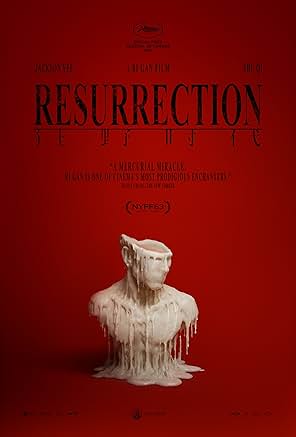

In a world where human beings can live forever if they do not dream, a Deliriant (Jackson Yee) hides in film. The Other One (Shu Qi), who also functions as the narrator, tracks him down, almost gets overwhelmed in his world and allows him to spend his last moments dying how he lived, which casts him in a variety of roles in unmarked chapters that journey through the chronological evolution of film from silent, expressionist film through the end of the twentieth century. Even if you are familiar with film and world history, “Resurrection” (2025) may be more challenging for even the most sophisticated cinephile to wrap their minds around. Consider the following to be the equivalent of a docent walking around a museum helping you, and in turn myself, in bridging the gap between the movie and Western viewers who want to appreciate it on a deeper level.
Film was flammable. From the 1890s to the 1950s, it was made of nitrate and would cause theater fires. If you can hold on to the idea of people as candles meant to burn brightly rather than remain preserved, it should help. For writer and director Bi Gan, film is not a diversion passively watched but an immersive experience that allows a theater goer to live many lives more real than the “fake world” outside the theater. It makes sense for Gan and probably other filmmakers that the point is to get lost in film and not see it as a waste of time while other people are living, which may be why critics are left cold because the driving force does not adhere to convention like money, fame or love, but the love of film. It is a concept made further abstract in the execution. For Gan and the Deliriant, his onscreen surrogate, living happens in the theater, and life is shabbier. Cue Nicole Kidman AMC’s secular invocation at the cinematic temple: “We come to this place for magic.”
For the Other One, she can watch without losing herself. The Other One is part detective, part hospice care and part photographer taking the concept of a photograph stealing someone’s soul to its furthest physical extreme. When she looks at a headshot of the Deliriant, the eyes do become a mirror to his soul and offers clues about his whereabouts. She has power over images and thus over him. Her compact mirror serves as passageway to another realm turning him into powder, dust or ash, to rematerialize into corporeal form into her world. What is most puzzling about her world is there is no way to know if it is the same as the immortal one for human beings since there are no people other than the two of them. Her realm can be called the framing realm since it ties all the stories together and is immune to the Deliriant’s ability to hide and transform. There is a bit of mythology to this universe with mirrors, which includes the Other One’s eyes, disorienting and disempowering people to get the upper hand. Even though she is tasked with finding him and sees the Deliriant as a monster, she views him with pity and mercy as if he is a person with a substance use disorder, not criminalized. Everything is vaguely supernatural in a bittersweet way.
The central concept of “Resurrection” is a revolution of the imagination and through existing, not political, not treasonous. It would be too simple to conclude that it is revolution against a government or a power, but a mindset, especially since the eras covered are times of instability, upheaval and threat of occupation. The Deliriant is an outlaw in every realm that he occupies, which leads to oblivion, but he is just being himself. In the first twenty minutes, there are two layers of outlaw as a dreamer who does not want to live forever (cue Freddie Mercury needle drop) in the Other One’s realm and a basement dweller in opium dens during the early twentieth century which was outlawed as a Western incursion into their economy and an attempt at weakening the population with the import of a drug from British colonized India. The imagery is akin to a Nosferatu figure devoid of sexuality with the shadow advancing on the Other One but ultimately being harmless. Instead of a stake to the heart or a literal opiate so only the wealthy can feed off his tears, the Only One sticks a movie projector into him. Win-win.
In the second chapter, which is around twenty eight minutes long set during World War 2, around 1937, before the Japanese land on mainland China, the Deliriant is a Japanese spy suspect and a homme fatale in a noir film; thus an outlaw in two ways for being queer coded and a double agent though not allied with the Japanese, but himself. In a collective culture, being an individual who is different feels illegal. In this world, he induces madness in men, and the final image is all consuming. Sound coming to film is disruptive. Instead of shooting in black and white, the cinematographer Jingsong Dong uses shades of blue except for a burst of red in the end because of something akin to spontaneous combustion in the shape of a projector image almost like a vampire immolating.
The third chapter, which is roughly twenty-five minutes long, occurs thirty years after World War 2, which is the time of the Cultural Revolution and around the late sixties. It begins with the idea that it does not snow then it immediately snows. For a Western viewer, there is little cultural vocabulary overlap to discern what is going on other than people locating Buddha statues and destroying them, but we would assume that it is for profit, which is likely incorrect. The Cultural Revolution saw religion and tradition as enemies for encouraging loyalty to anything except The Party. The Deliriant is a former monk but is called a Mongrel. He is obedient to this literalization of destroying the old ways in his personal history and the present, but because the old ways are either real or still reside in his imagination, he fails to adhere to the norms of his day and imagines a partially destroyed Buddha statue offering medical advice to resolve his tooth ache, but it is a trick to further engage with a world that he forsook.
In Chinese ghost stories, a tooth can reappear as a person and demand a moral accounting for past mistakes or unfinished business (hi, “We Bury the Dead”). The past cannot be destroyed because it literally exists inside one’s body. Prepare for me to butcher a concept that I do not understand, but in Chinese traditional religion, a single person can have multiple souls that can exist in several realms at once, which explains the Deliriant’s power to physically exist in the Other One’s realm then occupy the film realm.
In this section, it is the only time that physical transformation occurs within that era though done offscreen. The Deliriant is bad at straddling worlds: cannot effectively destroy the past, cannot exist in the present because seen as disposable and cannot live in the future as a full person. In this case, dogs are a karmic punishment for betraying the past in a literal and personal way, so he retains a human mind without the ability to function as one. A psychological degradation occurs before a physical one. He could be dead, but it does not matter. When the sun rises, he is transformed. It is an interesting take on the werewolf tradition of the west except the Deliriant is not the one bitten but assumes the burden of another person who was bitten.
After the Cultural Revolution, movies stopped being ideological battlegrounds. All these chapters on a meta level show the underbelly of society, which would be frowned upon, but as “Resurrection” continues, it becomes less surreal and adheres to narratives familiar to contemporary Western viewers. In the fourth chapter, which likely occurred around 1987 or twenty years after the third chapter, and is thirty-three minutes long, Gan shows a liminal society without the influence of tradition, the exposure to nature, the past or formal societal institutions like the family or foreign or state control. It is a tale of a scam artist and his kid partner trying to fool a man who executes people who cross him. Only money, wiles and brute force govern this world, but there is a yearning for the supernatural to offer human connection. Even the Deliriant seems like a man born fully formed in that time and a stranger to himself. Still an outlaw on the fringes of society, this time he is not a man who forsakes the past or his ancestors, but a man who does not invest in the future. The supernatural is nothing but a scam until it is not. A child asks for the ocean but only gets to sit next to a pool. Another child gets consumed in a fire off screen. The future is untethered and abandoned but gifted. Once again, when the sun rises, the Deliriant is dead, but his death does not lead to the immediate end of the segment. Life goes on for the surviving world, and there is hope in the mysteries of human potential. Gan’s take on the X-Men.
In the fifth chapter, which occurs on December 31, 1999 and is thirty-seven minutes long, Gan proves that if he wanted to adhere to more conventional supernatural tales, he could. The Deliriant is reborn as Apollo, who barely blinks as someone gets strung up near the docks but is a relative innocent when he meets Tai (Li Gengxi). Apollo is a Greek god of light, music and art They hit it off until Mr. Luo (Huang Jue) interrupts them, and the camera represents his point of view. If you hear people raving about “Resurrection,” it is because of an audacious thirty minute long take that took a month to shoot. It also has a small commercial for Pepsi. With each cycle, the Deliriant forgets more of his original identity and finally achieves humanity.
This last cycle is tinged with freedom and release from domination, but also death of an era. Because of historic limitations, oblivion comes with ideological freedom for some. It is still an idyllic end with a return to nature and the vast horizon ahead. Escaping on a red boat has Chinese historical significance since Chinese Communist Party leaders first met on a red boat to symbolize a new beginning so another ideological rebirth happens on New Year’s Day. Because piano music is playing, it has a Western pairing connotation. (Wherefore art thou, oh sweet Prince.) The future no longer seeks to erase the past but accepts it as it moves forward into the future.
The last fifteen minutes return to the framing storyline with the Other One. The Other One becomes a proxy for production: hair, makeup, prosthetics with the Deliriant as an actor as a blank canvas who dies when the movie ends. The afterlife is glimpsed as glowing figures (anyone remember “Cocoon”) in a theater made of candle wax.
I watched “Resurrection” in the theater with the benefit of Gan present with an interpreter and moderator. The coolest aspect was long time Chinese fans speaking in English then switching to Chinese immediately prepared to engage with the film on a higher level than most if not all the non Chinese speakers. With the benefit of hindsight, it probably would have made more sense to mimic the interpreting model for ASL in courts. In court, for ASL participants, there are multiple interpreters, one for each person speaking and one for the hearing person listening, which would probably be a heavy lift for a PR budget, but a good move for the future if Gan becomes an international moneymaker. Or the assumption should be that most speakers are Chinese and also have someone ready to interpret Chinese audience members for the non Chinese speakers because sometimes, we are the minority. Obviously this principle could be applied for any language that the special guest speaks. A lot got missed, and the Chinese speakers provided a lot of insight that got lost in translation.
We were just happy to be there and experience something new. Because “Resurrection” is such a long movie (2 hours 40 minutes), it was just a long trust fall not being able to anticipate anything but also feeling at sea. It sounded as if everyone grasped the cinematic style references, but how it came together was elusive. What is the overarching story? So it demands a second watch, which I was fortunate enough to have at home with a screener and the ability to start and stop to truly digest things and research others. During the first watch, I did not know if these cinematic worlds were rooted in history or fantasy, but on second watch, I was grounded and certain that it was the prior.
After the first watch, it was impossible to write anything about “Resurrection” for practical reasons too. The runtime combined with a lengthy Q&A equals time to go to sleep, not time to write. This film is oneiric in nature so the memory of it is too gossamer to recreate the experience with more time in between watching and writing. I could write if I just briefly touched on the writing, the seamless acting (10 out of 10, no notes), the cinematography, composition, etc., but I wanted to reciprocate Gan and his Chinese speaking fans’ deeper level of discourse instead of just checking a box. It deserved analysis, and I’m more a film analyzer than critic so if this does not read like a review, it is not.
How do I feel about the film as a movie goer? Net positive from a love of the game moviegoer who likes to be exposed to all types of movies, and the stranger, the better. It is an undeniable triumph. Would I throw it on periodically as a comfort watch or to relive certain moments? No. Sometimes a movie reaches into your body and squeezes your heart until you are struck dumb with unfamiliar emotion to suddenly find your soul projected onscreen for all to watch. While I intellectually relate to the movie, it did not snatch my soul. It was also surreal to realize that Gan’s thesis is the same as Roy Batty’s maker, “the light that burns twice as bright burns half as long” without being angry about it. Gan needs to help Ridley Scott, who has been pissed about death for as long as he has been making movies.
If you are going to give it a shot, see it in a theater as early as possible so you are in a big crowd. It is what Gan would want you to do. It does not feel long unless you are hungry or need to go to the bathroom so if you prepare to implement “Avengers: Endgame” (2019) protocols, you should be fine. Jay Kelly claimed that all his memories are movies, but they were not. “Resurrection” shows what it looks like to be so consumed with this transitory life, that in turns, it consumes you. If any aspect of this film sounds daunting, skip it until it does not otherwise you may hate it. You should know what you like. If you are instinctually dismissive of anything different, it is not for you.