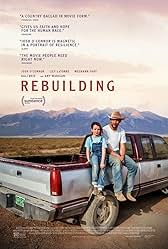

“Rebuilding” (2025) is a utopian film in a dystopian time. Set in Canejos County, Colorado, a rancher, Dusty (Josh O’Connor), loses his home, his barn and the ability to use his land because of the severity of a wildfire; thus his way of life is finished. Contemplating moving to Montana to find work so he can rebuild, he temporarily stays in a FEMA trailer camp and does not see a reason why he should stay. His ex-wife, Ruby (Massachusetts native Meghann Fahy), and daughter, Callie-Rose (Lily LaTorre), help ease him into his new, temporary community of dislocated neighbors, which makes the camp feel more like home. With government funds drying up and everyone hoping to find stability, how will this new community stay together? Writer and director Max Walker-Silverman’s sophomore feature is an understated, wholesome masterpiece that affirms that when all else fails, all that we have is each other.
Immigrants are taking American jobs, specifically Brits like O’Connor in a plethora of American roles (“The History of Sound,” “The Mastermind” and the upcoming “Wake Up Dead Man: A Knives Out Mystery”). O’Connor is a talented, versatile actor who fits any era, place, class, so his soulful performance as a displaced rancher is not a surprise. His collaboration with Walker-Silverman is strong from the outset. The opening scenes start with the land cleanup with strangers sifting through the rubble in white coveralls and orange safety vests with him wearing a almon shirt and a white hat as if he is all warning and open wound. Walker-Silverman shoots him blurred at first then focuses with each scene of him surveying his loss from the land to the cattle. His decision to hold on to the metal gate after his cattle is auctioned, and they exit the arena emphasizes his inner shaken emotional state with the shaking lasting a beat longer than their exit. These performances are about the little things, and it establishes Dusty as a proud man who feels alone and as if he must continue to stand alone. Even his scene with Dusty’s horse is a poignant moment.
“Rebuilding” becomes a masterclass of how to move on without minimizing loss. Dusty is not a great father. The first indicator is the fact that moving on means leaving the state when he has a little girl. Ruby does not give him a choice to forget that his responsibilities are more than financial. Even though he has come down a peg in terms of accommodation, Ruby shoves their daughter his way and is determined that he figure it out. It implicitly seems as if she never made him be a father, but the clock is ticking with the pending move. Fahy plays this ex as firm but fair. Everyone is on decent terms, but it is tense though as the movie unfolds, they form a new kind of family as they come together to support Dusty. Stepdad Robbie (Sam Engbring) wordlessly accepts and washes Dusty’s plate. Ruby’s mother, Bess (Amy Madigan fresh from her memorable role in “Weapons”), restores lost memories. His loss is implicitly Callie Rose’s loss since it was also her family history that went up in flames too.
LaTorre is a natural and is not one of those child actors who set your teeth on edge. No “Star Search” line reading here. It is like seeing the third coming of a Fanning girl. Her Callie Rose is like her onscreen dad, proud of her independence from him but also knowing when to ask for help. “Rebuilding” becomes an ode to the essentialness of libraries as internet hubs for ordinary people. Callie Rose becomes a gateway to learning more about his neighbors, which he initially dismisses.
“Rebuilding” captures the American phenomenon of how collective challenges are seen as an individual problem. Dusty keeps trying to distinguish himself from others when the outside world has lumped him with others with nothing. A tender scene with Mr. Cassidy (Jefferson Mays), a humble banker, disabuses him of any notions that recovering his old way of life will be quick and easy. A normally laconic man, he is not shy about verbalizing how he is different and implicitly better than anyone else, which could have put him on the outs with his neighbor, Mali (Kali Reis), but does not. He gradually gets to know everyone’s tragic story, but also why they stay, how they live and what they still manage to hold on to: skills, kindness, each other’s company.
2025 has been the year of support groups, but “Rebuilding” shows how it is supposed to be done organically, which makes this movie feel like a fairytale. Is community still possible? Reis is the anchor element as she delivers a grounded, gentle crafting of a character and a community. She introduces Dusty to everyone: her daughter Lucy (Zeilyanna Martinez), Gertie (Nancy Morlan) and Esmeralda (Kathy Rose), the local plumber and griller Art (David Bright), Derrick (Binky Griptite) and Darla (Jeanine London), and Rick (Christopher Young), an unhoused hermit who used to live in the woods. Everyone takes turns leaving food at Rick’s door in a quiet acceptance of his desire to remain apart though still live among this community.
Rick ends up becoming a herald of hope for the future, which gets portended as the FEMA camp seems less sad than the perfect place to showcase and appreciate the beauty of the land and sky around them. Walker-Silverman captures a lyrical harmony between human beings and nature in an environment that is usually seen through the camera lens with disdain. It is not his first rodeo since he did the same in his first feature “A Love Song” (2022). He paints an image of America as a place replete with intergenerational relationships, many races, and sexual orientations in a natural way that never seems heavy handed. Quick, someone buy a ticket for Woody Allen or Tim Burton. People are just people.
Walker-Silverman conveys this meaningful connection to interiors. Again, these are trailers, which are usually filmed as sad, cluttered places for itinerant loners. In “Rebuilding,” these interiors reflect the personality of its occupants. Callie Rose transforms Dusty’s trailer into a magical paradise. The camera shows Dusty drinking in the scene at the parking lot, which transforms into mini living rooms with clusters of people congregating staring at their respective screens, not as a sign of the downfall of civilization, but collective yet individual hearths that do not burn.
The lesson of “Rebuilding” is how to preserve individuality and maintain community and not pathologize poor circumstances. There are no typical images of despair, but reframing spaces of poverty as practical paradise without romanticizing, minimizing or whitewashing them. Community and place contain ephemeral, priceless value though it may not have a monetary value. How do you create paradise in a fallen world that briefly became a literal hell on earth? Dusty goes from thinking about preserving his way of life to treasuring this liminal space and wanting to hold on to it. It is a visually luminous and sumptuous film that feels like a secular, civic Capra-esque movie.