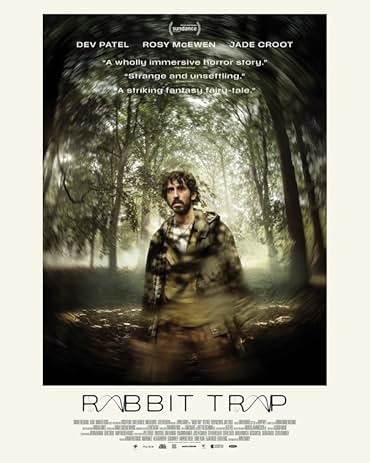

Set in 1976 Wales or Cymru in Welsh, which is in the United Kingdom, “Rabbit Trap” (2025) is about a London couple, Daphne (Rosy McEwen) and Darcy (Dev Patel) Davenport, who move to a cottage to work on their new album which takes sounds from nature and amplifies them through their sound system. One of their songs attracts The Child (Jade Croot), whom they develop an ambiguous relationship with and disrupts the couple’s dynamic. Even though Celtic folkore permeates the story, because the meaning of the metaphor is unclear, it is another case of unsatisfying psychological horror for those looking for a story as substantial as its visuals.
Patel will be the main attraction to “Rabbit Trap,” but his good looks and excellent acting cannot save a vaguely drawn character. Darcy suffers from sleep paralysis that appear in the form of a man credited as The Shadow (Nicholas Sampson), who sits on the edge of the bed, has oddly blemished skin and appears to messily eat something. Later Darcy calls after him as if he thinks that this figure could be his father. The yellow substance coats the bedroom window. He is the one who walks around and records sounds. After passing out during one hunt, he finds a “sublime” sound, which he dutifully gives to his wife, and this sound briefly has an aphrodisiac effect on them. The next day, The Child appears and proves that despite the couple coming from the city, they possess no survival skills.
The Child lays it on thick describing themselves in the plural third person as innocent, children and not scary while also showing their hunting skills. This character is deliberately mysterious, gender ambiguous and into describing nature, but it sounds more like talk about faeries and legends. Gradually the couple diverges on their feelings about The Child with Darcy understandably suspicious and Daphne digging the vibe even if it seems dangerous to do so. The Child talks about their family history. Croot is equal parts sympathetic and sinister though less overtly dangerous than characters from Barry Keoghan’s early work, but she also has the unreasonable, determined focus of a tyrant toddler on a bad day. Keoghan’s eyes felt dead, but Croot transmits a lively, timeless mischievousness and need.
Daphne is a passionate person who usually spends time indoors with her music and stuck in reverie. When Daphne is with Darcy, they are at ease with each other and their bodies, but her avant garde approach to life and her music crosses the line when she records Darcy’s mumblings at night, which he takes as a violation. When The Child arrives, Daphne is completely taken with them and thinks part of their charm is their strangeness. In the history of women, Daphne is the only person not offended when asked why she does not want children yet. McEwen has an early Nicole Kidman quality to her acting style and also embodies someone drawn to the prospect of oblivion in the vein of “Annihilation” (2018).
Shot in North Yorkshire, writer and director Bryn Chainey’s first feature leans heavily on the fecund, verdant and natural allure and variety of the landscape to stretch out a plot that relies more on evoking ideas than conveying them. He uses the folklore of faeries, goblins and demons and the natural distrust of isolated landscapes whether stony and flat, tree lined and dense or rolling and high to hint at the turbulent inner lives of the characters without spelling it out. While it is not as disappointing as “The Watchers” (2024), if you are looking for a film that really treats the Old Ones as if they are real and deals with childhood trauma, “Frewaka” (2024) would be a better bet. The beauty of lyrical and ambigous images is insufficient substitute for an oblique story that does not give moviegoers enough to hang on to.
Chainey arranges for Darcy to reveal his disturbing past to Daphne without allowing the moviegoers to hear it out of respect for the privacy of their union and his past. He deliberately wants the story to be ambiguous so the audience could project their own meaning onto the story, which can work if there is something to hold on to. Is The Child a metaphor for a child that the couple lost, decided not to have or a shared, suppressed memory that they had to face and accept before moving on? Is the child a faerie? You probably won’t care and kind of give up wondering long before things get weird in the last act. Again, films like “The Occupant” (2025) and “Call of the Void” (2025) may not be perfect, but their overlapping images and similar storylines accidentally invite comparison and for all their imperfections, they at least offered answers with their psychological metaphors for more quotidian inner struggles.
In the end, the couple’s music and love feel like the rabbit trap that unwittingly ensnared The Child, whether a ghost or a faerie, who could not find peace until they accepted The Child and made them a part of them. Also, if I had to guess, Darcy’s father sexually abused him as a child so it made him think that if he should avoid them. Daphne wanted kids, but she never talks about it. So this encounter is actually healing, not horror. So real horror fans will probably feel cheated and disappointed, and more casual moviegoers will probably scratch their heads and regret their life decisions. Even devout, sophisticated movie lovers will find this challenging. If Chainey is vague, it is because he is trying to deal with the unspeakable and feels that spelling it out cheapens it. Fair enough.
Unfortunately, the onscreen implied history of trauma will not be as palpable as the real nightmare of a small guest who won’t leave, especially a child who demands a parents’ love and attention from strangers. While it may not be what Chainey wanted, sadly now kids are more seen as a threat to life, liberty, financial security and the pursuit of happiness in a world that offers jobs with pay that is insufficient for basic living, an inadequate health care system and a world that tries to kill the heart beating outside of their bodies after birth. Plus, while a child is more vulnerable, adults have few options if they are delegated with responsibility that they did not sign up for.
While not as unsatisfying as “The Severed Sun” (2024), “Rabbit Trap” relies on its prettiness, performances and unpredictability to keep people hooked, but by the end, most people will struggle to walk away with anything other than an ephemeral sense that it is incomplete. While there is nothing wrong with a filmmaker sticking to his personal set of unspoken filmmaking ethics, it means that most will receive a complete film as if it was a sketch, not a decisive move. If you are not into artsy fartsy movies with no clear answers and almost stubbornly resistant to interpretation at a crossroads between literal and symbolic, save this one for when you are feeling adventurous.