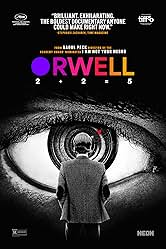

The people who need to see a Raoul Peck documentary are the people who would never watch a Raoul Peck documentary. In the unlikely event that they do, they probably wouldn’t understand what they watched. If they did understand it, they would think it is inapplicable to them. “Orwell: 2+2=5” (2025) is part autobiographical as it takes excerpts from George Orwell’s writing to tell his life story. The documentary also explores the theme of totalitarianism, state control of a person’s public and private life, that Orwell examined and depicted in his work, specifically the famous novels “Animal Farm” (1945) and “Nineteen Eighty-Four” (1949), his last novel. This movie frames Orwell as prophetic. Peck’s latest documentary is aligned with his most popular documentary, “I Am Not Your Negro” (2017) so it is a must see for fans of that narrative structure. If you are currently living in an authoritarian state and/or have rigorously practiced never seeing Presidon’t or hearing his voice, buy a movie ticket and give it away to protect your peace.
“Orwell: 2+2=5” is mostly told in chronological order starting with his childhood immersion in imperialism and class. Actor Damien Lewis reads George Orwell’s words. Peck uses clips from films from such films as David Lean’s “Oliver Twist” (1948) and Sydney Pollack’s “Out of Africa,” which are unrelated to Orwell but evoke imagery from his childhood. Orwell’s unique quality is his frank admission of culpability in systems which use race and colonialism as a pressure valve to relieve class tension in a homogenous dominant society, i.e. it could happen anywhere. Orwell was born within and a tool used to enforce the British Empire, but most people find it difficult to take the position of the villain instead of the oppressed. Peck uses ample black and white personal photographs from the Orwell Estate, which authorized this film, and archived film from that era. He also includes clips from “The Road to 1984” (1984) to illustrate Orwell’s role as a colonizer. “Land and Freedom” (1995) is used to depict his time in Spain during the civil war. “Morning in the Streets” (1959) and “The Crystal Spirit: Orwell on Jura” (1983) clips flesh out his adoption of a boy.
Orwell is the audience’s tour guide of totalitarianism around the globe starting in the Isle of Jura in Scotland where he began to write his last novel. Peck uses Orwell’s tuberculosis infection as a metaphor for fascism which suffocates human beings. This conceit becomes literal with the murder of journalist Jamal Khashoggi’s final words, “I can’t breathe,” to the 2020 US national protest of George Floyd’s extrajudicial execution, which Peck references in the denouement. Peck uses the sound of wheezing periodically in “Orwell: 2+2=5.” The images of contemporary Jura are visual breathers for moviegoers to alleviate the onslaught of oppressive images.
Peck’s style is to provide clips that are visually associated with Orwell’s concepts, so they are not just theoretical, but brought to life and feel urgently germane to the dangers that everyone potentially faces today. Peck uses adaptations of Orwell’s work, especially “Nineteen Eighty-Four.” Rudolph Coutier directed the second television adaptation, which aired in 1954. Michael Anderson’s 1956 film was the first film adaptation. John Hurt starred in the most recent one, which was released in 1984. “Orwell: 2+2=5” also feature Ralph Steadman’s illustrations from a 1995 edition of “Animal Farm” and clips from the 1954 animated film and 1999 live action film.
More disturbingly, there are numerous news archival clips, montage of newspaper headlines, that show how those concepts are practiced today. A clip from “Fahrenheit 451” (2018) is more technically proficient than an American awkward political ad, which proudly carries on the tradition of book burning. Peck relishes giving examples of double speak, when words are dissonant with what they represent on the ground for ordinary people. Here Peck really sinks his teeth in skewering political leaders all over the world, including Presidon’t, exposing the ugliness of war, and the violence of technological advances on quotidian life. These segments interrupt the narrative about Orwell’s life story and could prove to be the most controversial. For example, Peck is true in spirit to Orwell’s concerns when he includes a clip of city ruins in 1945 Berlin, Germany, which most would consider a triumph. A lot of Americans will probably get lost in the shuffle because of our ignorance of the plight of the Rohingya people in Myanmar, but the meaning of these clips is easily understood even without knowing the context.
These interruptions often lead to Peck doubling back and returning to an already covered aspect of Orwell’s life such as his childhood and the issue of class. Peck includes clips from “My Way Home” (1978), “I, Daniel Blake” (2016), “Orwell Rolls in His Grave” (2003), “Generation Wealth” (2018). Since Peck’s work is more lyrical, waivers should be signed even though it feels repetitive. Peck just wants to make sure everyone gets that smoke and turns to skewering figures in the top 1% with emphasis on the technocrats. He deserves credit for also emphasizing which ones have a monopoly on the media and demonstrating how the government collaborates with private interests.
As “Orwell: 2+2=5” approaches the denouement, Peck uses talking heads such as futurist and author Amy Webb, socialist and writer Zeynep Tufekci, scholar and activist Shoshana Zuboff, Anyvision CEO Eylon Etshtein, Edward Snowden, the “Godfather of AI” Geoffrey Hinton, novelist Milan Kundera, Program Director of Fairness and Accuracy in Reporting Janine Johnson, sociologist Pierre Bourdieu, Prof Robert W McChesney, Maria Ressa, TV news producer Danny Schechter, and Bernie Sanders. These clips originate from television broadcasts, recorded book tours, films or exclusive interview for this documentary. As someone who has not watched more than a handful of Peck’s films, he does not usually lean on experts and trusts that the literary giant’s words and his carefully curated images are sufficient to move his audience. He also dips into some blockbuster movies like “Minority Report” (2002), which feels integral to the documentary, and “Megan” (2022), which did not, to hit home these heady ideas.
Peck also transparently utilizes AI images to show how more propaganda could be made, but also to supplement his storage of images. It is disturbing, including the deep fakes of political figures. Because the intent is to expose the increased potential for deception, it is appropriate, but it is so visually disruptive that it makes it harder to watch “Orwell: 2+2=5” without being on guard during a movie that audiences should be absorbing and processing.
If you admired the moxie of “2073” (2024), but thought it did not work, “Orwell: 2+2=5” is an ambitious, more cohesive documentary that hits closer to the mark. Unfortunately, it is a preach to the choir film. That choir is tired and busy living the content of this documentary so if they watch it, it will be out of solidarity, not appreciation. It is the kind of film that if it survives and remains in circulation, it will be easier to digest in a few decades instead of finding its audience now. It is an incisive and comprehensive film, but not as seamless as Peck’s James Baldwin visual essay, which was perfectly crafted. Perhaps this film needed more time in editing, or it is such a huge topic that correctly touches on too many subjects to comfortably digest. While Orwell never gets lost in the mix, sticking to a chronological narrative, a single text or organizing more thematically would make it feel less unwieldy.