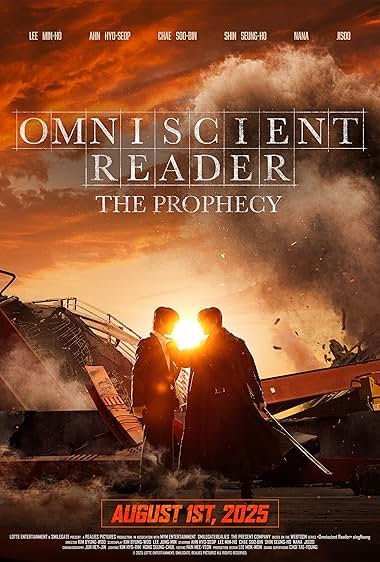

“Omniscient Reader: The Prophecy” (2025) follows the ordinary Dok-ja Kim (Hyo-seop Ahn), a temp worker at the end of his contract. Headed home disappointed at the ending of his favorite novel, “Three Ways to Survive the Apocalypse” (TWSA)—in the source material, it is called, “Three Ways to Survive in a Ruined World,” he writes the author to express his displeasure. When the author responds, his world suddenly plays out the scenarios as they appeared in the book, which gives him an advantage over everyone else, including his former co-worker, Sang-ah Yoo (Soo-bin Chae). Can he change the book’s ending?
If you are interested in reading a review from someone unfamiliar with married couple SingShong’s South Korean web novel, “Omniscient Reader” or ““Omniscient Reader’s Viewpoint,” then this review is for you. The source material is primarily text based and was already adapted into an ongoing webtoon, which is illustrated and will be translated into English. There are plans to also adapt the web novel into an anime television series. This movie may be the beginning of a franchise depending on how well the movie performs in the box office. In South Korea, it outperformed “The Fantastic Four: First Steps” (2025), which opened the same weekend, and took first place. In the worldwide box office, it ranks at 154th place versus the MCU movie ranking 11th because limited number of theaters are showing it. Most fans of the source material complained about the movie’s faithfulness.
The protagonist is Kim, and the story is exclusively told from his perspective. Kim’s character is familiar as the average guy who rises because sensational events suddenly make his ordinary traits valuable, which includes reading only TWSA, obsessively recalling details from it, an ability to appeal to people’s good nature and create plans quickly. His most unique trait is a tragic brutal backstory involving school bullying, which has unforeseen, devastating, long-term consequences. This history explains why he relates to the novel’s hero, Jung-hyuk Yoo (Min-ho Lee, who is best known in the US for appearing in the Apple+ series, “Pachinko”), a cool, unflappable character who seems to effortlessly overcome every challenge and is extraordinary in every way with an infinite array of weapons. When Kim meets his hero and his hero’s allies, these encounters do not measure up to his imagination.
Not a lot of time is spent on Yoo, but it does feel as if his character is world-weary and like Kim, more aware than he is letting on as if he is having a “Groundhog Day” (1993) experience, but with fewer details than Kim. One of Yoo’s novel allies, Hyun-sung Lee (Seung-ho Shin), has two defining characteristics: his experience in the military and PTSD, but in Kim’s world, they barely interact. In contrast, Kim’s other allies vary. Yoo is also a temp worker, but less of a sad sack because she is eager to get away from a workplace that did not match her talents and a higher-ranking colleague who is a sexual harasser. Initially it felt as if she would be a love interest for Kim, but there are no romantic relationships except for the masses of married people clustered away and dealing with the apocalypse. Gil-yeong Lee (Kwon Eun-sung) is a kid who loves bugs.
The first act establishes the monotony of normal life and ithe relationship between Kim and the novel. The second act kicks off the action and shows how Kim navigates the sudden turn of fiction entering his reality without immediately turning savage. The third act proves whether Kim can survive on his own and how he will interact with fantastical creatures such as the dokkaebi, who could be dangerous, but are also cute and look like toys.
In “Omniscient Reader: The Prophecy,” dokkaebi are like the host of a reality show held for the Celestials, higher beings, who, like the Greek gods, enjoy messing with human beings and are not necessarily interested in promoting a better world even though they claim to start the apocalypse to punish human beings. Korean mythology is the backdrop for the dokkaebi. The Celestials act as sponsors for people who survive “scenarios,” which are like levels in a video game and get more challenging. If a person accepts a sponsor, they may get skills, which can be used anytime to overcome a scenario. If you acquire coins, and that can happen a lot of ways, including extinguishing a life, you can amplify your pre-existing skills to get more things to trade in a dokkaebi shop. If it sounds complex, it is not, and I do not play video games. Everything is spelled out so it should be easy to follow; however, the video game format leaves little room for deep character development other than seemingly bad characters can be redeemable and seemingly good characters can actually be inhumane and monstrous. The latter feels thinly metaphoric for people in power, including people successful in government and the corporate world but not wildly wealthy. Greed translates to the desire for coins and feeding on lavish feasts.
Kim’s motivation is to make sure that Yoo survives and save as many people as possible, which is the only reason that he is interested in overcoming scenarios. The biggest shock of “Omniscient Reader: The Prophecy” is how other people treat the scenarios and encourage the collective good, but the motivation is often as toxic as an individual out for themselves in a dog-eat-dog world and feels more insidious, almost cannibalistic, than when people are openly scrapping to survive. Kim and his allies constantly recalibrate and find a balance instead of assuming a person’s character is good based on their rhetoric. It did feel as if the subway underground exploits should have been the start of a new movie instead of included in this one.
“Omniscient Reader: The Prophecy” never bored me, but it felt rushed, especially at this point as the cast expanded, and new characters were introduced. One monster gets introduced and defeated in too rapid a succession. Two more pivotal characters are introduced and though given a back story, barely feel like real people, but avatars in the game. Kim saves Hee-won Jung (Nana), a badass, justice motivated warrior whose life before the apocalypse is a mystery. Ji-hye Lee (Jisoo from BLACKPINK, a South Korean music group that most Americans may remember from Lady Gaga’s “Chromatica” album’s song, “Sour Candy”) is a top-rate shooter whose backstory is how her life as a student and apocalypse survivor intersected. While the point may be the fighting, the CGI is so exaggerated that it can get hard to be invested more than theoretically except about the characters that have spent more time onscreen.
“Omniscient Reader: The Prophecy” felt like a mashup of “Train to Busan” (2016), “Squid Game,” “The Hunger Games” franchise and “Snowpiercer” (2013) except packaged for a younger audience by being less graphic and more obvious with its messaging. While the actual plot was not predictable, the moral of the story was, which is not necessarily a bad thing. The moral is that people need to subvert systems trying to isolate and turn people against each other by working together. There is no point surviving alone. I would watch the sequel, but as soon as it ended, it kind of evaporated. Let’s hope that in the future installments, the consequences feel more grounded and less theoretical.