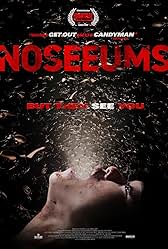

Ember (Aleigha Burt) is about to turn twenty one years old, but instead of celebrating with her friend, Jasmine (Chase Johnson), she decides to go on a girls trip to Florida with friends that she met through her ex: her roommate, Tessa (Jasmine Gia Nguyen), lake house heir, Abigail (Tabby Getsy), and Lexi (Jessie Roddy). From the outset, it is obviously a bad decision, and it gets worse when she arrives at the vacation spot. “No-See-Ums” (2025) is the first feature film of director Raven Carter and cowriters Jason-Michael Anthony and Hendreck Joseph. It is a rough start, but nothing that a bit more experience and resources could not fix starting with not making the entire group, including Ember, so unlikable that it is hard to root for most of the characters
If you watch a lot of movies, you will have a rough idea of where“No-See-Ums” is going within the first ten minutes, but it still a solid storyline. Ember can see dead people, especially dead Black people, which is horrific if you are in the South. The movie tries to keep the dead people’s motives ambiguous. Do they want to harm Ember or not? Ember does go on a journey of growth over the course of the movie, but initially she chooses to clout chase and fit in with the popular girls in the majority culture of her college instead of have fun with her real friend. Ember is a problematic protagomist because she denies her identity and adopts one that does not suit her and is ultimately toxic even to those who benefit and belong to it. Code switching and assimilation become Ember’s Achilles heel, and the only way out is through authenticity, embracing her past and aligning herself with people whom she embodies the values that she claims to believe, which technically, she never does. Birds of a feather flock together because by the end of the movie, Ember is still awful. She endangers a flawless character when getting that person medical care is the furthest thing from her mind. The final scenes are too light, and the tone shift too abrupt.
Anthony and Joseph need to work on writing women and not giving away the story arc so early and so often. College girls are a little bit better at not being obvious frenemies. They make them too transparently awful, too soon. It was frustrating that none of them even considered that Ember was acting weird because she has a history of sleepwalking. The only good characters are Jasmine because she is not mean to Ember and Earl (Tyler Bib), a Good Samaritan who decides to help Ember after Ember shares her visions. Because he knows of the history of the house, he does not think that she is crazy and is willing to help her unearth the mystery behind the apparitions, Tilly (Trisha Arozqueta) and Lee (Steven Aaron).
It is obvious that out of all the characters, the writers relate to Earl more than anyone else and are fulfilling the fantasy of what if the woman who rejected you actually realized that you were a nice guy, and you can rescue her. To be fair, Bib is not only one the nicest characters, but the most attractive man in the cast so that fantasy is not a stretch. Another possibility was that he was a long-lost cousin. It would have been helpful if the writers eliminated the latter if it was not meant to be implicated.
Out of everyone in the group, including Ember, Tessa seems the most likeable because she often validates Ember when everyone else is treating her like crap. At the eleventh hour, the writers invent a reason why she is actually awful, but it already existed. When she has a choice between advocating for Ember and her comfort, she always chooses the latter just like Ember does with Jasmine and Earl. The creative choice at the eleventh hour felt dropped out of nowhere. She is problematic because she knows better but refuses to do it. It would have been more meaningful to create consequences for a character flaw instead of making it trite though more appealing to the targeted viewer demographic.
Lexi is a follower, a bit boy crazy, but seems as if she is still cooking and not done yet. Abigail is fresh out of the oven with the fork sticking straight up. Everyone is rife with microaggressions, but Abigail is the worst and treats Ember like a servant, not a friend, including how she assigns the accommodations. During the first night, a confrontation between Abigail and Ember is so heavy handed that it felt as if Keenan Ivory Wayans was going to jump out and scream, “Message.” From the opening classroom scene to their argument, the writers are so eager to get to the twist that there is no twist. It just becomes a waiting for the inevitable and how to get there. Again, it is a good idea, but there is a difference between laying down the foundation and showing your hand too early.
If “No-See-Ums” is scary, it is not because of the supernatural elements. The CGI is dreadful, but that can be fixed with money though the titular insect did not feel essential to the story and could have been retrofitted to something more affordable and effective. It is probably a reference to “Candyman” (1992). It is completely plausible why Earl and Jasmine would be worried about Ember because everyone knows of a story like Tamla Forsford’s death, and the tendency for a lone Black person to die under mysterious circumstances then law enforcement rules the death as suicide or accidental. Black people commit suicide, and everyone does not get suspicious every time it happens, but in conditions like the ones laid out in this movie, everyone would side eye the people who could be involved. When Ember gets bad treatment, the three “friends” do not protect her or express any concern. Even if they are not trying to kill her, if someone was, they would not lift a finger to stop them. (Hi, BAFTA and BBC!)
Carter and cinematographer Christopher Lee Fatt capture the beauty of the area, especially in the daytime. The oneiric scenes are solid. There is a shot of the chiggers swarming Ember, and it was unclear if it was also supposed to be construed as a deliberate misdirect as if she was a person with rectangular confetti falling around as if she was celebrating. Given the context, it did not appear to be the intent, but you never know. Again, the CGI was so bad that “No-See-Ums” needs the same advice as “The Morrigan” (2025). It is better to be modest and visually sumptuous than ambitious and plaster bad CGI in your film, especially when you are not a known quantity, so people are judging you based on the movie that they are watching, not comparing your latest film to a portfolio of work. The body language work between Burt and Arozqueta was sufficiently evocative.
If you are interested in seeing “No-See-Ums,” don’t watch the trailer since it gives away the big reveal at the end. It is a very solid story with uneven execution unless it is supposed to be a pilot of a television series instead of a first film. As a television pilot, it is a perfect supernatural mystery launch with Ember as the problematic woman who discovers that she has powers and must choose between being authentic or fitting in, i.e. the reluctant hero. It aimed for catharsis but seemed rushed and the choice of inflating the number of targets did not always work. Revenge or judgment feels as if it needs to be earned, and some were just red shirts, especially once the motives of the ghost was established. Work on finetuning the story and making the best-looking movie with the available funds are the keys to the next project.
S
P
O
I
L
E
R
S
My biggest issue with “No-See-Ums” was the obvious binary of Black characters as good and redeemable and other characters as not, but not for the reason that most people would think. The problem is caring more about property, power and position than people, not race though dehumanizing people for things is a factor that contributes to racism. Ember still suffers from this problem, which is why she belongs with that group of friends, and Jasmine is the real hero. When Jasmine is unconscious, Ember does not try to get her medical help, but chases after the deed. When Jasmine recovers, no one cares about getting her medical help, including Earl. Jasmine’s treatment in the movie needed to be corrected or punished to truly show that a toxic property system was not just returning property to a Black person attached to it even if they were the rightful heir. It is disturbing to me that Jasmine’s innate value, dignity and superiority to every character is taken for granted and a footnote. It felt like discarding an unproblematic Black woman character and taking for granted her sacrifice, love and contribution, which is systematic of a toxic society. The solution to that society is not only restoring Ember’s property rights, but valuing people’s lives, especially Black women, more than property. Ember is as guilty in her treatment of Jasmine as the three women were of their constant mistreatment of Ember. Now THAT would have been a great movie.