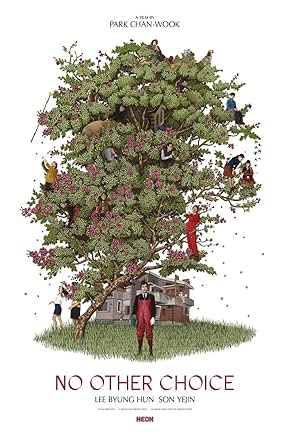

“No Other Choice” (2025) is the second film adaptation of Donald E. Westlake’s 1997 novel, “The Ax,” after Greek French director Costa Gravas’ “The Ax” (2005), which is unavailable to speakers who only speak English. Auteur Chan-Wook Park’s latest and funniest film is South Korea’s submission to the 2026 Oscars “Best International Feature” category. When Man-su (Byung-hun Lee), 2019 ‘Pulp Man of the Year,’ loses his job in the paper industry, he discovers that it is not easy to get another one in this field, so he decides to literally eliminate the competition. What edge does he have over his competitors? The unconditional love and support of his wife, Miri (Ye-jin Son) and his family. Oh, and becoming a serial killer. Along with “Highest 2 Lowest” (2025), this movie explores the crossroads of living up to your moral code and retaining what you worked hard to achieve.
While donning purple hip waders and a business suit, Lee’s performance basically slapped Christian Bale in the face and said, “You’re weak.” Most Americans will know him as the Front Man, the guy in the mask, from “Squid Game,” or the Big Bad in “KPop Demon Hunters” (2025). He delivers a gonzo performance that will keep movie goers off kilter and guessing the entire time. The material is difficult to pull off, and in the wrong hands, could go off the rails. It is also a long movie, and Lee basically is doing the equivalent of an emotional and physical marathon. “No Other Choice” is not “Dexter.” Man-su is a family man, who is completely head over heels for his wife and devoted to his children, the elder Si-one (Seung Kim Woo) and the neurodivergent Ri-one (Yul Choi So). At the beginning of his journey, he is a manager who has not forgotten his humble origins and is willing to fight for his workers. He asks them, “If you guys are fired, who will I work with?” Drinking after work and talking shop are a part of the job, but it also holds the seeds of losing his family, which is reflected in the fate of two of his targets. This behavior leads to neglecting or abusing the family.
After being laid off, he attends a self-help group for recently laid off men probably as part of his severance package. He affirms to himself, “I’ll be born again. To put food in my family’s mouth there’s nothing I won’t do.” After thirteen months of constantly and literally getting caught with his pants down and on the precipice of losing his home, he is finally ready to keep that promise. After a disastrous interview, he decides to think “creatively.” He develops a parasocial, jealous relationship with Seon-chul Choi (Hee-soon Park) who has an active social media presence and is conspicuously prospering. He even physically overpowers Man-su during an unexpected encounter, which leads to an impulse that becomes a plan. On a second viewing, pay attention to what Choi is talking about. The image and reality are stark contrasts.
When Man-su begins targeting his competitors to survive, he is conflicted because he relates to them. After all they are like him and killing them is like killing parts of himself. His stalking gives him a bird’s eye view of their lives, but what he fails to see through his envious eyes is often a pathetic existence. Everything is relative. Park offers three acts profiling Man-su’s three top competitors for a new job. Eagle-eyed viewers will notice how these men were around each other before Man-su decided to strike.
Lasting thirty-seven minutes, Beom-mo Goo (Sung-min Lee) gets the longest arc, and his life is shown in flashbacks from the perspective of Beom-mo and his actress wife, A-ra Lee (Hye-ran Yeom), the only spouse besides Miri who is shown on screen and thus her dramatic foil. This storyline explicitly parallels how the health of a marriage and the vigor of youth are conflated with employability. Yeom is an over the top, wild card, and her deft histrionic antics provide the perfect segue to the wives’ issue: they care less about money than attention. Mi-ri is still grieving time lost with Man-su when he was attending school while working. Meanwhile the men are more concerned that younger men will replace them just as they were discarded at work. Are they loved for what they do or who they are?
The second act has the most abridged murder scene probably to keep Man-su from losing the audience entirely but is twenty-six minutes or less if it includes body disposal. Si-jo Ko (Seung-won Cha) is industrious, hardworking and kind. In another world, he and Man-su would become friends. He offers an image of what settling for another field would look like, but there is only a glimpse of his private life. Man-su is calculating and economical with him, but the disposal is more intimate and horrifying. It does gauge the health of the family in a twisted way as the adults form a unified front to protect their son, who reciprocates. “I’m fighting a war for this family” is something that each of them could say as they close ranks. “My loving family will support me fully” is not just a mantra, but a fact for Man-su, which gives him an edge over the competition.
The callous unemployment process refines Man-su’s identity to make him only risk himself to secure his family, not his colleagues, but also to not become his father. The greenhouse is on the site of his father’s barn where the pigs lived, and once his father’s fate is revealed, it offers some insight into why the alternative does not seem like an option. “No Other Choice” is better than “The Surfer” (2024) because it does not just recycle toxic masculinity tropes but looks at all the issues in a three-dimensional way. It never feels as if it is going over well-trod ground, but an individual family history, which includes military service, the Vietnam war, experience with guns and mental health, which includes the vicarious damage of witnessing or proximity to harm.
The movie’s title is aligned with the decision to stay in a certain profession even if it is not a feasible option, laying off employees, killing people, or breaking sobriety, but of course, they are choices. It is an excuse so people can live with their choice to be the predator, not the prey. Being a victim of these choices is not a choice, but the perks of being a victimizer is the desire to do so without judgment. There is something innate about certain professions whether a pig farmer (pigs are like people and associated with body disposal) or a paper man that are inherently cruel. As a hobbyist in the greenhouse, he mercilessly manipulates plants’ limbs to create beauty for the landscaping of his house, and his care for plants is part of the spectrum with trees and paper. The scenes at the work factory feel like scenes from the “Final Destination” franchise without the Rube Goldbergian deaths. The closing automation scene of the soup to nuts process of the paper industry reveals not only the dehumanization within the profession, but the innate brutality and violence to other living beings and the environment. When “No Other Choice” opens, it is a hot day, and he is waiting for the fall, which becomes literal for him. This violence has widespread consequences for the entire planet.
The last potential victim’s act is the shortest at nineteen minutes before the denouement reveals whether his plan was a success and/or whether he got caught. The movie ends with winter. Regardless of the result, “No Other Choice” shows how there is no way to go back to the way things were before. It is a bittersweet end to a tale that finds a way to root for the protagonist without glorifying or encouraging the means.
If you want to see what a movie looks like when Park, a legendary director, uses all the tools that movies have to offer instead of just sticking a camera in people’s faces and letting it unfold, then the theatrical opening for “No Other Choice” is your lucky day. While everyone will be inclined to talk about the dissolves, the editing choices and the wipes (accompanied with a windshield wiper), I want to talk about the sound choices. Christopher Nolan’s movies frustrate me because he often uses sound in a way that is louder than reality and results in obscuring the dialogue, which is relevant when subtitles are available. Park does the same in a way that elevates the emotional temperature in a scene, especially in his comedic take on a John Woo standoff between three characters. Everyone is finally hearing each other, but there are also layers of messy misunderstandings while someone plays music at Maxwell Cassette Commercial volumes. Park has always brilliantly used color with subtitles to distinguish who is saying what or a particular characteristic of the speaker. Here the lyrics to the song get equal coverage with the dialogue. It is challenging to focus on one thing, but the meaning of the scene is clear. In the final scene, when a person uses earplugs, the diegetic noise starts playing. That character may be shutting out the reality of their situation, but Park is not. “No Other Choice” may not be every person’s cup of tea with its fast pace, lengthy run time and distasteful subject matter, but it is the work of a master who makes the path and does not follow. It is worth it even if you normally avoid movies with subtitles.