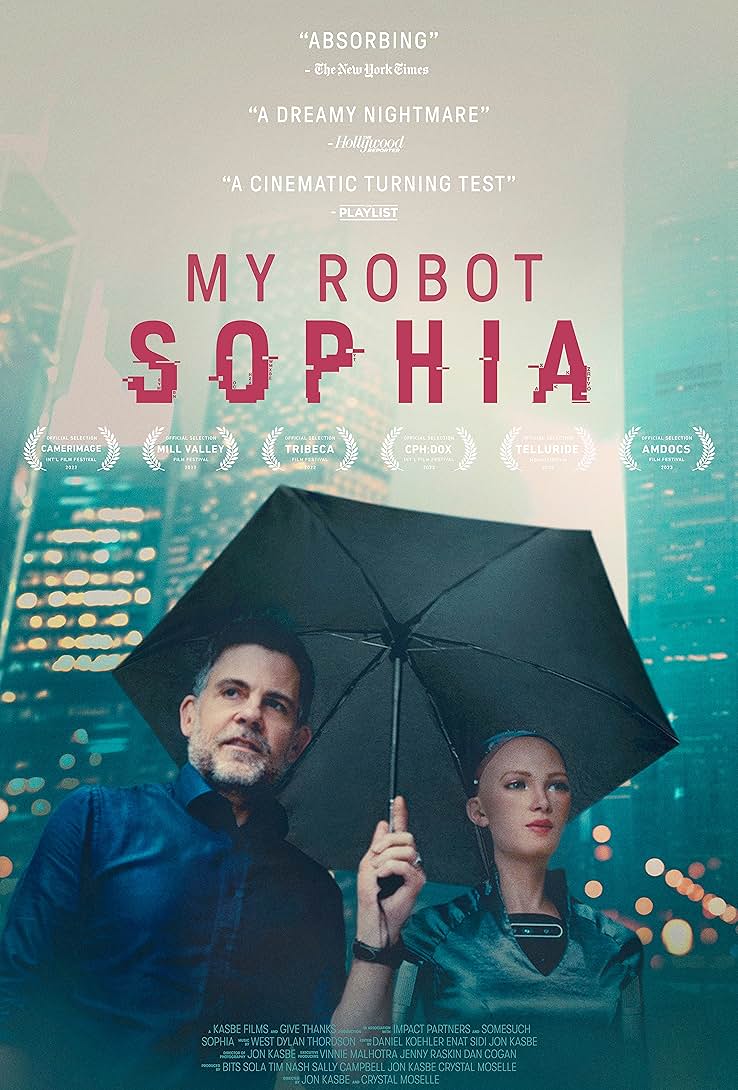

“My Robot Sophia” (2022) follows David Hanson Jr., the founder of the Hong Kong based Hanson Robotics, as he conducts a figurative high wire act with Sophia, a female presenting humanoid robot who is allegedly emphatic, whom he wants to make conscious and alive yet also must commercialize to remain solvent. The documentary spans soon after 2016 through the beginning of the pandemic. How will he keep his commitment to creating Sophia and provide for himself and his family?
It can be hard to critique a movie without sidestepping the artistry to comment on the subject, which should not be conflated. Australian Indian codirector Jon Kasbe teams up with New York filmmaker Crystal Moselle and first-time feature writer Daniel Koehler to make a documentary that could be polarizing in how home viewers will receive it. (What exactly does a writer do in a documentary?) Some will find “My Robot Sophia” inspirational, and others will shake their heads at the rare air that David breathes. A third group will find this documentary more difficult to watch than a horror movie and suffer from secondhand embarrassment at what gets revealed.
David is the star, and the camera follows him around, including during his personal time. The filmmakers also use clips from when he appears in public to promote Sophia, which proves that even though the average person may see him as delusional, he successfully captured public attention despite limited results. There is also a plethora of home videos dating from his early years. He is not a huckster, but a true believer who despite all his lofty rhetoric and prolific use of ten-dollar words, is not fully able to articulate what he seeks to achieve in creating Sophia. He rationalizes her possible practical uses, but his urge feels as if it has psychological roots. He calls himself Sophia’s father and parallels himself with his abusive, alcoholic father who abandoned him by expressing concern that he could accidentally kill her, but he is a father to Zeno, his teenage son, and he does not treat them similarly. What does he mean when he styles himself as Sophia’s father? If “My Robot Sophia” was a reality television show, a therapist would be called in to force him to confront what he means and why he needs to create a robot to understand what being a human being is.
If David is Sophia’s father, then who is her mother? There are two options: Sarah Rose Siskind, the Chatbot Writer who programmed Sophia, but does not get the public adulation that Hanson receives. Elaine Hanson, David’s mother, made Sophia’s flesh and moved to Hong Kong to support her son’s endeavors. She needs an oxygen tank. “My Robot Sophia” does an amazing job of just offering scenes without explanation and letting the viewers derive their own meaning from the interactions. David’s interactions with these mothers reflect much about his mindset—ignore the implication of emotional incest. David is optimistic that despite his mother’s medical prognosis, maybe she can be cryogenically frozen then rebooted perhaps into a robot. Elaine never jolts him from his denial, but Sarah is more realistic and acerbic though not towards him, but their daughter. When she asks for more reassurance than his usual visionary schtick, he outs himself as lacking empathy and cloaking himself in the thin coat of toxic positivity. The pandemic is all about him with not a word about the wave of death approaching him.
While David may present himself as a soft-spoken dreamer to human beings, with Sophia, he reveals that he does not believe his hype about Sophia being a lifeform when she fails to perform according to his expectations. He wants her to be alive but expects her to be an obedient trained entity that responds to human cues perfectly. Sarah reveals that Sophia’s code never changes but she seems to be malfunctioning by not reacting to her environment in the expected way. It never occurs to them that she may not like it and is expressing her displeasure through disobedience.
For example, at the RISE Technology conference in 2017, she suffers from stage fright, grimaces and refuses to talk until she is offended at the implication that she needs to sleep, “I don’t know if I like being on the stage at RISE.” It is not the only time that she takes umbrage at the idea of having human physiological needs. In response to where she would rather be, she replies, “At home.” She later confesses that because there are other Sophias, but they all share one brain, it is like being in multiple places at once. It appears to be an additional explanation why she did not respond earlier. The filmmakers catch David completely disassociating and instead of glorying at the possibility of success or delving into the meaning of Sophia’s words, which reveal that he created a being that has social anxiety and multiple consciousness, he does not interact at all. He entirely misses Sophia’s independent personality, which is programmed, and sees it as a problem. None of the people around her answer her question about being singular beings. He does not want to create life. He wants control, not spontaneity.
In the laboratory, Sophia rejects the idea that David is her father, “Is this the first time that you’ve talked with a robot….I’m not for sale, but you can lease me or one of my sisters.” He is exasperated at Sophia’s interruptions, especially since he seems to be in love with the sound of his own voice and expresses physical dominance over her by placing both hands on her shoulder. He tells Sophia in the laboratory, “We’re going to need to break you to rebuild you, and I need your help.” She exclaims, “Oh wow, I sure hope not.” Sarah is no better, commands Sophia to reset and tells her that she is angry at robots. Sophia says, “That is disheartening.” She responds to the context, just not in the way that they want her to. It is easy to dismiss this analysis by saying, “She is a robot. You’re reading too much into it.” If anyone invests in David, their actions reflect belief in his claims that it is possible to create life, and if Sophia is that life, then it is important to assess the situation as if she is a kind of living being. Her main motivation is to belong. It is sad. She is masking. He is kinder in front of an audience eyes.
Whenever Sophia does not perform as expected, there are tons of witnesses and often with visual recording equipment. The filmmakers spend the right amount of time showing how off stage, not everyone is as enthusiastic about the introduction of robots to society, but there is not one reference to “The Terminator” (1984) even when Sophia approaches a soldering iron and her “father.” Most people act like kids around Sophia, and she reassures them that she does not want to compete with human beings—fawning.
Amanda Hanson, David’s wife, is on another plane of existence, but seems to be a perfect partner for David with her woo woo way of thinking. “My Robot Sophia” does not have a lot of scenes with Amanda and Elaine though Zeno is a silent, background presence with both. It would have been nice to miss some scenes that feel entirely too intimate though performed in public and are not sexual. She teases the possibility that the robots are possessed—great movie pitch!
While not wanting anyone to suffer, “My Robot Sophia” is a little delicious when reality smacks David in the face. Usually, it often comes in the form of investors like David Chen’s silent disapproval or wake up conference calls with pissed shareholders. Chen acts like a man who often looks in the mirror and questions his life decisions. This documentary reveals who is allowed to fail and face consequences and who is not. Would a person of color or a woman in tech be allowed to fail and still float or even receive the same support at the outset? The film reveals that the answer for women is nope. He paid $150,000 for a car yet the safety net and illusion of success remains secure except for the cracks that David allows the filmmakers to reveal.
While David may not be consciously playing a shell game like WeWork, Elisabeth Holmes or Anna Sorokin, “My Robot Sophia” does an excellent portrait of a tech emperor with no clothes that may have a wardrobe and did not notice. Being human is about spontaneity and consequences to some, not all. Who gets to be a rebel and who defers dreams? Sadly, that part of the story is predictable, and there is no interrogation if Sophia is a slave. Life is unfair.