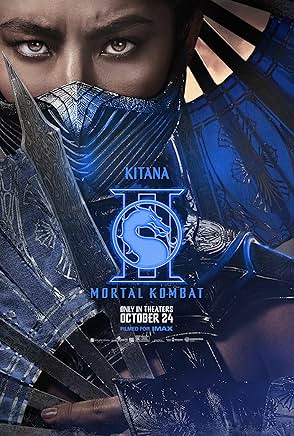

“Mortal Kombat II” (2026) is the sequel to “Mortal Kombat” (2021) and the second in a trilogy if the filmmakers have their way. Starting with a backstory for Princess Katana (Adeline Rudolph) before fast forwarding to the present day with the realm of Earth recruiting one last fighter, has-been actor Johnny Cage (Karl Urban), in time for the last of ten tournaments with Earth on the losing end. Who is the Chosen One? More enjoyable than its predecessor, it is still not strong enough to dislodge my absolute adoration for “Mortal Kombat” (1995). Instead of taking an ensemble approach, it would have improved if it had focused predominantly on the Chosen One like the original movie. This review is written from the perspective of a person who never played the video game.
Many of the characters from the first movie appear in the second film, but anyone can die. Jax Briggs (Mehcad Brooks, “Supergirl”) has super strong and durable prosthetic arms. Sonya Blade (Jessica McNamee) can now shoot round fire energy blasts. Cole Young (Lewis Tan, who thankfully had fewer lines), has a chest of armor to absorb and redirect kinetic energy. Liu Kang (Ludi Lin, whose rendition of the character is the most graceful but not very memorable) is a son of the dragon with fire powers to match. They are still working with Lord Raiden (Tadanobu Asano), god of thunder, which is a more anti-climactic title than it sounds. Though Liu Kang has the most impressive powers of any of the fighters, Sonya seems to have her head in the game.
The returning Outworld fighters are Kano (Josh Lawson), who shoots lasers out of his eye and is legitimately the funniest character in “Mortal Kombat II.” He is the closest that the movie gets to having a genuine sense of humor and joy. Returning power brokers are Shang Tsung (Chin Han), a sorcerer who seems to want to take power instead of serve the head honcho, and turncoat assassin Kung Lao (Max Huang). Bi-Han or Sub Zero (Joe Taslim) and Hanzo Hasahi or Scorpion (Hiroyuki Hasashi) still cannot stand each other and are just in the margins until the denouement. Hasashi is too good an actor for this material, but he has bills or reasons. Maybe he is a fan of the game?
Katana, who reluctantly fights for Outworld, and Cage are the most complete characters because they get backstories and suspense regarding their ultimate fate. Will Katana lose everything if her real sentiments about the conquering of her realm, Edenia, which feels a bit on the nose, are disclosed? Her adoptive (against her will) father and lead fighter for Outworld, Shao Khan (Martyn Ford, who does some great voice work), has his claws in everyone whom she loves. He employs her security guard/best friend/sister, Jade (Tati Gabrielle, who brought the most emotion). Those three have a kinder, more functional dynamic as sisters and father-daughters relationship than Thanos and his daughters. Her mom, Queen Sindel (Ana Thu Nguyen), is his consort and one of Outworld’s lead fighters, but Quan Chi (Damon Herriman), a necromancer, has changed her nature, but at least it comes with a Canary Cry. Katana has the most normal life of all the characters even if it is in a fantasy world setting. Kudos to Sophia Xu for laying a solid foundation for Kitana as a child so Rudolph had a firm starting point to build on.
Urban is the focus of most of the promotion for “Mortal Kombat II.” Cage’s appearance in the sequel was teased at the end of the first movie. Since his salad days on “Xena: The Warrior Princess,” Urban has proven that he can standout even under the most outlandish circumstances, but despite giving his all, I still miss Linden Ashby’s rendition of the character. As the the fish out of water character, Johnny Cage is the perfect audience surrogate and palette cleanser compared to the other super serious characters. His encounter with the Tarkatan tribe, who are all teeth and spikes, is the turning point for his character. Baraka (CJ Bloomfield), the head of the Tarkatans, is another scene stealer.
“Mortal Kombat II” shows life when it lovingly skewers Hollywood action movies, the convention scene and the meta commentary about reboots to take some air out of the sails of any future criticism. Using the New Line Cinema logo within the movie was hilarious. Unfortunately, when the winking at action movies runs out, the actual action movie lacks the verve of the spoof. It is frustrating to see that the filmmakers can pull it off then do not.
The fight scenes are plentiful and well-choreographed with solid CGI, but none so compelling that anyone would want to rewind and watch it repeatedly. While the acting is functional, it is often still too close to the line of wooden and perfunctory. Most of the characters have zero chemistry so many of the jokes land flat instead of reflecting group camaraderie. It is as serious as a heart attack with a ponderous score, so I must ask why not keep a techno soundtrack? Everyone loves the techno soundtrack. It appears briefly during the end credits, but frankly, it is not enough.
Even though it is a tournament, it does not feel like it except at the bookends of “Mortal Kombat II” when spectators appear. A lot of the fights occur outside of the tournament. Frankly the tournament feels like an afterthought. Maybe hard-core gamers will be familiar with a couple of the fight locations, specifically during the fight between Liu Kang and Kung Lao. Does it matter? No. It alternates between glowing red for the bad guys and blue for the good guys. The tournament is over, but the reboot is not. The third movie is supposed to be about the post-tournament activities, which will include restocking fighters, but if the tournament is over, why? So it does not feel as if it will be three and done. Will Earth be the one to challenge others? (Oops, is it a spoiler that Earth won?)
“Mortal Kombat II” may have been better if it did not approach the second movie with a jaundiced eye over what audiences want. The film ultimately turned the Chosen One into a mystery, which felt unnecessary because throughout the story, many people probably thought that choice made sense and was annoyed at the offered options. It would have been a better movie if it was presented less as an ensemble vehicle than a film with a hero and the others as supporting characters.
Better than the first in the trilogy, “Mortal Kombat II” is fine and functional, but ultimately empty, soulless and forgettable except for a handful of characters. It will tempt fans of the first adaptation to revisit it and see if it is as good as their memory believes. For the next film, it would be nice if the stronger actors got more of the story instead of treating everyone equally. Also while the fight scenes are good and gory, it is missing the frisson that comes with believing that a fight is really happening.