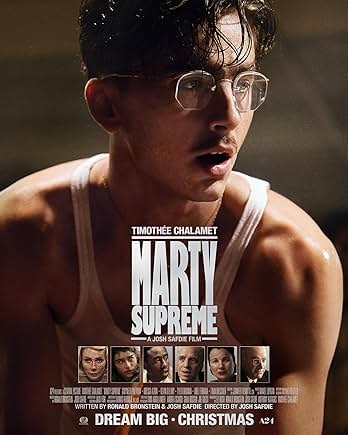

You’ll never care more about ping pong than you will the first time that you watch “Marty Supreme” (2025). Martin Reisman’s autobiography, “The Money Player: The Confessions of America’s Greatest Table Tennis Player and Hustler,” inspired director and cowriter Josh Safdie’s solo directorial debut about Marty Mauser (Timothée Chalamet), a young Jewish New Yorker determined to become the world champion of table tennis, but when his luck turns, he is willing to do whatever it takes for another chance to play to the best of his abilities. Will he ever be able to slow down, grow up and be happy? It is obvious which Safdie brother has anxiety and brings the excitement which covers a more cursory, deceptively simple story and which one has a sense of dread that smothers the finer, substantive qualities of his work. (Talking about you, “The Smashing Machine.”)
It is the end of the year, which means Chalamet, who may be just as driven as the protagonist, makes a play for award season time. This time, he chooses a cocky, kinetic and callow young man who is so focused on making it big that he goes too big, too early, self-sabotages, reverses his luck and squanders any favor that he has with anyone who believes in him. His circumstances become so dire that there is a real possibility that his dreams won’t come true in the most absurd and random Rube Goldbergian fashion ever. The fewer details that movie goers know going in, the better because half the pleasure of the film is how impossible it is to predict the narrative’s trajectory. On second watch, it is easier to spot the deeper themes, but then the desire to check out before the two hour thirty-minute runtime ends becomes tempting.
“Marty Supreme” is a very New York film. Three days in Manhattan are more harrowing than eight months abroad. World War II is still at the forefront of everyone’s mind even though it is set in 1952. Japan is seeking to reclaim its place on the world stage through ping pong on the shoulders of Koto Endo (Koto Kawaguchi), a hearing disabled man who is the opposite of Marty: quiet, not a showman and focused. Meanwhile Marty is an undeniably great player, but his mouth writes checks that he cannot cash. He uses jingoistic language to smack talk his opponents, but it is only to gain attention. Marty is a completely self-centered individual with little to no devoutness to his religion but a theoretical pride in his Jewish culture, history and ethnicity from wearing a Star of David necklace to his actions while visiting the pyramids. He has an innate pride over Jewish people’s ability to survive despite persecution and sees himself as a foil to the idea of the Ubermensch, which is never explicitly mentioned, but heavily implied.
His luck begins to turn sour when he sets his romantic sights on a shiksa looking, married woman who was a former famous movie star, Kay Stone (Gwyneth Paltrow, who is Jewish in real life), instead of focusing on his childhood friend, the also married Rachel Mizler (Odessa A’zion). His aggressive flirting catches the eye of Kay’s husband, Milton Rockwell (Kevin O’Leary in his first acting role and he is a natural though the character is not a big stretch), who resents Jewish people more than the Japanese people even though his son fought in the Pacific theater during World War II. The colors of his business are even red and white like the Japanese flag. “Marty Supreme” is a lengthy humiliation ritual to see how low Marty is willing to go to achieve his dreams and who he is willing to betray and leave in the lurch thanks to his recklessness. Alternatively, it is a scared straight program to get him to stop acting the fool and start being responsible. The collateral damage of Marty’s scams to achieve his dreams touches everyone. Marty basically lives in the shadow of death. He is constantly engaged in the cha cha of life and keeps pushing his luck.
“Marty Supreme” often feels like a retelling of the Prodigal Son or maybe the Prodigal Father. As “Marty Supreme” reaches the denouement, the moment of truth comes when he receives orders to kiss a pig, an unclean and forbidden animal. His luck depends on his decision. Earlier Marty decides to take a dog named Moses, another unclean animal that occupies the lowest status in society in ancient times, under his wing as part of his many schemes to make a quick buck. In Psalm 22:16, it says, “Dogs surround me, a pack of villains encircles me; they pierce my hands and my feet.” Naming a dog Moses feels almost contradictory, but he does evade a pillar of fire at night, and Marty does often escape via a pillar of cloud in the day to get to his tournaments. This dog brings little to no luck to the people devoted to it except Marty does fulfill the promise of Psalm 91: 7, “A thousand may fall at your side, ten thousand at your right hand, but it will not come near you.”
Along a similar vein, his competitor, friend and collaborator, Béla Kletzki (Géza Röhrig), a former world champion who survived Auschwitz concentration camp and is just interested in making money. He tells a story reminiscent of one of Samson’s tales but is also inherently and unexpectedly erotic and precedes a sex scene with Kay. Marty is a journey to learn how to live in a sustainable way, not just for himself, but for the future survival of their people. He rejects any responsibility to the future endurance of their people though he gradually increases that devotion to caring for others as “Marty Supreme” unfolds whether to Rachel or his best friend and collaborator, Wally (Tyler Okonma better known as Tyler the Creator).
The ensemble cast of “Marty Supreme” is an embarrassment of riches. There are no small parts. I almost screamed with delight when Isaac Mizrahi appeared. If you are not following his TikTok channel or missed “Unzipped” (1995), fix your life now. O’Leary is a natural though it is not a stretch to play. Fran Drescher de-glammed to play Marty’s mom. Abel Ferrera is like a shark. Emory Cohen, who recently appeared in “Roofman” (2025), crafts a performance that gives one impression of a brutish Neanderthal but actually delivers a counterintuitive portrait of a long-suffering man. Though set in the fifties, the synthesizer soundtrack from composer Daniel Lopatin is in harmony with the perfect Eighties needle drops though there are some Fifties hits at the high points of the film.
Reminiscent of Francis Ford Coppola’s “The Godfather Part II” (1974), “Marty Supreme” is an epic that is more intimate and controlled than “One Battle After Another” (2025) and shares the same objective of transforming a man with little sense of responsibility into someone willing to invest in and protect the future in concrete ways instead of living for himself.