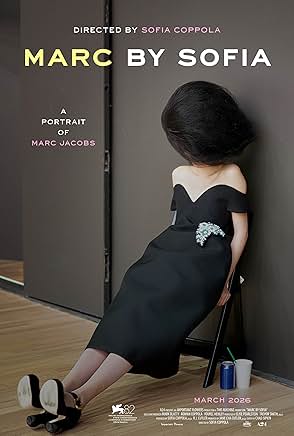

The best part of “Marc by Sofia” (2025) is recalling and listing all the better documentaries about fashion designers: “Unzipped” (1995), “McQueen” (2018) and “Westwood: Punk, Icon, Activist” (2018). The title refers to fashion designer Marc Jacobs and director Sofia Coppola, who wears two hats. Coppola appears on screen and spends twelve weeks filming the prep leading up to Jacobs’ spring 2024 fashion show. Watching them feels like being the guest of the person invited to the reunion: no context, not wanting to the spoil the fun so staying on the edges letting it wash over you, catching some bits, missing others. There is nothing to hang on to for long as it floats along. This documentary is for the deep cut fashion fans because beginners will not get the references and only long-time followers of the art may be able to follow along. It will still be challenging because of how unstructured and repetitive the narrative.
Just when Coppola was reaching the zenith of her craft with “Priscilla” (2023), she decides to try something new and make her first nonfiction film, “Marc by Sofia.” It is a hybrid of a participatory documentary, which means that the filmmaker’s participation affects the narrative structure and conclusions of the subject that is external to the filmmaker, i.e. Jacobs, and a reflexive documentary, which is more purely autobiographical, because Coppola does go on tangents that are about her though tangentially related to Jacobs. The footage includes photograph montages, footage from fashion shows, archival news footage, movie clips, behind the scenes footage as he prepares his 2024 collection for the runway, exclusive interviews, and footage of him answering fashion students’ questions at his store, Bookmarc, his bookstore chain, and it would have been interesting to learn more about that, but alas, no. It feels as if they wanted to hang out and decided to maximize the return so they brought a camera. God bless the person off screen trying to help Coppola, who has been directing since 1993, figure out how to use a clapboard, which they kept in and gives them extra points.
“Marc by Sofia” is a film based on assumptions and structures the story in chronological order in terms of the behind-the-scenes prep while alternating with stream of consciousness interview supplemented with visuals depicting anything referenced in the interview. If you expect that the documentary will use its time to lay out Jacobs and Coppola’s credentials, think again. It is more joint autobiographical. Fortunately, Jacobs is an interesting person to look at with his black lacquered bob sometimes with pins as an accessory or to prepare it before unsheathing it, so it flips just so at the end. It bears an eerie resemblance to Diana Vreeland’s signature do and half the fun of the documentary is watching Jacobs’ look completely change over the decades. Love the era when he could have moonlighted as an Anne Rice vampire. When he tells stories about his life, either about work or his childhood, the movie is way more engrossing. It gets better as it approaches the end, but the casual framework makes following the thread challenging if there is a through line. For instance, he mentions mental illness in the family. Wait? What! Just when things get memorable, it is curtailed, and the subject changes. Maybe Coppola’s lax style is a feature, not a flaw, to induce him to agree to being under a microscope. It is all worth it to see his home or his pajamas, especially when the latter matches the prior. No home tour though. Ugh.
When Jacobs talks about his inspirations such as Yves Saint Laurent or Barbra Streisand then switches focus, it is easy to believe that they will never come up again, but they will with tons of movie clips. If you are fan of one or both, you will not complain, but it feels redundant or poorly structured. As pointed out earlier, Coppola is disinterested in any conventional filmmaking or structure. In an interesting creative choice, she does note many of the people who appear in Jacobs’ studio even if they do not talk: Joseph Carter, Runway Creative Director, model Delilah, stylist Alistair McKinnon, stage designer Stefan Beckman, manicurist Jin Soon, design team member Anna Koehler, designer Ryne Larson (best voice ever), and makeup artist Diane Kendal. There are a handful of interviews from people who worked with him before such as Anna Sui, another fashion designer, and artist Rachel Feinstein, who helped prepare the runway with her signature sculpture style. Jacobs quickly jumped on a podcast with Pharrell Williams, who offers some kind words and felt like an unexpected crossover with the more satisfying hagiography documentary, “Piece by Piece” (2024). The most puzzling editing juxtaposition is his dog, Neville, exiting a vehicle intercut with former creative director of Vogue, Grace Coddington, singing Jacobs’ praises. To an outsider, the choice felt shady.
Believe it or not, the careless, casual style of “Marc by Sofia” is a signifier of class, and not in the way that you may think. Of course, the documentary shows how he makes clothes for famous people and a laundry list of big names in the fashion world, but that aspect of the film is not the class signifier. Coppola’s lack of concern about obeying conventions or doing things well reveals an assumption about belonging. Jacobs compliments Coppola, “you know about things.” That’s the point. The wealthy do not have knowledge to improve their net worth or career prospects. They do not travel or consume to relax from arduous work. The point is having a wealth of information about topics, often cultural.
Though the relationship could be genuine, Jacobs and Coppola are also playing friendship for the camera. Jacobs is serving Coppola and validating her in the currency that she needs: cultural literacy. Coppola is not going to make money off this documentary, but she is going to get what she wants: belonging and cultural cache. It is parallel to witnessing the Jimmy Fallon clip where Jacobs receives direction to sit and share a seat with Anna Wintour. On one hand, he must seem comfortable. On the other hand, the hesitancy in his physical movement betrays how he is aware that an invisible boundary is being crossed. He is at work, but he cannot seem like it. In “Marc by Sofia,” his job is to show how comfortable Coppola is in this world and knows everyone. Of course, when she directs the camera to just pass over a table with fabric samples, it betrays her lack of an eye for knowing what to focus on then center and praise Jacobs. When a movie goer needs context, and Coppola does not give it, it is not a flaw. It is a feature and still satisfies Coppola’s real goal: to distinguish this world as part of the in-crowd, but there is one problem. Needing visible validation means that she does not possess the cultural literacy that truly would set her apart from the hoi polloi. Instead, it transforms into nostalgia for a bygone time
“Marc by Sofia” leaves plenty of room for future documentarians who can charm Jacobs into a second round of embedding a camera while he works around it and allows them to enter his home. Coppola’s best choice is ending with the ending of the fashion show even though the audiences are reacting to different displays. Coppola and Jacobs’ performance is convincing. Side note: my mom, a former model, would judge the movie based on the clothes, which is not the appropriate deciding factor for a movie, but it was hers. She would have panned it. If you are in it for the clothes, it is unlikely that you will find anything that you want to fantasize about wearing.