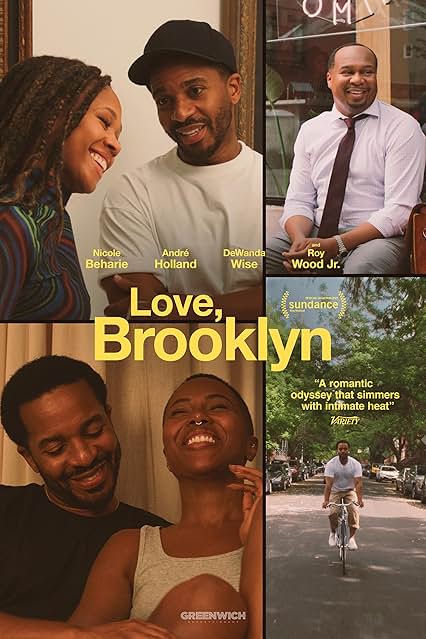

“Love, Brooklyn” (2025) focuses on three people at a crossroads trying to figure out if they want to retrace their steps and try to recover what was lost in the past or accept their new reality. Roger (André Holland) is a writer with a deadline to write an article about the evolving city and in his efforts to procrastinate, winds up reaching a turning point with two of the women closest to him in his life. His ex, Casey (Nicole Beharie), remains a friend, but keeps huge swaths of her life squirreled away from him to keep their dynamic playful and familiar. Nicole (DeWanda Wise) is a widow and single mom, who wants to keep things light, but her daughter, Ally (Cadence Reese), does not understand why she cannot be part of the fun. How will they move forward? You should go ahead and buy a ticket if you are a fan of any of these actors because this movie is an embarrassment of riches when it comes to so much talent getting showcased in one movie.
The gentrification of Brooklyn becomes a metaphor for the unwanted change that happens in people’s lives that makes them lose what they love, cannot recover and must move on if they want to live fully. There is a heavy-handed metaphor that Casey and Roger discuss while pondering Henry Ossawa Tanner’s painting, “Sodom and Gomorrah” (1920), as they glean lessons from Lot’s wife’s punishment for looking back. Being pushed out of places that are becoming inhospitable is a theme for Tanner in real-life since he left the US for France to get away from racism. “Love, Brooklyn” is not about Black suffering, but finding a way to thrive even if the characters do not want to grow and leave their comfort zone.
“Love, Brooklyn” has a predominantly Black cast. The underlying, occasionally referenced, issue that many of these characters face is that despite their talent, education, roots, etc., they are hanging on precariously to what they have, which is not negligible. These are people with beautiful homes where the walls are painted Tiffany blue, work that either makes them their own boss or at least have considerably more freedom than most, but the clock is ticking. Black people, art and voices are not in anymore after the pandemic, but they still need to survive and thrive, and they will if they take the hint.
Roger’s approaching deadline must not be missed otherwise he and his editor (Lisa Lucas) are out of a job like most writers. To be fair, the idea that any writer can just work on one article and afford to live anywhere seems wildly unrealistic anywhere, especially in a city. Meanwhile Casey owns the building where her art gallery is located, but buyers are drying up, the sound of construction is constant, and she can barely stand to socialize with faithful clients such as the well-traveled, bon vivant Lorna (Cassandra Freeman). Out of three, Nicole is already moving on and is shown studying to become a massage therapist, starting the business and working on clients. While her relationship with Roger is not serious, it is frequent.
“Love, Brooklyn” feels like a slice of life movie, which may feel to some moviegoers as if nothing happens, but it is the kind of film that people will appreciate if they are older because then they will realize that as an adult, just when you have life figured out, you have to change, and the sense of unfairness and grievance has nowhere to go. The trick is to learn to shake it off and level up. Director Rachael Holder’s feature debut is gorgeous. She has a gifted sense of how to establish routines through her framing and composition choices, so the audience has time to savor every interaction. The favorite scene is at Lorna’s dinner party, which seems crowded and lively when the camera is focused on her, but shots of Casey and Roger show them alone and isolated but occasionally fractions of themselves share a frame together. It is a sumptuous film that understands how innately romantic and energetic the city is.
It is also writer Paul Zimmerman’s feature debut. Even without witnessing the inane dialogue in “Run” (2025), it is easy to appreciate how natural the dialogue sounds. These characters, even the supporting characters who do not appear often, feel like real people. The dynamics and writing about Ally is brilliant because often scenarios involving children and pending stepfathers usually ends up tilting towards pathology whereas here it is textured, but refreshingly normal. After hearing everyone talk about Beth (Saycon Sengbloh), when Beth finally appears, it feels like a reward. Roy Wood Jr. plays Roger’s best friend, Alan, and the most grounded part of “Love, Brooklyn” is how Roger begins to discourage his friend’s roaming eye and protect his marriage. Riley (Jack Haven), Casey’s assistant, fishes for Casey to ask about their weekend and gets ignored. Everyone tells the truth leaving no room for misunderstandings, the cheapest form of tension in movies, television and life.
After seeing Holland in “Exhibiting Forgiveness” (2024) and upon reflecting on his earlier work, it is shocking how his ability to just naturally embody his characters is taken for granted. He imbues his characters with a sensitivity and credibility ordinarily missing in most male performances. In the wrong hands, Roger would come off as an irritating soft boy who would be easy to dismiss, but he makes Roger’s transparency does not seem like a ploy. Initially it felt as if Roger was going to have a self-medicating storyline, but it is just an observation that Casey and Roger share with each other.
Anytime Beharie appears, Blerds are happy because we will never stop being angry on her behalf for the way that “Sleepy Hollow” treated her. She is such a versatile, natural actor plus she is stunning. In a just world, she would get her pick of roles. Because of her talent and life experience, she is the perfect actor to appear in “Love, Brooklyn.” Here she gets to play a character who seems wise but has problems following her own advice. Also, her facial and physical expressions when Casey begins to realize that Roger is moving on are so relatable. She is trying to stay cool and hang on, which is the reverse of how Casey acted in the opening scene where they are firmly in routine, and she is on automatic just putting in time.
I have only seen Wise in “Jurassic World: Dominion” (2022) so I did not recognize her here, which is always high praise for an actor, and their ability to transform to fit into their current role. It is so nice to see a movie that is not French with a mother who has a personal life and is not demonized. Wise brings such a steady confidence and calmness to the role.
For awhile, people have tried to make lightning strike twice and bring back the golden era of Black romance movies. “Love, Brooklyn” feels like the next step in that genre. It is definitely not for people who saw “Weapons” (2025) and walked away saying nothing happened. It will be a common complaint for this movie which hews closer to quotidian life, but it is one of the reasons that I love it.