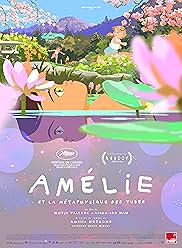

“Little Amélie or the Character of Rain” (2025) adapts Belgian Amélie Nothomb’s 2000 autofiction novel “The Character of Rain” or “Métaphysique des tubes.” The 98th Academy Awards nominated it in the “Best Animated Feature” category. Born in Kobe, Japan, Amélie (Loise Charpentier) appears to be in a vegetative state, but on August 13, 1969, when she turns two years old, she starts responding to the outside world and wreaks havoc in her Belgian family’s rented house. Her family’s landlord, Kashima-san (Yumi Fujimori), hires Nishio-san (Victoria Grosbois) to care for the property, but Nishio-san organically ends up spending most of her time raising Amélie. All Amélie’s senses are alive, but she is only beginning to understand them. Will she remember everything when she becomes three years old? An undeniably poignant and stunning feature but translating Japanese and Belgian culture for American viewers may leave them more puzzled than moved. To date, it was the hardest of the nominees to absorb, but not impossible.
Amélie thinks that she is God. Don’t freak out! There are explanations behind her thinking to unpack before jumping to accusing her of blasphemy. Children think that the world revolves around them so it is not as outlandish as it may originally sound, but there is actually lore behind this concept. Apparently, the Japanese believe that before all children turn three years old, they are gods, okosama or a “lord child.” When they turn three years old, they fall and become human beings. Nothomb’s language is Biblical stemming from Genesis, and one image is straight out of Moses parting the Red Sea, a popular cinematic recreation before talkies. As a viewer who brings a context that the author hopefully unintended, it reminded me of when colonizers mistakenly believed that the indigenous people thought they were gods. Apparently, the film did not dwell on the divinity theme as much as the book.
Amélie, the narrator of “Little Amélie or the Character of Rain,” is aware that her family exists, but she does not consider them central to her story. She sees them as hanging on her every word, and she has the power to delight or exasperate them. Danièle (Laetitia Coryn), her mother, plays the piano at home, and her family is neither referenced, nor appears. Her father, Patrick (Marc Arnaud), is a diplomat, who is very close to his mother, Claude (Cathy Cerda). Her blonde older siblings, Juliette (Haylee Issembourg) and André (Isaac Schoumsky), have roughly the same relevance except Amélie is annoyed with André for being mean to her. There are only two people who make an impression on Amélie: Claude and Nishio-san, and they both arrive at the same time.
Claude distinguishes herself with a gift of white chocolate. Codirectors Liane-Cho Han Jin Kuang and Maïlys Vallade depict Amelie’s tasting experience like a Christlike ascension to the heavens, and the imagery evokes the joy and epiphany of tasting a new, favorite food. It is Amélie’s first relatable moment in “Little Amélie or the Character of Rain” and is only one of many memorialized moments of childhood development visually rendering her individual sensations as universal. It is then that her story becomes an every child story though it is not always sustainable at every juncture. Overall it is a visually impressive and light experience despite delving into some tenebrous themes for a child’s story.
A child has no sense of history, so when she meets her person, Nishio-san, Amélie begins to understand that things happened before she existed, and these events affect people that she loves, which affects her. Nishio-san introduces World War II to Amélie when Amélie starts asking about death. Nishio-san rejects Kashima-san’s judgment and disdain of the family because they are too young to play a role in WWII. Kashima-san condemns them for being heirs to perceived aggressors.
Because “Little Amélie or the Character of Rain” is a story between Belgian and Japanese people, there is no historicity in the story, i.e. that the Imperial Japanese Army was an aggressor in WWII, which does not negate Kashima-san and Nishio-san’s pain and loss even in the worst case scenario if their families were enthusiastic supporters and war criminals. Because that information is withheld, it is easier to empathize with their pain instead of looking at it cynically as consequences for their actions. The idea of national roles for the Japanese or the Belgian is never even considered in the film, which could be hard for some viewers to stomach. It is possible to admire Japanese culture while acknowledging that there are still people alive with well founded, personal grudges and wounds.
When Kashima-san attacks Nishio-san and hates a baby, she is briefly the villain because her feelings are rooted in prejudice, hatred of Europeans for their role in WWII, but the sentiment is not wrong per se unless Nothomb kept in contact with her version of Nishio-san and returned the favor when Nothomb became an adult as many children would for their parents. If you are a member of the global majority, Amélie’s love for Nishio-san, a servant, is unsurprising because it is a universal theme that part of colonization is outsourcing the labor of raising your kids to someone else. Multiple things can be true at once. The emotions between the caretaker and the child are authentic, but servants are not “just like family.” In this case, Amélie’s family never hired her, but they also let her raise their family member and risk her job for their comfort.
As an outsider, “Little Amélie or the Character of Rain” is an image of colonization even if it is unintentional. If a moviegoer with knowledge of Japan prior to World War II watches this animated feature, they are aware that Japan looked down on and routinely shunned Europeans. Even without World War II, this conflict could still exist in an alternate timeline if Japanese permitted Europeans to live in Japan. A lot of European people are unaware that there are a lot of countries that shun them. Kashima-san and Nishio-san’s conflict may be about WWII, but there is also a subtext that Japan was used to being the colonizer and conquerer, not the colonized and conquered. For a Japanese woman to directly serve a European family, it is not just about her. Watch “Little Amélie or the Character of Rain” with “Marty Supreme” (2025), and both films are continuations of World War II in a new forum without weapons except from a Japanese person’s perspective, it is about the barbarians at the gate.
When Amélie says that she is Japanese, it is reminiscent of the protagonist from “Don’t Let’s Go to the Dogs Tonight” (2024). Even mixed-race Japanese people must fight to be considered Japanese. Being born in Japan is insufficient for Amélie. She does not realize that she is not just a wild child, to many in her homeland, she is an eternal outsider and barbarian. She may not be Japanese, but she is not Belgian. “Little Amélie or the Character of Rain” is about death and memory, and the existential dread that Amélie feels is rooted in her homelessness. A challenging watch for any viewers that are unfamiliar with the concepts in the film. Trigger warning for theme of suicidal ideation.