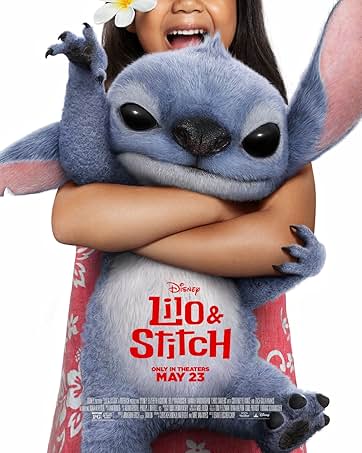

“Lilo & Stitch” (2025) is the live action remake of the 2002 animated film that spawned a franchise. After Stitch (Chris Sanders), an illegal genetic experiment, escapes the Galactic Federation and crash lands on Earth, Stitch wakes up in a dog animal rescue center. With Agent Pleakley (Billy Magnussen) and Stitch’s creator, Dr. Jumba Jookiba (Zach Galifianakis) hot on Stitch’s heels, Stitch convinces six-year-old Lilo Pelekai (Maia Kealoha) to adopt and bring Stitch home. Stitch and Lilo’s shenanigans exacerbates the threat of Lilo’s older sister, Nani (Sydney Elizabeth Agudong), losing guardianship of Lilo. Will the family get separated or stay together?
Somehow Stitch is even cuter this time around. The ears reflect Stitch’s emotions. The eyes are bigger and rounder. Sanders is the only member of the original cast to play the same role that he did in the original film while simultaneously writing and directing an Oscar nominated animated film, “The Wild Robot” (2024). If you shed a tear during “Lilo & Stitch,” Sanders is responsible because Stitch’s voice is imbued with so much poignant emotion that it will make even the most hardened, cynical adult want to believe in the security of family.
The connection between Lilo and Stitch is strengthened. In the original, Stitch reveals her identity to Lilo, and Lilo rejects it whereas in “Lilo & Stitch,” Stitch acknowledges that she originally saw Lilo as a shield and was using a child then reflect true love through sacrifice. There is never a moment when the antenna and extra set of arms are shown to Lilo, but in turn, Lilo never rejects Stitch. Stitch seems more like a mischievous kid than an inherently destructive creature designed to be a weapon, and Lilo’s flaws are filtered through ordinary kiddie horseplay and glass shattering screeches of excitement. Lilo is Kealoha’s film debut role, and the role demands a lot from a child. She works with blue screens, does stunts and is not annoying. She has chemistry with everyone, including her onscreen sister.
Agudong as Nani is a revelation, and as Lilo’s last remaining living blood relative, she adds realism to a role that originally did not fully explore the extreme pressures that Nani had to face while being a caretaker. By never referencing Nani’s life before their parents’ death, the original film shortchanged Nani and only defined her as a caretaker and potential girlfriend, not an individual. In “Lilo & Stitch,” Nani has a similar restrictive focus and willingly self-abandons to care for her sister, but her story arc is about restoring her individual dreams and accomplishments and reminding elder daughters that they have a right to a life. While Nani was a surfer in the original film, this film fleshes out how she trained to be one and treats her like a skilled athlete, not a Hawaiian organically born with this gift. Also, her education and the family’s financial difficulties are never brushed over in the story. The original had Nani looking for a job, but she never got one, and they were magically fine. Even Lilo understands the serious consequences of her play though she is still too young to understand how to not get them in more trouble.
“Lilo & Stitch” also solves the problem of how to depict aliens on Earth without breaking the bank. It reduced the number of aliens who appeared on Earth—no Captain Gantu (Kevin Michael Richardson). Aliens can disguise themselves as human beings. It was a tasteful creative choice to ditch the stereotype that mad scientists have thick Eastern European accents, which meant Galifianakis could play the role. He plays a more reserved character compared to Magnussen. Both feel as if they channeled Vincent D’Onofrio’s performance in “Men in Black” (1997) with their too wide smiles and physicality which shows that they are not used to their body. Magnussen steals the show as someone who adores Earth and is not as serious as his animated counterpart. Magnussen has always been a solid character actor without recognition, and it was good to see him do comedy for a change compared to his more serious roles in “The Big Short” (2015), “The Oath” (2018), and “Ingrid Goes West” (2017).
My main gripe with the original was the lack of community. “Lilo & Stitch” adds more characters. The awesome neighbor, Tutu (Amy Hill), watches Lilo when Nani is busy and encourages Nani to pursue higher education. She is related to David Kawena (Kaipo Dudoit), Nani’s potential love interest. Instead of Nani inexplicably deciding that Lilo should adopt a dog, this story has Tutu take Lilo to the animal rescue regularly to look at the dogs as part of their routine. Hill makes a meal out of a morsel as the badass neighbor who gets around on an off-road vehicle, and it would be a dream come true if one day Hill could have her June Squibb moment because she seems poised to take center stage after half a century or more as an actor.
The original movie seemed oblivious to the historical and cultural context of removing indigenous children from their homes and the US government not treating Hawaiians as citizens. The role of the social worker gets divided into two parts: a new character named Mrs. Kekoa (Tia Carrera, who played Nani in the original), and Cobra Bubbles (Courtney B. Vance), an undercover CIA agent pretending to be a social worker. Tutu does not trust Mrs. Kekoa, and Mrs. Kekoa cares about what happens to the sisters individually and collectively, not just Lilo. In the original, Lilo was going to be taken somewhere away from her family and neighborhood whereas here, it feels more like a community issue.
Cobra has a completely different backstory than Ving Rhames’ version and is a weaker character as a result, which is necessary for the story to feel more authentically Hawaiian as opposed to emphasizing the sci fi vibe. In the original, Bubbles was a social worker who coincidentally had prior experience dealing with aliens. He was a deliberate visual reference to the legend of Men in Black. This Cobra flounders more and is in the CIA with no regard to the human drama unfolding before him. This Bubbles symbolizes the soul of the government and has an opportunity to decide whether to care about actual individuals as opposed to the concept of protecting people.
Without being heavy handed, “Lilo & Stitch” is better than the original and solves all the problems with the original film’s story. Instead, the priority is making sure all the sisters wind up in the best situation while staying together. While the movie may not make you a shed a tear, it makes it challenging to see the screen with all the dust getting in your eyes.