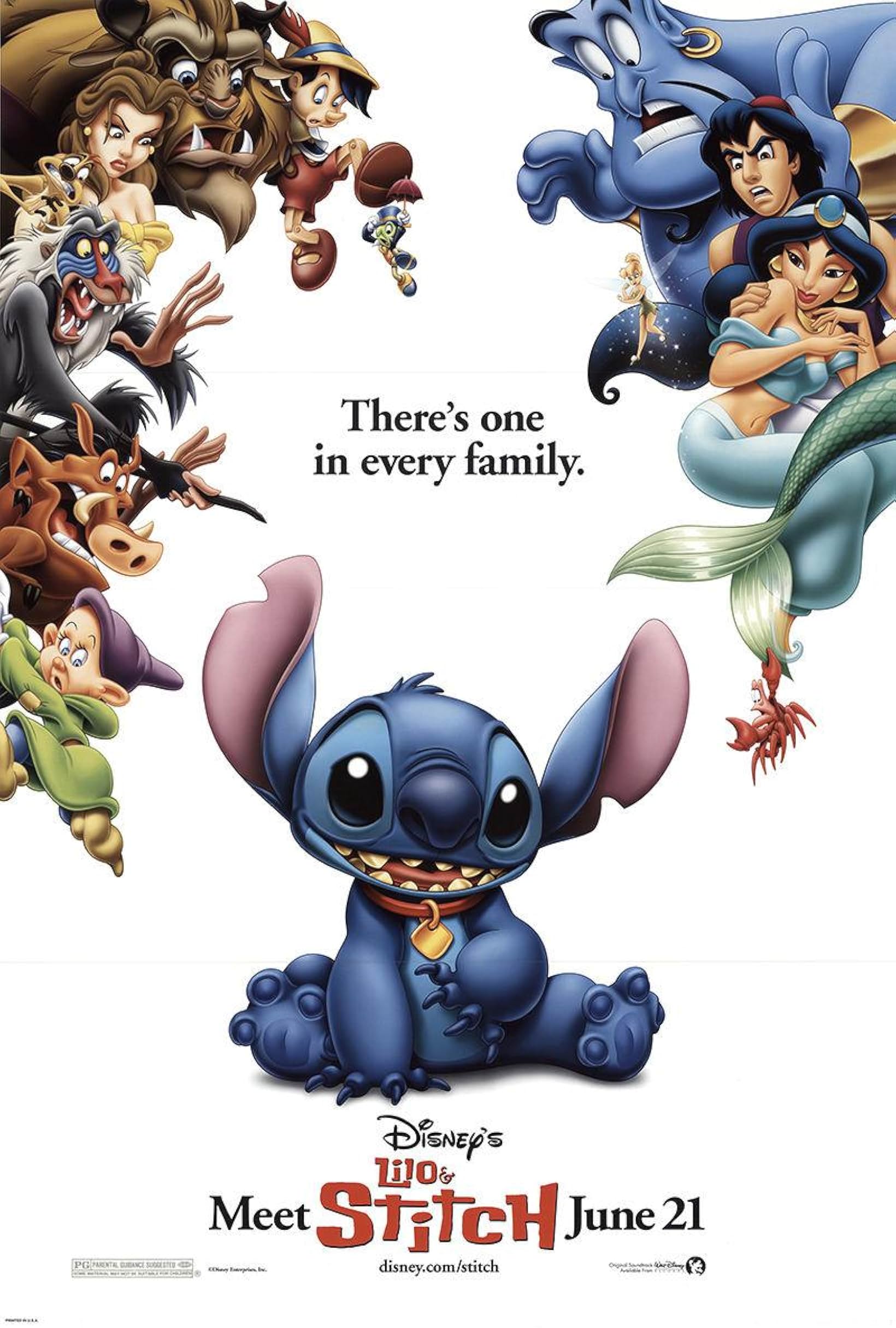

“Lilo & Stitch” (2002) is a Disney animated film about a little girl (Daveigh Chase) and Stitch, her “dog” (Chris Sanders), who is actually an illegal alien experiment, Experiment 626, intended to be a weapon. Stitch becomes a fugitive and lands on Earth after running away from the Galactic Federation. He drops in at an inconvenient time for Lilo and her big sister, Nani (Tia Carrere), who is trying to keep custody of Lilo even though social worker Cobra Bubbles (Ving Rhames) knows she is not doing a good job. Will this family get to stay together or get ripped apart?
Stitch and Lilo are foils. Both are outcasts in their communities and destructive forces of nature whether by design or for psychological reasons. When Lilo has big emotions, she acts out of frustration, and because she is a child, she does not understand the consequences of her actions. Because Lilo is different, she is attracted to Stitch. They both love to drool. Stitch originally uses Lilo as a shield against his captors, Dr. Jumba Jookiba (David Ogden Stiers), his creator, and Agent Pleakley (Kevin McDonald), an alien Earth expert. Without anything to destroy, Stitch appreciates becoming a part of her family and learns that no one is born bad but never had a bigger purpose or belonged. Awwww. Don’t tell Ted Bundy.
Nani is someone who may be old enough to be a guardian but is unprepared to assume the task this early in adulthood. She is still acting like a big sister when her little sister annoys her. Maintaining a house is a challenge, and Nani has not learned how to deal with other adults, including keeping a job. I would not have recognized Carrere’s voice if I had not looked at the voice actors before watching “Lilo & Stitch.” After hearing Carrere sing in “Wayne’s World” (1992), it is disappointing that there were no original songs made for her.
Instead, inexplicably the soundtrack features a lot of Elvis Presley songs because the action takes place in Hawaii so it is supposed to harken back to Elvos’ Sixties beach movies, which is not a reference that kids or even their parents would get when “Lilo & Stitch” was released. It worked, but is an odd choice, especially the section when Lilo innocently encourages Stitch to imitate Elvis to learn how to be a model citizen, a man who became the guardian of an underage girl and used drugs, but hey, fun music. Were there no funds to make more original music or use more than one Hawaiian indigenous song? It probably was just insurance to ensure more butts in movie theater seats when the characters are brown.
Well, it worked. “Lilo & Stitch” was so popular that it spawned a franchise which includes two direct-to-video sequels, a television series, an anime series and an English language Chinese animated television series. I stopped watching animated films ages ago after seeing “WALL-E” (2008) and “Madagascar” (2005). Animation is the equivalent of “Guardians of the Galaxy Vol. 3” (2023) to me. Just like with onscreen animal characters in danger, I feel animation too keenly, and I enjoy not being too devastated when I go to the movies. I only broke that pledge because the live action “Lilo & Stitch” (2025) is coming out soon, and I wanted to be able to compare the two.
Compared to other Disney animated films, it tugged my heart strings, but I never got misty eyed. I was really impressed with the idea of linking the child with the ill-tempered alien to deliver the message of nature versus nurture regarding pathological behavior that could lead to stigma and getting pathologized in bureaucratic systems. It was obvious that the creators of “Lilo & Stitch” were oblivious to the historical implications of indigenous Hawaiians being separated from their families because the film treats it as a normal consequence of Nani’s caretaking flaws, not a grievous, deep generational wound. Native Hawaiian children are still overrepresented in the Hawaiian foster system. It felt as if the community would have been more supportive of Nani and Lilo given that context, which did not have to be specifically alluded to, but could have been reflected by showing further involvement. The only real person rooting for them is David (Jason Scott Lee), Nani’s coworker and wannabe boyfriend.
When I decided to see “Lilo & Stitch,” it coincided with (re)watching the “Mission: Impossible” franchise, which includes Ving Rhames as a supporting character in every movie. Who knew that I was actually having a Rhames marathon?!? He is the government representative, a social worker, who dresses as if he is a man in black, which is an intentional character design reference. Swapping out mean missionaries for a sci-fi hero in an animated film with sci-fi elements is a deft way to deflate any outrage at separating the family without making the person a villain. Should it? It is a kids’ movie, and everything does not have to be heavy. On the other hand, Disney made “Pocahontas” (1995) with diluted colonizers and “The Hunchback of Notre Dame” (1996) who has an evil judge. They could handle it. Hopefully it was not a conscious decision to erase history.
The concept of Stitch is brilliant and inventive. Sanders’ voice makes the “evil koala” into an adorable creature, and the animators use enormous eyes to make him cuter. It is a great concept that he is incredibly intelligent and physically strong but gets treated like a puppy. That could be really frustrating like Claudia in “Interview with a Vampire,” but the ohana concept is a credible incentive to reform and risk his life to go in water. When he screams, “I’m lost.” Awwww. It is such a relatable moment that could never be taken literally. It is the idea of being unmoored with no tether to love. Not going to lie, but when Stitch reveals his true self to Lilo, and she rejects him, even though it made logical sense, I was so upset for Stitch, but Stitch does not hide his true self again and finds a positive way to be himself, to rescue her and help human beings. On one hand, I do not love that the lesson is that you can receive love as yourself if you are useful to society, but it is good to show that the flip side of destruction can be redemptive in the right environment.
“Lilo & Stitch” may not be one of the titanic greats in the Disney animated catalogue, but cowriters and codirectors Dean DeBlois and Chris Sanders are able to hit the right notes and bring the story in for a strong landing , which was sufficient enough to make a giant impact in children’s imagination. It would have been stronger if it had fully embraced the creative decision of placing the action in Hawaii. More original or traditional cultural choices would have made the movie feel more original. It always seems easier to make aliens than fully embracing existing indigenous experiences. The indigenous talent needs to be in front of and behind the camera.