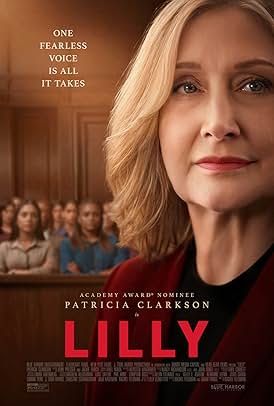

“Lilly” (2024) allegedly adapts Lilly Ledbetter’s autobiography, “Grace and Grit: My Fight for Equal Pay and Fairness at Goodyear and Beyond,” which she wrote with Lanier Scott Isom, and spans from 1979 through 2009. In 1979, Alabama resident Ledbetter started working at Goodyear Tire & Rubber Company as a supervisor and after almost twenty years of working there, discovered that she was paid less than other supervisors, filed and lost a sex discrimination lawsuit that went to the Supreme Court of the United States and won the war with the passage of the Lilly Ledbetter Fair Pay Act of 2009. This law clarified that each disparate paycheck was a new act of discrimination, and the clock for the statute of limitations did not start when the employee received the first paycheck because it is unlikely that the wronged party would immediately know about the discrimination. Ledbetter is a real American hero and deserved a better movie, not this disjointed collage.
Do not blame Patricia Clarkson or any of the actors for “Lilly.” They act as if they are in a good movie. Clarkson plays the titular character, and even though she does not physically resemble Ledbetter, who seems more physically imposing, Clarkson is game to get roughed up and catch tires. Did she have a stunt woman? Ledbetter also acts as the narrator, and the movie prefers to tell over showing. When she is not narrating, Clarkson is given reams of monologues to talk about past stories instead of recreating those scenes for the screen.
John Benjamin Hickey, who plays her husband, does not get much time to develop his character’s story arc from resentful partner who is not on board with his wife working to staunch advocate willing to go to bat for her publicly regardless of the neighborhood pushback. It just happens, which is cool if that is how it transpired, but seems unlikely. Will Pullen, who plays son Philip, is resentful and estranged for vague reasons, and it is an unfortunate casting choice to have someone who looks thirty play a teenager. It would make sense if Philip was lashing out at the unwanted attention, but nope, he is depicted as a jerk in a vacuum. Bethany Anne Lind’s character, Vickie, the daughter, is almost an afterthought as she mills around to exist as her parents’ emotional support child and fill in the happy family blanks.
Ledbetter’s life outside of work is so fleeting, but functions as a homespun, humble contrast to her opponents who conspire in nice restaurants and halls of power. Kent Kohler (Robert Pralgo), head of the Chamber of Commerce, lights a fire under Otto Vogel (Eddie King), the Goodyear CEO, as if Ledbetter was a horseman of the apocalypse hellbent on destroying American businesses with her greed. Later, he reminds Congressman Dan McGinty (Josh McDermitt, who is best known for playing Eugene in “The Walking Dead”) to do his job and stop her. They are grim, serious and utterly forgettable.
“Lilly” depicts the work harassment as harrowing but makes the horrific choice to randomly tell one incident out of sequential order by starting with Ledbetter filing a complaint without the victim’s permission then revealing what happened before rewinding to show that the victim was demoted. Yes, let’s make the story more confusing! It is not the only puzzling creative choice that detracts from the natural momentum of Ledbetter’s story. It often diverts its focus from the onscreen action to play archival footage of Justice Ruth Ginsberg’s reflections on the case instead of allowing moviegoers to experience it without interruption or being told how to feel. It works better when real life footage is played at the point when it transpires within the story like when Senator Hillary Clinton or Senator Barack Obama speak in favor of the bill. Starting at the beginning of the movie, the same ballroom finals sequence is shown repeatedly. It makes sense later when Lilly worries about taking the wrong step, and the montage intersperses her ballroom dancing with an on-the-job injury that seems deliberate.
The legal drama is painful to watch but is the point when “Lilly” starts to build momentum—only to stop that momentum with more clips of Ginsburg’s reflections. It feels like a paint by the numbers rendition and lacks any real dramatic tension. The film’s lack of rhythm is most evident in these scenes as Ledbetter’s lawyer, Jon Goldfarb (Thomas Sadoski), is forced to repeatedly deliver the same speech that the odds are against them. Director and cowriter Rachel Feldman chose poor optics to frame the woman lawyer as a glorified secretary taking dictation while everyone else strategizes other than in her first scene where she commiserates over their shared plight. Boo boo tomato tomato. Goldfarb gets the best line, “We all grow up thinking that law is based on the truth and in reality, it is based on who can best manipulate the system.” True story.
The Congressional stumping is when “Lilly” finally adheres to conventional storytelling and becomes more watchable. The transformation from blue-collar worker to white collar, confident public speaker is fun to watch and may be the only part of the movie where Feldman decides to show Ledbetter’s life instead of giving Ledbetter heavy-handed dialogue explaining what is being shown onscreen. The professional friendship between Ledbetter and her handler, Marcia Greenberger of the National Women’s Law Center (Rhoda Griffis), is solid, but stiff because every moment only serves the retelling of how the law exists, not to create a portrait of the living, breathing three-dimensional people who lead full lives outside of their fight for equality.
Feldman and cowriter Adam Prince do not trust the audience, and maybe they are right since national stupidity is at an all-time high, but they are also in competition with their subject. The music is intrusive and verges on drowning out the dialogue. “Lilly” feels less like a movie about Ledbetter, and a film trying to relive the glory days of Obama’s first term; thus, failing to recognize that, to many Americans, especially fifty-three percent of white women, Obama is a polarizing villain, and to many leftists, a neoliberal, international war criminal. They made a preach to the choir film, but that choir is getting smaller. Movies are empathy machines. By failing to create a movie that is easy to get drawn into and so nakedly, though understandably, partisan in a ham-fisted way, it killed its chances to make its central point: women are not the enemy, but the backbone of society. Equality makes everyone stronger, not weaker. Focusing on Ledbetter as an every woman above the fray who gradually gets drawn to the Democratic side would make more sense regardless of whether it is fiction.
Some life stories are so innately good that they succeed despite the movie’s flaws. Sadly “Lilly” is not one of them, and it is not even as good as some television or straight to streaming movies though it belongs in the latter category. Not counting her vast television experience, Feldman’s feature directorial debut is poor even for the average first time filmmaker. It is shocking that she has more experience writing and failed to make a biopic that at least could have imitated “Norma Rae” (1979) or “North Country” (2005). The film was stuck in production purgatory so maybe it is not entirely her fault, but the prognosis is not good. If equality really exists, one misstep should not mess up her career, but the world is less forgiving of flaws in women.