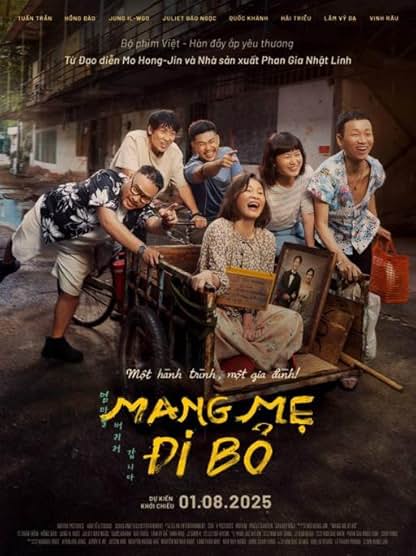

“Leaving Mom” (2025) is a Vietnamese Korean film about street barber, Hoan (Tuan Tran), who is taking care of his mother, Le Thi Hanh (Hong Dao), who has dementia. When Hoan’s health begins to deteriorate, it exacerbates already dire conditions at home and work which make it more challenging to appropriately protect her from herself. Meanwhile his mom is stuck relieving the past about her memories of her first son, Il-woo Jung (Yeon-woo Bae). Will Hoan be able to reunite his mother and the older brother whom he has never met then be able to leave their mother with him? While unflinching in its portrait of a mother and son with physical and mental limitations and no resources trying to manage each other’s health problems, it veers towards a happy ending that dismisses everything that came before to create a feelgood story which reinforces cultural values of children taking care of their parents.
Usually when I watch caretaking films, I scoff at the unrealistic parts regardless of the overall quality, but “Leaving Mom” pulls no punches for most of the story, and it may be rougher than what anyone could imagine. The opening scene is framed like a slasher horror film with a mysterious man holding a bloody bag and a woman tied to a chair. A moviegoer could be forgiven for thinking that they ended up in the wrong theater, but it is Hoan bringing home food from the butcher, and he ties up his mom to ensure that she does not hurt herself, run away or make a mess. It is smart of the movie to signal to its audience that writer and director Hong-jin Mo knows what this looks like.
Mo and Tran deserve credit for making Hoan so instantly affable and trustworthy because objectively, it is no bueno and would probably get you arrested in the US. Later in “Leaving Mom,” a doctor lectures Hoan for his treatment of his mom, and Hoan finally gets a weary monologue explaining the double bind that he is in. He cannot afford care. He needs to work to live. No one else can help. There are no offered resources. His choices are to do a bad job or abandon her in the hopes that someone else will take care of her. To be clear, his bad job is filled with patience, care and concern without an angry word. His mom acts like a kid in the way that she eats and handles her bodily functions, which usually only parents are prepared to handle, but he does so without losing his temper. It is easy to forget that they are not related in real life.
Dao needs some awards. While sometimes she is over the top in the way that she eats, especially considering dementia patients often lose interest in food because they do not recall what it is and eventually stop eating, Dao is deft at signaling the switch from her bad days to returning to herself. To be fair, only some dementia patients return to childlike behavior, even resembling grown adorable babies in their physicality, which is a minute flaw considering it is some people’s reality. The best scenes are when she is lost to the fog of dementia but understands on some level that Hoan is not her captor and tries to save him while screaming for her first son. He thinks that she never thinks of him, and only the first son, but these heartbreaking deficits in communication prove that he is wrong.
Unfortunately, “Leaving Mom” makes that mistake. There is zero hint of how Hoan’s mom became his mother or their relationship before she became ill. The only flashbacks are reserved for his mom’s time in South Korea and why she ended up leaving her first son there. It is not initially obvious that these scenes are flashbacks, and it is not of Hoan’s childhood. Hoan exists in a vacuum without any family other than her. He does have friends who love his mother though their assistance is limited to financial, which Hoan usually rejects. Chau (Lâm Vỹ Dạ) and Tuan (Quốc Khanh) are husband and wife food street vendors who are implied to meet the mother and son during his lunch break. Minh (Vinh Râu) is like a travel agent but is also good at getting visas. He seems to exist just to help get the pair from Vietnam to South Korea because if the barber cannot afford to get care for his mom in his home country, how can he afford to travel internationally? Anh Dung (Đào Hải Triều) is a transwoman who seems to exist to flesh out the group so there are an equal number of men and women, but also as comedic relief so Hoan can cut her hair badly. The fact that the scene does not include cutting Tuan’s hair makes it feel less like a joke and more mean-spirited.
“Leaving Mom” kind of goes off the rails once the action turns to preparing and going to South Korea. It is as if Mo decided that he tortured his characters enough but took his foot off their neck in a way that undercut everything before. The course correction threw everything out of orbit. It kind of becomes a more wholesome “Pretty Woman” (1990) wish fulfillment scene punctuated with toilet humor, which earlier was framed in a more grounded, exasperated way. South Korean cab drivers are national heroes historically as dramatized in “A Taxi Driver” (2017), but it would take the patience of a loved one or Job to show equanimity to your fare treating the cab’s backseat like a diaper.
The climax of “Leaving Mom” is supposed to be cathartic and heartwarming because Hoan finally lands on what he wants to do, but the way that the big brother (Jeong-min) is treated is aggravating unless there are plans for a sequel. Without giving away the ending, it may result in the occasional viewer whispering, “What the hell?!?” It feels like watching the mistakes of the past getting repeated in the present, which was likely not the intention. The movie is otherwise so poignant in the quotidian details for instance in the way that a bowl of noodles has deeper significance.
It is kind of funny to see South Korea shot like the promised land considering it is so well known for its class disparity and grittiness in films and television shows like “Parasite” (2019) and “Squid Game.” It is all about perspective. The movie does acknowledge the challenges that children of multiracial children face in South Korea.
“Leaving Mom” is “Stella Dallas” (1937) levels of melodramatic excellence until it pulled punches at the end. It is a shame that the film flinched at the world it created and magically ignored all the obstacles that were erected. If Mo had found a way to credibly solve the issues or decided to maintain the tone during the South Korea trip, it would have been perfect, but considering most films cannot bear to face reality of caretaking and aging, this film is still a triumph.