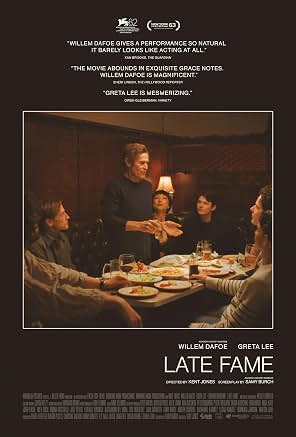

“Late Fame” (2025) is one of the best movies of the year and loosely adapts Austrian writer Arthur Schnitzler’s 1894-1895 novella, “Late Fame,” which was posthumously published in 2014. Ed Saxberger (Willem Dafoe) is a postal worker who lives in Greenwich Village probably in a rent controlled, walk up apartment building. One day, Wilson Meyers (Edmund Donovan), the head of The Enthusiasm Society, meets and invites Ed to join since they admire his book of poetry, “Way to Go,” which was published around October 1979 when Ed was younger than Meyers. Intrigued, Ed joins them, enjoys the attention and intellectual stimulation, becomes distant with his work friends but also refrains from completely surrendering to the hype. What does the future have in store for Ed Saxberger’s next chapter in life? The best movies are the ones that stop feeling like a movie and start feeling like a documentary, especially when watching it under the least optimal viewing circumstances. It must be sublime in the theater! You either know these people, are these people or have seen them around. It is so real.
When you look at people, you do not know what kind of life they live. A lot of people are a mystery to themselves, and getting older does not extinguish the hope of more youthful days. Often shooting in New Jersey, director Kent Jones wordlessly and economically evokes the Manhattan of yore referenced in the opening with black and white montage of archival footage before he establishes Ed’s routine and rhythm from jump: post office/work, walk and home to banter with his neighbor, Paulie (Tony Torn). The routine gets disrupted early when Meyers inserts himself into it. If it was a horror movie, he would be Michael Myers just standing and watching quietly across the street. It is Paulie that points Meyers out to Ed. Dafoe is just so organic as Ed and has his own deep well of experience as an artist and a damned good one to draw from. Dafoe makes Ed open and verbose with a hint of skepticism and a lot of pleasure. Ed responds eagerly to the call to adventure, the life of an artist, but not instantly. He takes his time.
“Late Fame” is a deliberate movie. Those unaccustomed to independent films may find it slower than their usual fare, but Jones and writer Samy Burch are giving time to the audience so they can savor this experience, understand the characters, observe the dynamic and how it shifts with every new element. As Ed leaves his world and delves deeper into Meyers’, the audience will relate more to Ed as the protagonist assesses what kind of people inhabit this world, if their interests and values align, and can they collaborate and validate his artistic work at the eleventh hour of his life. Does Ed still have the capacity to write poetry? Is Meyers authentic or full of shit?
How have I not seen or remembered Donovan’s work before this movie! Donovan nails the affectation of a character like Meyers. His naked thrill at finding and meeting Saxberger slowly segues into a machinery with the goal of romanticizing, recreating and cosplaying creatives from the Seventies unaware that art is an elusive beast, not a math equation or a logistics meeting that responds to deadlines or prompts. It can but there are no guarantees. Donovan shows the budding frustration of discovering that the Seventies were a very different time and being an artist then was a much more desultory affair. For most of humanity, artists and businessmen had very different skillsets, and the businessmen or patrons knew that they were not like those beneficiaries of their patronage. Jake Lacy appears in a brilliant cameo as a literary agent having one last creative pretense hurrah before he settles down and joins his father’s firm where Meyers’ dad works. Lacy’s physicality is pitch perfect and clear. Unlike Meyers, he knows who he is and what he is doing and assesses Ed as spectacularly unaligned. (Hint that I may not be an artist and more business: I would have accepted the memoir proposal and the meals with the right to edit the ghost writer.)
Meyers and his group are reenactors, and if you watch them closely throughout “Late Fame,” you will be able to tell if they practice what they preach and are in fact like Ed. The other members of The Enthusiasm Society are introduced and differentiated but not given much airtime because they are mostly knowable with a glance. They are mostly young men who spend more time scoffing at influencers than writing or creating thus confusing contempt with creation. The more screen time that Brussard (Clay Singer) gets, the more that he suffers. He is predictable as he assesses, projects on to and dismisses the women who cross his path until he gets his very own devotee who is suddenly immune to his criticism. He is so now.
While Ed laps up the adulation, he correctly senses that it stems from an eagerness for proximity to authenticity, which these callow men (and boy) may lack with the exception of the lone woman member, Gloria Gardner (Greta Lee), a mysterious actor who prefers to frame herself as an “ingenue.” She is Ed’s foil and opposite in many ways. She commits to the bit of an artist because she is, but she is coy about the real person when she is not playing an exaggerated herself as a character in the vein of a classic actor from the turn of the twentieth century who can do anything if called to do it: sing, dance, act, entertain. Ed does not play it to the hilt. He is living his life, and if he shared air space with the greats, he did, and if he did not, he does not pretend. He may be content as a postal worker, but he misses the community of artists and how they see him and his capacity for art, which reignites that potential. Lee plays GG as a woman trying to clue Ed into how he can leverage these relationships to create sustainably without letting her guard down. When the mask slips, then she tearfully re-erects the façade, it becomes obvious that it is an authentic part of an artist’s life to have a stage, even at dinner, but most importantly within the borders of New York.
For many, being an artist is inseparable from being in Manhattan, but Manhattan is no longer a place for artists if only because of the cost, financial and mental. The characters that get the most spotlight are the ones who walk with Ed through a Manhattan very different from the city that he met back in 1977 when he arrived from Pennsylvania, and their true selves are revealed in the spaces that they inhabit. Jones shoots the city lights like stars before descending to the sidewalk. Location management, production designer Tommaso Ortino, and set decorator Leo Swartz transform these three characters’ apartments into a window into the soul of their inhabitants, a very New York City concept. We are obsessed with where a person lives, how they afford it, how they occupy the space, etc. While these people are likely as much transplants as the writer and director of “Late Fame,” the lingo is infectious upon arrival.
“Late Fame” also deserves praise for what it does not focus on behind the closed doors of that home. There is an unknowability to each of these three, but it is hinted at during dramatic moments that are not entirely explained: when Meyers shows stress, when GG has an off night or what really drove Ed from the family home into the arms of a chosen family that never quite coalesced or understood every aspect of him, but was more of a home and safe space than any place in Pennsylvania. I left wanting more.