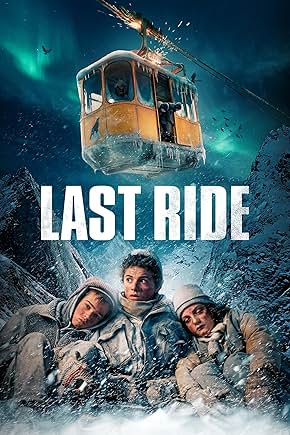

John Gribbin and Stephen Plagemann’s 1974 astronomy book, “The Jupiter Effect,” likely inspired Cinqué Lee’s film, “Last Ride” (2023), which was originally titled “A Rare Grand Alignment.” On March 10, 1982, three boys on vacation in Vargoy, Norway get stuck in a cable car. This coming-of-age film is more sci fi survivalist tale than thriller. Disclaimer: I saw a screener and did not see the movie in a theater on a big screen so I would recommend going to the theater if you are interested. It is an earnest, heartwarming movie about how kids cope with big events out of their control…if you can understand what people are saying or can see what is happening during the nighttime scenes.
The cast of “Last Ride” is outstanding. The bookends of the story take place in the present, but the meaty center occurs on that fateful Eighties day. Gustav Skarsgård, one of Stellan’s many talented sons, plays one of the three children as a grown up. He brings his adult (and hot) son, Devin (Samuel Paul Small), and a random Finnish man, Kaapo (Jasper Pääkkönen), to the location without disclosing the reason to them. The movie is supposed to show the story that the father is likely telling them to encourage his son to get on the right track, but he is drunk out of his mind and barely coping so maybe not the best teaching moment. Parenting is tricky.
The trio are supposed to be American. Roman Griffin Davis, who plays Devin, the curly haired innocent, and Charlie Price, who plays Jamie, the brash, wannabe libertine, are both Brits. Davis’ debut was the star of the critically acclaimed “Jojo Rabbit” (2019) and recently appeared in “The Long Walk” (2025) so he is not coasting on being adorable or having an accent. The kid has chops. Price has more television experience, but he has been in two movies. While I am unfamiliar with his work, it seems unlikely that he would get to appear as a supporting actor in Kristin Scott Thomas or Elle Fanning’s projects if he was not good. Australian actor Felix Jamieson, who plays Syd, also worked with Price on the Fanning project and a little television series known as “Game of Thrones” and other HBO television series. HBO is usually a guarantee of a certain pedigree of acting excellence.
Another disclaimer: I almost decided to pass on the offer to review “Last Ride” because I’m not into stories that have little boys as the leads; however, the premise, the caliber of the cast and the way that the trailer captured the location locked me in. The trailer must have selected the few moments that these children were not mumbling. Were they supposed to be naturalized Americans? From what I could discern about the story, it did not seem essential that these children needed to be American except that Syd was wearing a lot of Brooklyn swag, but could not they just appreciate urban wear?
Here is what I think happened even though I cannot prove it. They were supposed to be kids of color, and it was supposed to be shot elsewhere. Who would pass up an opportunity to shoot in such a gorgeous location, but then it was deemed unrealistic to have a bunch of brown kids able to afford to jaunt around Europe with broken homes if they were. Lax parenting is not something customary in the culture. Plus, it is more marketable with three white boys. I don’t have a problem with this shift at all if there was one, but they needed to let go of making them sound American. It is the one thing that these children could not do. We heard of Michael Rappaport, Mick Jagger, and the Beatles. It is not unheard of for people to appreciate other cultures without being a part of it. It is fairly common. They would have been more intelligible if they let them use their natural accents. Maybe it is me. I usually use subtitles whenever they are available.
Even with this challenge, “Last Ride” continues its momentum as the trio charm Oyvind (Kristofer Hivju, also from “Game of Thrones”) into taking them to the mountain. The group dynamic with the adult conveys a carefree boyhood on the eve of manhood as they dance to The Clash. It is a magical moment. When things go south, they are little boys completely incapable of making wise adult decisions and make a great number of magnificently bad ones so they have something to do during the long night, but the ways that these children are written is so thin that the momentum almost entirely ceases except for the natural phenomenon that raises the stakes and threatens more loss.
Lee should have just copied any number of Stephen King books/films and leaned more on the natural catastrophes, which were impressive and unusual even for apocalyptic movies. If you watched the forest scene in “Dreamcatcher” (2003), you would have a sense of how the special effects could have carried “Last Ride.” Instead, the boys go an emotional journey that threatens to change the nature of their friendship. I actually hate when movies decide to threaten the friendship because the audience has just met the onscreen characters so unless their camaraderie is so convincing that moviegoers can buy that they would never separate, the threat just makes everyone believe that they were never that close. Also, “The Lord of the Flies” friends to enemies’ pipeline is overdone.
“Last Ride” ends up being an intervention story with the two friends encouraging one to get therapy for an underdeveloped trauma. It felt as if there was a checklist, and the boys were like, “Oh yeah, get help.” I was alive in the Eighties, and I’m alive now. Here is a broad generalization: adolescent boys do not generally encourage each other to see a therapist and discuss their feelings. Why did this film have to unfold in the Eighties? It would have been more plausible or at least aspirational if it took place now, but Lee was so committed to the source material, that he kept the date. The astronomical theory of the great alignment is not so commonly known that detractors would complain about the change. It also never happened, and this film is not based on actual events, so changing the date could have worked and made the story more evocative and prophetic, but Lee seems averse to any spiritual implications and wants to stick to Big Bang territory then transmute it to the specialness of friends being soulmates and meeting each other.
“Last Ride” has nothing but great ingredients, but it never cooks. Lee is Spike Lee’s brother, and Spike served as executive producer. The problem with creative freedom: it is helpful to have people give feedback and hone ideas like contemporary filmmaking counterparts with less famous creative support, but more revisions. Lee definitely has something special, but he needs to learn how to kill his darlings so his creative baby can soar.