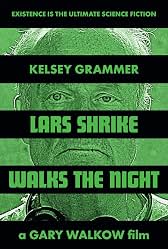

“Lars Shrike Walks the Night” (2024) wraps an existential crisis in a sci-fi wrapper starring Kelsey Grammer as the titular protagonist. Believing to be trapped on a prison planet where the lighting is green, Lars only knows his name because it is tattooed on his right arm. He fends off creatures that look ripped from a B movie. As he progresses in his journey, the lighting changes, and he finds himself in an unfamiliar land, which to the viewer is obviously Earth, specifically California. With everything seeming strange, but successfully escaping the prison planet, he goes on a journey of self-discovery and to find out the identity of the man’s voice that speaks to his inner voice while trying to figure out who he is. For newcomers to writer and director Gary Walkow’s work, the answers will be a surprise but also may make them wonder if they need to see everything to appreciate this movie more. For those with less curiosity, it could really divide audiences as a sci-fi ripoff or a pleasant way of addressing serious issues in a circuitous manner. If you are a Grammer fan, you will not want to miss his excellent performance regardless of how much knowledge of Walkow’s filmography you bring to the movie.
Grammer is no stranger to sci-fi with his take on Beast in the “X-Men” franchise and the upcoming “Avengers: Doomsday” (2026) so if he is in “Lars Shrike Walks the Night,” he wants to be in the indie, little known film. Grammer’s career proves that a dissolute past and conservative politics does not automatically cancel people in showbiz. He is beloved, booked and busy despite it and because of his talent, specifically that voice, but in “Frasier,” he displayed a physicality that showed proof that he had comedic timing in his bones. All those gifts and skills are on display in this strange little film that is an unexpected mix of oddball, low-budget B-movie in the first act before giving way to poignancy.
“Lars Shrike Walks the Night” starts with Lars having flashes of the past but not knowing anything about his life before he struck out on his own with shackles on his ankles and mounting injuries. Everything is a mystery to Lars, and his approach to life on Earth is filtered through his slim, but existing knowledge and experiences on a prison planet, which leads to some amusing conclusions such as believing that kids in their individual bedrooms are actually in prison cells. The word “family” eventually surfaces, but he has no personal experience with one other than what he can imagine. Most of the film consists of hearing Lars’ thoughts, seeing him navigate the real world or depictions of his internal thoughts then thanks to the miracle of editing, subtracting or adding in elements as he internally and verbally alters his thinking.
It is impossible not to sympathize with Lars’ plight. The trailer for “Lars Shrike Walks the Night” gives away too much, and if you do not watch it, you will not guess what Lars’ origin story is. Instead, it could easily be an exercise where Grammer plays a homeless man with mental health issues who does not know how anything works or a person who suffered from a traumatic brain injury which results in starting from scratch but appearing as if he should know more. During his first moments on Earth, he shuns people but gradually enters more populated areas. Initially there is a sliver of concern that he will get into trouble because of the way that he gets supplies, but his encounters with people are largely kind. It is heartwarming when he seeks refuge at the Joshua Tree Library where a kind librarian (Kati Schwartyz) is the most realistic personification of existing benevolent government. His priority is not getting to know others but know himself.
Lars is the protagonist in “The Trouble with Dick,” a book that the fictional author, Richard Kendred (David Clennon), wrote. Lars makes an oversized pipe into his reading room then heads over to meet him. Lars demands answers from his creator, but it only results in Kendred having more questions for his creation. If “Lars Shrike Walks the Night” works, it is because it exists on the same parallel tracks that existed since the Book of Job when Job confronts God about his suffering or Roy Batty (Rutger Hauer) talking to Eldon Tyrell (Joe Turkel) in “Blade Runner” (1982) demanding accountability. Richard is not high handed like the other referenced creators and relates to his creation because after all, Lars came from his mind so of course they would be like each other. While the questions are important, the answers are unknowable, which makes the story’s mythology work. It is a mystery.
Lately, there have been a lot of movies where a writer’s creation comes to life: “I Know Exactly How You Die” (2026) and “Big Baby” (2025), the prior falling apart and the latter being my favorite though it does not stick the landing. “Lars Shrike Walks the Night” may be the most consistent though it drags a bit because huge swaths of the movie require Grammer to occupy the screen alone other than chatting with his unreliable, somewhat petulant invention, the Chrono-Blaster (Laurie Drayton). It becomes a literal representation of the process of writing, especially the use of autofiction mixed with genres that are unrealistic. The creative process becomes a philosophical, internal exercise of what makes a person into an individual. The artist is in conversation with an externalized version of themselves that they have to create to commune with.
If “Lars Shrike Walks the Night” commits an error that detracts from the story, it is the insertion of a clip from “The Trouble with Dick” (1987), which is Walkow’s first movie and is available on his website. I did not watch it (growth). It has the effect of taking the audience out of the movie if they did not bring existing knowledge of Walkow’s work to this viewing experience. If you are like me, you will pause the movie then do an internet deep dive to ask yourself if you signed up for more than you bargained for since it is not apparent that it is part of a larger Walkow universe. Walkow describes “Crashing” (2007) as a sequel to his first film. Other reviewers describe “The Trouble with Dot & Harry” (2015) as connected in other reviews, but the film is not listed on Walkow’s website so take that tidbit with a grain of salt. A filmmaker can do whatever they want, but even the Marvel Cinematic Universe is deterring some fans with its growing list of required viewing before watching their latest movie. If it is a lot to ask even when the movie is popular and available, it is definitely an obstacle to people who are completists and wonder what is the point of watching a movie if they cannot derive the complete, intended meaning. Walkow must be thrilled that he does have people who are committed to his filmography, but even if he intended his most recent film to standalone, it is a big ask to mentally categorize this installment as a standalone film. The clip gets in the way of keeping attention solely on Lars’ plight.
In the end, “Lars Shrike Walks the Night” departs from ditching anger over not being asked to exist before he is thrown into life and suffering and arrives at ambivalent gratitude over experiences. If you are interested in a philosophical exploration with a hint of sci-fi, definitely check it out, but drink a coffee.