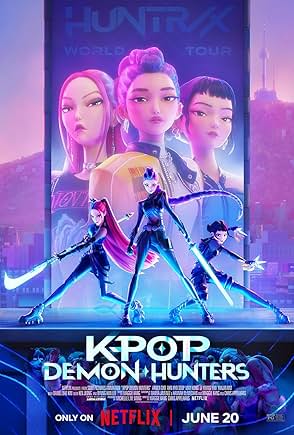

Netflix did not directly promote “KPop Demon Hunters” (2025), which was released on June 20, 2025, to critics until August 12th. My K Drama friends and online community put me on game. With a Halloween theatrical rerelease, it was my turn to get into the animated sensation even though animation is the one genre that I personally skip because the line must be drawn somewhere. Every generation has three hunters, who are more than warriors, but singers who unify the masses through music, which forms a barrier called the honmoon (soul door or spirit gate) to keep demons out of the human dimension. They are basically shamans who use song and dance to fend off evil spirits. Once the honmoon turns gold, the demons will never be able to enter Earth. Just when the honmoon is on the verge of becoming golden, the demons find this generation’s demon hunters’ weakness. Is it a weakness that needs to be hidden or accepted?
The demon hunters of our era are known as Huntr/x, who are the leading KPop band, live together in a tower that resembles Tony Stark’s Avengers’ tower and are best friends. Unlike “Buffy the Vampire Slayer,” there are no clues how the three are determined, but for casting, they were looking for Korean actors who spoke English and another actor did the singing. Rumi (Arden Cho and Ejae), who fights with a saingeom or Korean sword and is unusually strong, is the lead singer with a long purple braid which may visually remind you of the Na’vi from the “Avatar” franchise. A saingeom wards off ghosts and kills evil spirits. She is called popstar royalty because she is a descendent of one of the prior generation’s hunters, the Sunlight Sisters, which are shown briefly in a flashback. Mira (May Hong and Audrey Nuna), who fights with a polearm weapon, has pink long hair, is blunt and the black sheep of her family, but has found a home with her colleagues/friends and is the band’s choreographer. The black , short haired, people pleaser, American born Zoey (Ji-young Yoo and Rei Ami), who fights with shinkai throwing knives, is the team’s lyricist and rapper and probably the most normal one of the group.
It is unclear whether they have any powers other than their amazing singing voices but considering that they can handle free fall skydives without parachutes, probably. They may remind some of “Jem,” an American animated television series from the Eighties. The trio are normal in their off hours only wanting to eat, couch surf and relax in the Korean bathhouse. The animation depicts them differently as visual metaphors when they are crushing on a cute guy and makes them seem more childlike. It is super cute. Rumi and Zoey may be most relatable to Korean adoptees, especially if they are transracial. If I had a problem with the story, I always have an issue when friends split up then reunite, especially over a serious issue which would normally be a deal breaker in the real world.
Former Sunlight Sisters’ member, Celine (Yunjin Kim from “Lost”), trains them to hide their flaws from the public, but it is a seed that unwittingly divides the team from each other, creates shame and self-hatred, which makes them vulnerable to attack. Celine is usually depicted next to a dangsan tree, which is associated with shaman rituals that protect the village. In the US, it could be associated with “Black Panther” and the ancestral plane, especially considering Rumi’s story arc and her personal mission of reconciling the values of the past with present circumstances. As a result, Rumi is turning into a workaholic that her voice is unable to sustain.
The big bad, Gwi-ma (Byung-hun Lee, Front Man or Im-ho from “Squid Game”), who resembles a massive open flame, is freaking out that soon he will have no souls to feed from when Ji-noo (Hyo-seop Ahn and Andrew Choi), one of his demon minions, comes up with the plan to form a demon boy band called the Saja Boys, which includes Abs (SungWon Cho and Neckwav), Baby Saja (Danny Chung), Mystery Saja (Alan Lee and Kevin Woo), and Romance Saja (Joel Kim Booster and Samuil Lee). Saja means lion, which they use as their pink logo, but also underworld messengers or grim reaper, which signals that they are sucking the souls from their fans.
When Ji-noo meets Rumi, he immediately figures out her secret, and they are a bit attracted to each other. He uses a tiger and magpie to secretly communicate with her, which has significance in minhwa, Korean folk art, and are not demons. In kklachi horangui paintings, the tiger, a symbol of aristocratic authority that serves as household protectors, i.e. guardians against evil, is depicted to look like an idiot and to Western audiences resembles the Cheshire Cat in “Alice in the Wonderland.” The magpie is a symbol of the dignified common people and messengers of good news. Paired, they are a visual form of satire of Joseon’s feudal society. In this society, social media establishes the hierarchy.
“KPop Demon Hunters” may be one of the best animated movies for an underage audience because of its strong visuals, its appeal to the kids’ grownups, i.e. you are not going to need coffee to get through it, and a film first record, four songs from the soundtrack appears on the top ten of the Billboard Hot 100. How is the music? I would not buy the soundtrack, but I would play the movie repeatedly in the background for multitasking.
With its Halloween promotion, how is it on horror? It is intentionally not scary since the demons, while mostly evil and dangerous, are humanized with backstories. The story and visuals pay homage to the genre with the opening fight sequence on a plane that may remind horror fans of “The Twilight Zone” episode with William Shatner called “Nightmare at 20000 Feet.” Also in another scene, Bobby (Ken Jeong, former doctor turned comedian), who is unaware of their vigilante alter egos, says something is not the end of the world, and for a split second, the perspective shifts from the peaceful interior of the residence, to the exterior with the pink chaos of demons taking over reflected on the window with the score becoming ominous. It is hilarious.
Also for fans of K dramas and Korean variety shows, “KPop Demon Hunters” adheres closer to the South Korean entertainment industry than the American model because South Korea has variety shows where major music stars and actors appear and do goofy things that at most, only our B level groups participate in. Korean stars are more like classic Hollywood actors who were expected to be able to act, sing and dance. There is also a deep understanding of the culture’s aesthetic. It is usually an impossible hurdle to make people hot while skirting sex, but this child friendly movie accomplishes a contradictory task.
“KPop Demon Hunters” seems as if there is room for prequels or sequels. If there was a prequel, it would be great to explore their antecedents in different eras. A sequel may be more challenging because it could inadvertently undercut the lessons learned in this film, but if the story focused less on Rumi, and more on Mira or Zoey, then it could succeed. Humanizing demons other than Ji-Noo is another option. It is nice to have a horror-tinged musical that actually sounds good and is appropriate for kids without becoming mind-numbingly nonsensical. More importantly, it also shows that Korean Americans are a seamless part of continuing Korean culture without diluting it when creating it in a different nation.