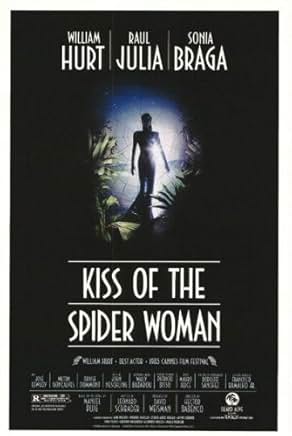

Set in Brazil, incarcerated for corrupting a minor, Luis Molina (William Hurt), a transwoman sexually attracted to men, tells stories about her life and the movies that she loves to her cellmate, Valentin Arregui (Raul Julia), who is contemptuous of Luis. Will Molina redeem her life? Y’all, thank God that the 2025 movie is not a remake of “Kiss of the Spider Woman” because just writing a summary of the 1985 movie is shocking. At the time, this movie was considered progressive, but forty years later, it is difficult to watch though impossible to forget how it moved the needle forward.
It is only after I got older that I wince when I hear fellow American movie goers mix up South American countries, Brazil and Argentina, if the films are about government oppression like “I’m Still Here” (Brazil, 2024) and “The Penguin Lessons” (Argentina, 2025). This confusion is not just pure ignorance, a flaw, but perhaps a feature, especially if you trace the evolution of “Kiss of the Spider Woman” in media. Argentinian author Manuel Puig wrote his 1976 novel, which was set in 1975, then adapted his novel into a stage play in 1983. In 1985, a critically acclaimed film adaptation of the novel moved the action from Argentina to Brazil. Then composer John Kander, lyricist Fred Ebb and playwright Terrence McNally collaborated to adapt the novel into a Tony Award winning musical starring legendary Chita Rivera, who was not Argentinian. “Kiss of the Spider Woman” (2025) adapts the musical with Mexican and Puerto Rican actors in the leading roles. If we are confused, it is because the information that we are fed makes this mish mash normal. This review will reflect whether the first film holds up decades later. At the time, it was revolutionary despite all the punches pulled.
One look that aged well: Valentin’s most redeeming trait is that his scoffing at Luis’ favorite movie is warranted because Luis is describing Nazi propaganda, not an ordinary film, so Valentin functions as an audience surrogate. The 2025 movie wisely creates a whole new movie instead of remaining faithful to the first film. Valentin is repeatedly physically abusive to his cell mate and is way more single-minded even at the end of the movie. He never considers anyone’s well-being except the cause.
The 2025 movie completely overhauled Luis because as is, Luis seems like a creation from the fevered mind of a Presidon’t supporter, not a person who got picked on for existing. Watching Luis call himself the f-slur and not in a reclaiming and owning the word way was so sad as an (unintentional) example of internalized homophobic way. Luis describes her life as frivolous and meaningless because she only has friends. The character is also played in such a way that it does seem as if she would betray Valentin if promised the right incentive. Also, it is worth repeating that the character is gaga over Nazi propaganda and did not realize it. It is unfortunate that this storyline seems to set up an understanding that if the heroine of the imaginary film could fall for a Nazi, then under similarly stressful circumstances, perhaps Valentin would talk to someone like Luis.
With the bad news out of the way, for two actors with the stature and reputation of Hurt and Julia to play these roles was a big deal at the time, but they had zero physical chemistry as two people who would eventually fall in love and are stiff in the roles. Getting Hurt to play a queer character is huge, but because of his real-life straightness, masculinity, whiteness and height, he could do it and not get stigmatized with casting directors thinking that he was gay then refusing to give him any other roles. Now watching a tall, white American play a Brazilian is just confusing, especially without a whiff of a Spanish or Portuguese accent. Imagine watching a movie about Jesus and all British people play the Romans (Italians) and Israelites (Middle Easterners). That kind of casting was considered normal, not dissonant, and actually a way to get butts in theatre seats because otherwise the movie would be considered too foreign and gay to attract mainstream audiences. Besides the obvious, the drawback of having Hurt in the role is that Luis’ time with Valentin is supposed to instill confidence and dignity, and Hurt always possesses those traits. He may have been too old for the role whereas the other demographic characteristics were not a dealbreaker at the time.
Hurt’s best moment is when Luis calls out and rejects the inherent misogyny of Valentin deriding sensitivity in male presenting people, which gives Valentin an opening to share his stories, which is the inherent tension in “Kiss of the Spider Woman” because vulnerability meand Luis could betray him. Julia was a towering presence in the acting world, and his Valentin is a proud revolutionary first and a human being later. It seems more plausible that he would use Luis as a taster to protect himself than as a show of generosity. Alternatively, the dialogue paints him as a man that wants to return favors and not be indebted for kindness. Julia had more to lose than Hurt since having an accent and visibly being considered a minority meant he already received less offers than Hurt. It does not feel like an accident that his final scene shows him rewarded with his girlfriend (Sonia Braga) rescuing him. Still, he put a lot of gusto into the kiss, his character returning another favor. Both actors seem to brace themselves then hurl themselves into the kiss as if they are jumping out of a plane. The romance is not between these two people, but their willingness to be physical understudies for each other’s fantasies. If there is a multiverse, and this version was more comedic, this Valentin would adopt the frat boy disclaimer, “No homo.”
The 1985 version does have some advantages over the 2025 film. The space around them feels lived in, and the pair’s cell life contrasts with the other prisoners, which underscores the danger that Valentin is specifically in. The flashbacks make Valentin seem like a man of action, not just rhetoric. Instead of the loveless lone outlier, Luis is shown as part of a vibrant queer community who calls her Luisa. The architecture in the 2025 film is more brutalist, and the streets seem devoid of life whereas this film makes the city seem lived in as if life carries on while brutality unfolds away from the public eye, which is what happens in oppressive countries. Director Héctor Eduardo Babenco, who was born in Argentina to a Polish and Ukrainian parent who immigrated from Europe, lived in Brazil to avoid anti-Semitism before moving to the US so he breathed that atmosphere. Unlike Condon, state sanctioned brutality was not a theory to Babenco, but something that was part of the air that he breathed. In his youth, he allegedly was jailed in Spain on minor offenses. Puig did not like Babenco’s work or trust him.
At the time, “Kiss of the Spider Woman” was countercultural for centering a queer character and having two male actors play characters who would have sex with each other and were supposed to remain sympathetic to the audience. It should have been clearer that Luisa was not a pedophile, and it was a false charge. Moving from an imaginary movie to an imaginary musical was the right move because the prior was less vibrant and integral to the plot and felt more of a marketing ploy to get audiences to believe that women characters were more integral to the plot.