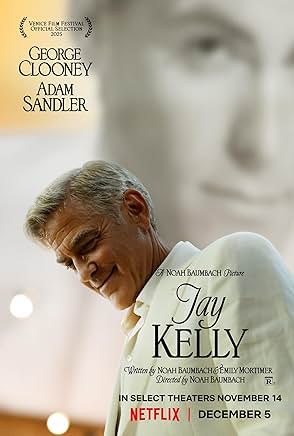

Greater love hath no man than this, that a manager, Ron Sukenick (Adam Sandler), lay down his life for his client, actor Jay Kelly (George Clooney). “Jay Kelly” (2025) is about an internationally iconic actor reflecting on his life and coming up short as he realized that he sacrificed real relationships for fame and art. While trying to care for his family virtually, Ron prioritizes Jay because he believes in his work and is trying to stop Jay from committing professional suicide. Director and cowriter Noah Baumbach’s latest film is a collaboration with supporting actor and fellow cowriter, Emily Mortimer, who plays Candy, Jay’s hair stylist, about the rewards and drawbacks of fame as midlife crisis hits these two men hard, face their mortality and realize that they only get one take. Longer than it needs to be, it is nevertheless poignant despite being a poor little rich boy story about facing deserved consequences. It is the second of a series of 2025 films about men struggling with and hoping to be found not guilty for their life choices.
Baumbach’s films are usually practical affairs that are elevated, polished mumblecore movies, but after “White Noise” (2022), he seems to want to experiment more with narrative. No doubt, because of his famous, successful life that is not exactly free of scandal, “Jay Kelly” is what realism is to Baumbach at this stage in his life. Clooney is an excellent choice for a debonair, charming actor that may only have a sliver of meaningful interiority despite being in a profession that is basically the equivalent of a doctorate in humanity. There is a scene where Kelly’s work is shown in a montage, but it is really Clooney’s past work, which reminded me that he is more of an attractive actor than an interesting one. He has a limited range though he has leveraged that talent deftly, so this titular character is the perfect role for him, but maybe not so engrossing for the audience with a punishing runtime of two hours and twelve minutes, which is longer than necessary.
The narrative starts with Kelly at sea after wrapping up one movie and waiting for another to start so he is looking for someone to hang on to and occupy his time. He only exists in the reflection of someone’s eyes. The most subversive twist is that Kelly does not look for a romance. It is a classic trope of “cat’s in the cradle and the silver spoon” with his daughter Daisy (Grace Edwards) grown and ready to leave the nest, not indulge dear old dad. Jay has an entourage of people at his beck and call: Ron, publicist Liz (Laura Dern), Candy, lawyer Alan (John Macmillan), stylist Krista, housekeeper Barbara (Matilda Thorpe), his security, his chef, Mario (Andreas Munoz). When he goes anywhere, his entourage takes up four massive cars as if he is the president. After an encounter with a former acting classmate, Tim (Billy Crudup), whom Kelly considers a friend despite evidence suggesting otherwise, he goes on a guilt-ridden international road trip exposed to the hoi polloi, who are delighted with their brush with movie magic, after a moment of weakness in seeking conventional cinematic validation. A cynical person would wonder if Baumbach and Mortimer wrote this story so they could travel to Europe for “work.” Slow Eighties clap of appreciation for their combination of work and play.
During this road trip, visions of the past play like movies where Kelly can walk around and watch them as if he is on the set. Less “A Big Bold Beautiful Journey” (2025) and more “Eternity” (2025), it reveals pivotal moments when he let down the most important people in his life such as the director who gave him his biggest break, Peter Schneider (Jim Broadbent), his older daughter, Jessica (Riley Keough, whom I finally recognized, but is always a phenomenal chameleon), a younger Tim (Louis Partridge) among many others. These reflections give Baumbach a chance to play around with different genres, a taste that he indulged in the aforementioned “White Noise.”
Kelly chooses himself over them, and some moments are more devastating than others, but are still compelling. In one scene, he fondly remembers an affair, and the mother of his children do not even get names. Kelly surrounds himself with photos of actors that he admires and wants a slice of their achievement. That hunger is relatable and often literal when Charlie Rowe plays younger Kelly. There is a spiritual resemblance that Rowe embodies, but physically not even a little bit. Anyone who watched “The Facts of Life” will be unable to suspend disbelief that Rowe is a younger Clooney. Kelly only feels bad that he is alone but has no actual regrets about his choices, just the consequences. In the present, when he finally gets to meet up with Grace and learn about her life, he gets distracted at someone filming a scene with a video camera that does not involve him. His career needed care, but for Kelly, people could be put on hold and would wait for his return except he was wrong, which is the source of his regret.
As “Jay Kelly” unfolds, Kelly gets distilled to his essence without much there, and even most of his entourage does not get paid enough to stay in his company, especially when the accommodations deteriorate. It is a great character study with a lot going on around him to make the film feel occupied even if it feels more like vignettes than an organic, realistic depiction of life. It is impossible not to feel bad for him in this classic, predictable scenario, but he also mostly gets what he deserves except for a scene with his father (Stacy Keach), which proves that Kelly was only marginally better as a father. At least he has a sense of where he slipped up and loves his children as concepts on a workday or as people on his day off if it does not disturb his self-image.
The real thespian in “Jay Kelly” is Sandler, but it is not a surprise if you have seen “Uncut Gems” (2019), “The Meyerowitz Stories” (2017), or “Punch-Drunk Love” (2002). Ron is a family man who calls Kelly his brother but treats him like his kid; however, he is beginning to wonder if his client sees him as nothing but an employee and takes for granted all the things that he pulls off. The man has range that Clooney only dreams of. Just borrowing Kelly’s glasses is a casual work of art. This Ron seems genuinely warm, and unlike Kelly, finds a way to stay tied to his family, but his focus is divided. The funniest stunt casting is finally seeing his other client, Frank Hewitt, and finding out how others see Ron. Greta Gerwig plays Ron’s extremely understanding wife, Lois, who must manage their two sick kids. I love Gerwig behind the camera, but I miss her playing the protagonist.
I was tickled to see Baumbach alum from “Kicking and Screaming” (1995) reappearing in brief roles. Josh Hamilton plays Jessica’s therapist, Carter. Why do all the therapists have blonde hair or on their second profession? I swear that Carlos Jacott played a disgruntled father in a pairs match with Ron.
Along with “Sentimental Value” (2025) and “Hamnet” (2025), “Jay Kelly” tries to cultivate a film about a father wanting to retain his status as a priority in his personal relationships while prioritizing his profession instead of just taking the “L” as a price for greatness. Dads want to have it all. Who does not regardless of gender. While a glossy, luxurious take on allowing the art to act as an excuse for personal failings, Baumbach’s film arrives at a realistic place of radical acceptance between the two people who have always been there for each other as they keep choosing art and accept their place in the world.