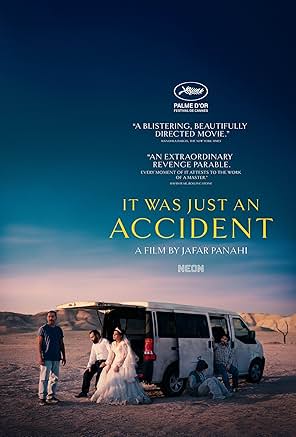

“It Was Just an Accident” (2025) focuses on a group of ordinary people who believe that they found the man (Ebrahim Azizi) who tortured them, an intelligence agent who works for the state. This dilemma comes with many questions. Do they have the right man? What will they do? What is the just thing to do: get revenge or be better than him? What are the consequences of their action? Iranian writer and director Jafar Panahi’s latest film won the Palme d’Or at the 78th Cannes Film Festival, and France submitted it for the Best International Feature Film category for the 98th Academy Awards to be held in 2026.
“It Was Just an Accident” is the kind of movie that unfolds with unique, unpredictable, organic beats. The opening scene shows a husband and wife driving on a dark road. Then the film gradually reveals more about who is in the car and what other living beings are on the road. They have some car trouble, and the accident serves as a Rorschach test of humanity. The wife rationalizes that it was an act of God, but if it was, He is not on their side, which is the tragedy of this story if he is the suspected individual who believes that he serves God. During these scenes, the camera is constantly on the husband. If he is the torturer, no one saw his face, but we get to. Panahi introduces him as a husband, father and relatable person first. If the audience is going to root for his death, Panahi will make sure that they have the whole picture.
Movie goers may need context. The Iranian government authorizes torture, so revenge is not an option unlike when movies show the Mossad tracking down Nazis and bringing them to justice. These characters are ordinary people, not trained government officials with resources to conduct an official operation. “It Was Just an Accident” has high stakes, but Panahi also uses the survivors’ ordinariness for humor. While the film features an ensemble cast, Vahid (Vahid Mobasseri) is the main character who originally recognizes the torturer but has doubts so he tries to find others to corroborate his suspicions. Panahi introduces each person engaging in their normal life and focuses on how the interruption results in a seismic shift, which reveals that a part of them is still stuck in that torture chamber.
In addition to Vahid, the group consists of very different people. Shiva (Mariam Afshari) is a photographer and dresses sensibly in slacks without a head covering. She is working on a wedding photo shoot between groom Ali (Majid Panahi) and bride Goli (Hadis Pakbaten). Eventually Hamid (Mohamad Ali Elyasmehr), an extremely reactive person, joins them. It is equal parts hilarious and harrowing because they are driving around with a man tied up in a box in a crowded city while trying to not attract attention or give him any clues about their identity. In one scene, they fail spectacularly near a couple of cops. The following scene are an example of why the Iranian does not Panahi to make films and must do so surreptitiously, which makes “It Was Just an Accident” more remarkable.
The Ministry of Islamic Guidance banned Panahi from making films because he represents society in a way that is not idealized and centers everything that they pretend does not exist in society. If you’re familiar with Christian produced films, which I am, and I actually enjoy the apocalyptic ones, imagine if those types of films were the gold standard and anything that wasn’t similar or at least didn’t serve a devotional purpose was banned. If you believe that the fundamental tenet that will make society perfect is just following Jesus regardless of life not being simple and not just falling into place, then the people who believe that could be uncomfortable with any depiction of the full spectrum of human emotion and experience then try to rationalize away the negativity instead of embrace and wrestle with it. Imagine if Job’s friends judged movies and decided which ones should be in theaters.
So Americans may think that “It Was Just an Accident” is just capturing a slice of life or playing for laughs, but it is considered forbidden to show cops and hospital officials solicit and accept bribes even though it happens. They are more concerned about casually revealing corruption than eliminating the bad conduct. There is even a critique of how hospitals treat women having a medical crisis. Panahi depicts government officials as ineffective, zealous, lacking in empathy, sadistic, but it does not feel as if he is painting them with a broad negative brush. Again, most of these will have you rolling on the floor. Authoritarian regimes do not have a sense of humor. These groups are unified in spirit tilting towards corruption.
Panahi loves having a child character in his films, and these characters act like kids. Delmaz Najafi may be my favorite one to date. As Eghbal’s daughter, she is still savvy enough to walk the tightrope of obeying her father and knowing how to function in the world. Also, unlike her mom, she has not drunk the Kool Aid yet and knows the difference between right and wrong and the value of all life, not bowing to human morality, state edicts or reflexive patriarchal deference to side with a harmer over the harmed.
In contrast, these ordinary people are divided about how they should treat this alleged torturer. While some talk tough, their actual actions suggest a stubborn streak of decency that refuses to die. Initially they use his debit card to cover expenses for moving him around town, but soon they take a collection to help him at a crossroads that he is powerless to assist in. It is New York City kind to a man that may not deserve it.
It is also a gorgeous film. While it may be a bit overdone to use the red of a car’s taillights to ratchet up intensity, it still works and conveys danger, guilt and the potential for blood shed or a signal of blood already shed. The editing from the city to the desert indicates the survivors’ inner desiccation where the river of human kindness evaporated in the face of cruelty and is hungry for more. The use of dogs throughout “It Was Just an Accident” as the hand of God’s accountability and judgment is controversial since they are seen as unclean and a sign of Western influence. Before Vahid captures him, a dog tries to cross the street, and the sound of the traffic functions as an appetizer of threat as if death will come. The capture scene is so sudden, blunt and shocking in its audacity. Is Panahi a fan of the Coen Brothers’ “Blood Simple” (1984)?
“It Was Just an Accident” is a perfect movie, and if you are unfamiliar with foreign films or films with subtitles and are interested in expanding your horizons, this movie is for you. Afterwards, if you do not get the hype but keep trying other foreign films, you may reflect on this movie and realize how special it is. The final shot will haunt you forever.