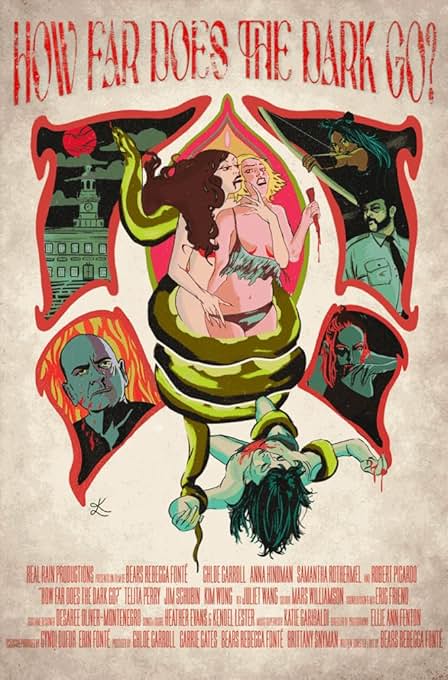

Do you like vampires? Do you like lesbians? Do you like vampire lesbians? Then “How Far Does the Dark Go?” (2025) is the perfect movie for you and expands the short film, “Elysia” (2021), which can be found on YouTube. Grace Nicholson (Anna Hindman), a junkie nurse estranged from her family, lets the wrong one in…or the right one depending on how you feel about vampire lady, Evienne (Chloe Carroll). Looking for someone to care for her dying son, Henry (Robert Picardo), Evienne kidnaps Grace and brings her to her underground lair. As they get to know each other, Grace keeps switching what she wants. Will Grace find her way?
Hindman works as a protagonist because she is pretty, must be good at improv, has good chemistry with every character and goes along with every plot twist without getting whiplash. Grace’s motivation changes if a stiff breeze comes her way, but she does not seem like a windvane because of Hindman’s empathetic and warm performance. Grace has mommy and addiction issues so meeting Evienne is a best/worst case scenario for her. She is more like a curious cat when she discovers that vampires are real, and because she has a habit for caring for people in her off hours, it makes sense that regardless of how she feels about being kidnapped, she would take care of Henry. Her relationship with her best friend, Mandy (Kim Wuan), did a lot to establish her character as fundamentally decent. Like any horror movie, it is aggravating how Grace alternates between being savvy or dumb, but then there would not be a movie.
Carroll is convincing as a vampire, whom she played in the original short film in which her character was called Molly. The British accent and pale skin do not hurt. The vampire rules are fairly traditional, but also a bit loosey goosey when it comes to sunlight. Not enough time was spent on the foundational mother and son relationship. Grace and Evienne spend a lot of time away from Henry, which undercuts the idea that they both care about him, but considering the overall context of the narrative structure, let’s overlook it and critique that later. Also, there are flashbacks of Evienne’s prior romantic relationship with Tempest (Samantha Rothermel), which are over-the-top in a good way in terms of sensational kills with a sardonic tongue-and-cheek sense of humor, but needed work in terms of making Evienne into a substantial character instead of just leaning heavily on the cool and dangerous veneer.
It is always good to see Picardo whom some may remember as the holographic doctor from “Star Trek: Voyager.” He was acting his ass off, but his character, author Henry Dante, is hastily drawn: sick or healthy and full of wit when needed. Picardo gets to chew some scenery. Sometimes his off-screen voice sounds as if it belongs to someone else. Also, writer and director Bears Rebecca Fonté, who does not seem to be connected to the original short, makes her most puzzling creative choices in the lair scenes when he and other characters’ voices are filtered to add a distortion. At first, I mistakenly thought that Fonté was trying to imply that Grace could read people’s minds, or it conveyed the psychological effect of being in Evienne’s press, but nope, just vibes. A sound effect like that has to mean something otherwise it is distracting and confusing.
Fonté is like a lot of filmmakers. She is so excited to make her first directorial feature that her first film is overstuffed as if she will never get another chance to make a second one. Anything good gets lost as if you are drinking from a firehose. “How Far Does the Dark Go?” has enough solid stories for multiple movies in a new vampire franchise or a television series, but because they are crammed together and not given enough space, it is easy to brush over it. It also means that supporting characters with the potential to be scene stealers do not get enough time and feel like afterthoughts that should have gotten cut like her sire, Tempest(Samantha Rothermel), and vampire slayer Dayanara (Telita Perry). These two characters would make terrific antagonists but not at the same time in the same movie.
I actually watched “Elysia” and compared it to “How Far Does the Dark Go?” to see the differences between Fonté’s film and the original. The son dies at the beginning of the short whereas Fonté expanded his role and introduced more characters to flesh out the main characters’ life. In the short, the human and vampire lovers are pretty normal and boring. Fonté embraced the idea of a Stockholm syndrome relationship, which has been revealed as not existing and a complete work of fiction so there is an undercurrent of prurient exploitation, which is a facet in some vampire subgenres. Regarding the end, both films are completely different, especially regarding what a happy ending looks like. In the end, Fonté wants to have her cake and eat it too, but if she was a bit more brutal, which would include killing one character onscreen instead of off screen, it would have a more powerful impact on the relationship, but she did not do it because it would muddy the characters’ morality further.
Fonté is primarily interested in the growing attraction between Grace and Evienne, which could be interpreted as a side effect of feeding, i.e. manipulation, or authentic. “How Far Does the Dark Go?” makes vampires sexy again but not safe, which is Grace’s problem. She lets her guard down and thinks that Evienne can quit blood just like Grace is trying to say no to drugs. Fonté suffers from the same problem and kind of pulls punches instead of really committing to Evienne as a monster. Think a Zalman King erotic drama meets Hammer Film Productions.
The soundtrack is amazing, but there is not a second of silent onscreen action. Early filmmakers often make the mistake of thinking that music needs to cover every moment, but even the best songs can be distracting. Moviegoers need to be given the space to think and feel for themselves, and incessant music does not permit it. Fonté explained that she shot the film like a music video, but a movie serves the story, not the music, so unless every song was written to reflect the narrative, it partially explains why the story is not as structured as it needs to be to sustain interest. A strong movie coalesces around a thesis that provides the momentum to propel the story forward. Next time, Fonté should try to make a musical. Even though the runtime is short, if you find your mind wandering, you are probably disassociating from the overwhelm. It is the New Yorker rule: if someone is screaming for attention, even if you are curious, the instinct is to ignore it.
“How Far Does the Dark Go?” shows that Fonté has a lot of good instincts but needs more experience in killing her darlings then reanimate them later. With more narrative discipline, she would be a beast; however, if she is deliberately trying to defy narrative conventions because this film is the one that she wants to watch, and it is not about anyone else, then while I think her work can improve, I get it. It just means that she will have a smaller audience of her people.