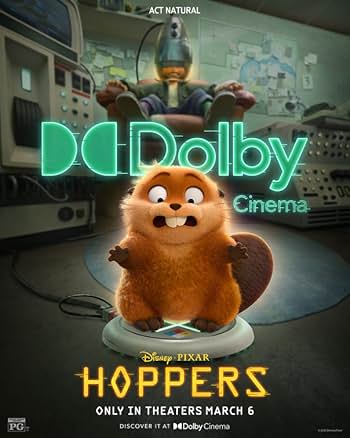

“Hoppers” (2026) follows Mabel Tanaka (Piper Curda) as she tries to stop Mayor Jerry Generazzo (Jon Hamm) from paving over a glade. Mabel’s professor, Dr. Samantha Fairfax or Dr. Sam (Kathy Najimy), figured out how to put a human being’s mind into an animal robot. The robot is so convincing that other animals believe that the robot is one of them. It also enables the human to understand what animals are saying and speak their language. Mabel uses the robot to mobilize the animals into fighting back, but things get out of hand. Will Mabel figure out healthier ways to channel her energy, communicate and achieve her goal? It is a cute, successful feature debut for director Daniel Chong and writer Jesse Andrews, but their next movie should explore the root of a character’s anger instead of only exploring the way that it manifests in the world.
“Hoppers” begins with Mabel as a child (Lila Liu). Her personality is firmly established. She cares for animals because she innately believes that human interaction is fundamentally harmful and wants them to be free but is oblivious to the way that her actions are also dangerous. When older people try to stop her, she reads their interference as a continuation, not a reasonable intervention against, her exacerbating the harm. She will do anything to stop them which makes her quite indomitable. She can evade, outrace and plow through anything. The movie’s goal is to reveal to her how she is also a human being causing harm, other human beings may have good intentions but are harmful yet deserving of the same good will that she directs at animals, and to not conflate her mind with how the animals feel and what they need.
“Hoppers” hints at, but never directly tackles why she relates more to animals than people and why she is angry, the origin that bore all conflict. This omission will not be a dealbreaker. People are angry and not making the anger specific will probably help people empathize with the character more, but if the story feels as if it does not have a self-propelling momentum, and that it drags a bit as it tries to find a way to climax and resolve this conflict, it is because the central emotion, anger, is never explored and resolved. She has an antidote, the glade’s peacefulness, which gets conflated and tangled up with other powerful emotions that I will not reveal because it would be a spoiler, but is quite moving. The filmmakers engage in a bit of a shell game when they invest in saving the antidote, not getting to the source of Mabel’s anger. If they had, then the story would be stronger.
What is the source of Mabel’s anger, the Rosebud of “Hoppers?” People relate to animals’ smallness and helplessness, lack of autonomy. If they can save the animal, then it is an unconscious way of saving and protecting themselves when no one did this for them as a child or whenever the person felt small or helpless. Mabel was a neglected child, and her first adult choice involves caring for a then helpless human being, which reflects this subconscious motivating factor. Mabel also casually remarks that her parents never taught her anything. Only her mom, not her father, briefly appears on screen, and there are no specific references to her father. Mabel’s mom is usually depicted in transit and in her first appearance, she is going to work so this story is left in the margins, but it is critical. It also partially explains the logic behind the story arc for Mayor Jerry, and why he is never treated as a real villain though he should be.
Instead, the filmmakers understandably stick to safer themes: adorable animals and an environmentalist message. It is a kids’ movie after all. The Emmy nominated Chong has a history of working in animation, and he came up with the storyline. Andrews started his writing career with “Me and Earl and the Dying Girl” (2015) and he did a couple more projects before switching to animation. Sometimes a filmmaker will spend their entire life revisiting an idea before they are able to face and address it without deflecting. Chong should do this because he has so much potential to make a powerful movie. “Hoppers” will probably be a commercial success. He is already doing great, but few people have the power to pair the commercial with art. Everyone is angry, and if he can confront the comprehensive emotion of his story, his movies could take a step towards healing the world. Some filmmakers probably do not even know what they are avoiding. Chong feels as if he is not there yet. It took Pedro Almodóvar forever before he could face a mother’s lack of acceptance of her son’s full self or a nation’s most recent original sin.
“Hoppers” is mostly committed to showing the world through Mabel’s point of view though it occasionally shifts to Jerry’s. If you are still in shock at the idea of the environmentalist message being the comparatively safe storyline, it still borrows the normal beats of other movies. The die-hard environmentalists, insects, specifically maniacal monarch butterflies, are still depicted as actually dangerous and pose a threat to people and animals. I actually hate insects. They are completely alien to human beings because they do not have features or communication styles that we can relate to. This story avoids villainizing any person, including Jerry, who does some reprehensible things, but his motivation and lack of empathy are underwritten. He otherwise is depicted as a person who likes his constituents and sincerely believes that he is serving them, but people do not hurt animals without being somewhat broken inside in a fundamentally dangerous way. Onscreen, he actually shares many positive traits with King George (Bobby Moynihan), Mabel’s beaver friend and King of the Mammals who is depicted as the best leader. Just like it is easy to kill bugs, it is easy to villainize them so while the creative choice makes for some solid sci fi and humorous moments, it is also a cop out antithetical to the lessons that the movie tries to instill in empathizing with the enemy.
Within the text, “Hoppers” admits to its contradictions but does not wrestle with them. Most of the animals are not individuated or have story arcs other than being cute or getting a handful of adorable moments. To be fair, Mabel’s tunnel vision could be attributed to this story’s feature because she regularly seems immune to noticing anything or anyone around her. People seem to know and like her. She wants things from people and animals instead of transparently communicating with them as equals, which is her desire. The film constantly references “Avatar” (2009) but wisely skewers the savior complex that movie touts. Instead, it models the antidote to anger and the way to communicate not through deception, but coexisting, parallel play. Think of all the times that you are just vibing next to an animal, and you know exactly how they feel, and they know you. You can communicate with animals and people without being like them.
“Hoppers” is no “GOAT” (2026), the animated kids movie to beat. “Hoppers” often can feel as if it is running the clock with exciting beats while giving short shrift to storylines that may have advanced the story’s emotional center and still appeal to kids. For adults, it could be a struggle to stay invested during the times when it makes a convincing sci-fi apocalyptic plot even though it is a solid movie, but skimming the surface of emotions is more for the adults behind the camera, not the kids in the seats. The best movie for kids treats their emotional world as if it was as serious as a heart attack. Kids go through shit, and the more tools that they have to understand life, the better.