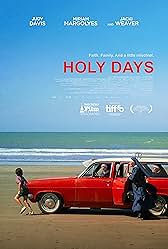

Set around Christmas break in 1974 New Zealand, “Holy Days” (2026) takes a motherless boy, Brian Collins (Elijah Tamati), and three nuns, Sister Agnes (Judy Davis), Sister Mary Clare (Jacki Weaver) and Sister Luke (Miriam Margoyles), and puts them on a road trip to the South Island to retrieve the deed to the convent so they can save the convent from Bishop Chaytor (John Bach) and a greedy property developer. Because of the amazing cast, the location and the subconscious association with Taika Waititi’s story style of intergeneration, inter-ethnic relationships, it is easy to think that you are in for a good time, but you would be wrong. Leaning on the mistaken assumption that gross out humor, frenzied nonsensical activities and juvenile antics are innately amusing if nuns do it, it makes for a puzzling, frustrating viewing experience that feels more targeted for people who will take their laughs and heartwarming moments anyway that they can get it.
It has been a year since Brian’s mom died, and Brian does not appreciate that his dad, Joe (Craig Hall), already has a fiancé, Liz (Nat Boltt, who also directed and cowrote with Joy Cowley and was great in “Demonic”). Um, one year is not long, especially since Brian has four siblings, which includes a child in a highchair. It is the first of many creative choices that do not land the way that she intended. If you perform a miracle and make a movie, you can do whatever you want, but some of those choices make the story harder to enjoy as intended though Brian being mean to his father instead of Liz would make more sense, but he is a kid, and Boltt wants to play in front of and behind the camera. His siblings do not get a line or interact with Brian. It is such a noticeable oddity that they almost feel like props. Of course, Liz is a good egg, which becomes apparent late, after the fifty-minute mark, in “Holy Days,” but resolving Brian’s mommy issues is as much about accepting Liz as mourning his mother. Liz and Brian could bond over having to wear bad wigs!
The nuns are underwritten. Sister Luke has a bawdy sense of humor and is constantly getting into messes, which leaves everyone surrounding her in peals of laughter. She has a form of dementia so it may make you feel queasy as if she is the butt of the joke. Prepare for her teeth to fall out of her mouth repeatedly, fart jokes, covering her arms in fish guts and spitting out food. If you are easily repulsed, she becomes the equivalent of a jump scare. Sister Agnes adheres closest to the expectation of a nun with a dry sense of humor. Only Sister Mary Clare gets a backstory. The actors imbue the characters with more substance and personality than what is on the page, but there is never anything about them that feels memorable. It was a bit disappointing that the only things that made them seem like nuns was the habits and crosses. Oh, and a lip syncing, dance sequence to a gospel song. No, thanks. We have the “Sister Act” franchise.
“Holy Days” bends itself in pretzels to offer a plausible reason for the road trip to the South Island. They try to call a former nun turned lawyer, Patricia (Tanea Heke), who appears indigenous and has the deed, but why does she have it instead of the convent? They try to call her, but she does not answer so naturally they decide to travel for two days instead. When they visit her, she is home. Lucky them! Boltt and Cowley could have reached the same destination if the trip’s goal was to visit a place sacred to Brian’s mother, who was indigenous and lived at the convent as a child when it was an orphanage.
Brian’s tie to his mother is his only tie to his Maori heritage considering his only living parent is Pakena as are most of the other characters. The neighborhood is depicted as diverse and harmonious, but the indigenous characters are mostly in the background. The Maori storyline is the most spiritual that the film gets, but as a living, breathing people with a community in and outside of mainstream society, that element is lacking though Brian does a mini-haka. One way for Liz to be made into a rehabilitated character was to reflect that she was helping his father make a conscious effort to keep Brian and his siblings in touch with that aspect of their life. Instead, Maori heritage is a destination, not a way of life. To be fair, the nuns seem similarly divorced from any visceral spirituality in terms of their faith except for platitudes, and the filmmakers probably had more experience with Catholicism.
Instead, “Holy Days” becomes a story about going to Patricia and back to the convent before the developers come. The question of whether they will get back in time to stop the developer is a way to increase the tension. So that ruins Brian’s poignant storyline of spiritually reconnecting with his mother and turns it into an obstacle for the nuns, which diminishes the intended emotional power of the wintry scene. It is the least silly detour, and honestly most of the detours seem like insults to the nuns’ intelligence. These comedic moments get aggravating, not amusing, such as not understanding that cars need gas before the gauge shows that the tank is empty.
“Holy Days” end up diluting the story’s strength because it correctly wants to highlight how the Catholic Church does not treat nuns with enough respect but also wants Brian to be central though he is easy to forget for huge swaths of the film. It also raises issues that potentially allude to real life tragedies that are brushed over or free of any conflict. We now know that many Catholic orphanages were actually Magdalene laundries which abused girls and women then trafficked their offspring for profit. Was Brian’s mother one of the stolen children that New Zealand stole from their families and put in institutions? No, instead, Sister Agnes gets a similar grievance.
So Boltt and Cowley (unintentionally) generalize a problem and create a fiction that whitewashes colonist practices that existed in the Seventies; thus, erasing a country’s original sin of genocide. Potentially the heroes of the film are culprits while being depicted as the victims of human trafficking and saviors of children. I do not know enough about the history of the area. If the convent was just depicted as a residence for neighborly nuns, especially since no other children are present, it would not have occurred to me, to even think of broader issues, but the minute the characters mentioned that the convent was an orphanage, all the red flags got triggered. The idea that Brian sees them as family becomes more disturbing if you are remotely knowledgeable about history, especially given discoveries in Canada and the US of indigenous children were given improper burials at residential schools, which has not been uncovered in New Zealand.
There was one unexpected, unadvertised delight that worked. Jonny Burgh was consistently and genuinely hilarious in “Holy Days” as Father Findlay, the self-interested, chain smoking, gambling parish priest. He takes the nuns for granted and treats them as if he is their ungrateful husband. They steal his car for the road trip, and his reaction elicited the only authentic and hearty laugh. Other characters laugh a lot as if they are having a great time, and to their credit, it does not seem forced, but it will remind you of advertisements that show women sharing a laugh over a salad wearing white on a sunny day when nothing humorous is happening.
“Holy Days” is the kind of movie that has enough solid content for a great trailer, but the actual movie never unfolds effortlessly but feels forced despite the ensemble’s cast’s best efforts. Boltt and Cowley need to watch more movies and at least imitate them because visually Boltt’s efforts seemed promising, but even with an oneiric, snow globe theme, the execution is insufficient to ignore the story’s flaws.