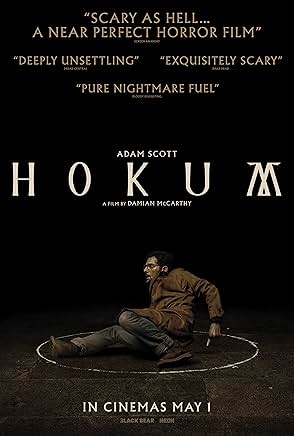

If you do not know French, “Hokum” (2026) will be a delightful surprise reminiscent of Stephen King’s work (“1432,” “The Shining”) combined with quotidian horror grounded in today’s statistics about common ways that people die. Ohm Bauman (Adam Scott, who resembles David Tennant here), a popular author of a book series, “The Conquistador trilogy,” takes a break from finishing his latest bleak tale to scatter his parents’ ashes in Bilberry Woods, Ireland around Halloween. The hotel workers immediately regale him with stories about a witch, cailleach in Irish, which he dismisses as hokum, which means nonsense to evoke an emotional response. When one of the workers goes missing, he decides to search the honeymoon suite for that person and has his own brush with the abnormal and supernatural. Will Ohm find a way to not have his own bleak ending and emerge with renewed hope for the future? Though not as scary as it seems and more heartwarming than expected, Damian Mc Carthy’s junior feature film is thoroughly absorbing, hilarious and entertaining.
If Mc Carthy’s name does not sound familiar, it hopefully will. He is a solid storyteller and made “Oddity” (2024). To make “Hokum” more marketable instead of just trying to make a foreign film appeal to Americans, casting decided to give the protagonist role to Scott; thus, tricking Americans into watching a diluted Irish folklore horror story. It is nice to live in a world where Scott is considered bankable and able to translate his television series success (“Parks and Recreations” and “Severance”) into a long overdue starring role. Scott’s dry sense of humor saves a thoroughly unlikable character who initially seems refreshingly frank and grounded in a strange environment, but Mc Carthy uses one bar scene with bell hop Alby (Will O’Connell) to emphasize that Ohm is not just a refreshing, tell-it-like-it-is outsider, but a man with a cruel streak whose behavior is not amusing and should not be dismissed. He does manage to hit it off with local nomad Jerry (David Wilmot) and bartender Fiona (Florence Ordesh) despite their belief in the supernatural.
Other notable locals are the hotel owner, Cob (Brendan Conroy), who enjoys frightening people with his tales of a witch that drags people to the underworld in chains that I regret not listening to more closely. He decorates the center of the hotel lobby with a work of art that depicts his sunny tale. He locks the elevator and keeps the honeymoon suite off limits because he believes the witch is in there. Cob’s son in law, Mal (Peter Coonan), is an affable sort who mans the front desk and is friendly with the guests. Fergal (Michael Patric) solves all problems with violence such as killing the nuisance goats. The inn has these immense pots that has goat heads decorating the top, but that is as far as the theme goes. Do not expect any Satan here. It is a misdirect from the main point, which is Ohm’s character development.
Let’s briefly examine the protagonist’s name. Ohm means resistance and is a unit measuring how conductive a material is to an electronic current. (McCarthy was an electrician.) Ohm enjoys challenging people and defying the norms of polite society. He also uses light to dispel his superstition that someone is lurking in the shadows. Bauman feels like a reference to L. Frank Baum, the author of “The Wonderful Wizard of Oz” (1900), but it does mean a person who lives in a tree in Middle High or Old German, which ties in nicely to Ohm looking for the tree from the photograph of his mom next to a big redwood, but trees are also passages for fairies though normally fairies are associated with hawthorn trees. His father is never shown and based on how Ohm acts, it feels as if he may be the spitting image of his father, at least spiritually, based on the way that he described him and his relationship to alcohol. Because he hates his father, he is not too big of a fan of himself. So, the journey is not just about finally giving peace and a resting place to his parents, but to him.
The Conquistador story feels like Ohm took the role of his father to punish the child version of himself, and this movie is his way of coming to terms with his past trauma using present trauma. Ohm’s journey feels very salmon like with a fish returning to the stream where he was conceived though not to reproduce a literal child, but a story. “Hokum” is really a tale about how present violence helps Ohm come to terms with the past and functions as a credible witness to something that would otherwise go undetected. Now, it does fit into an uncomfortable trope of women’s trauma being used to develop a male character on multiple levels. The missing character acts as a surrogate to the past figure and constantly saves him normally and supernaturally; thus, converting Ohm into a believer and instilling hope in Ohm. It is disappointing that it felt as if Mc Carthy was going to draw a link between Ohm’s parents implicitly conceiving him in the witch’s domain and a throwaway line about a bride locking herself in the room. It has “A Prayer for Owen Meany” vibe but does not amount to anything obvious. Please reach out if you believe otherwise.
If you are looking for deeper mythology surrounding the witch, prepare to be disappointed unless you come to “Hokum” forearmed with mythology. Cailleach, which means veiled one, Bhéara is linked to horned animals and is considered a winter goddess so not a witch in the contemporary Western meaning of the word; however, she is a triple goddess: a maiden (new beginnings), a mother (fertility and creation) and the crone (wisdom and transformation). Technically three characters combined fulfill this function, but it also could be a reach. The hotel was celebrating Halloween, which is related to Samhain, a Gaelic festival marking the end of the harvest and the beginning of winter. It is also a time when the Otherworld is open, which can be reached through a burial passageway, but the realm is usually characterized as a paradise, not hell. Dead relatives’ souls would visit for a meal. Bonfires were used to imitate the sun and were intended to have a purifying effect. The use of hanging objects only occurs indoors, not outdoors near a tree, which does not seem rooted in Irish folklore.
Even if the mythology may not be at its zenith considering the location, “Hokum” is still a well-crafted story that weaves together the past, present, oneiric truth and analogue horror. Scott proves that his cameo in “The Monkey” (2025) was not a fluke, but a sign that he has a home in horror. Mc Carthy is becoming a reliable must-see horror filmmaker, and I need to get around to watching “Caveat” (2020), his first feature.