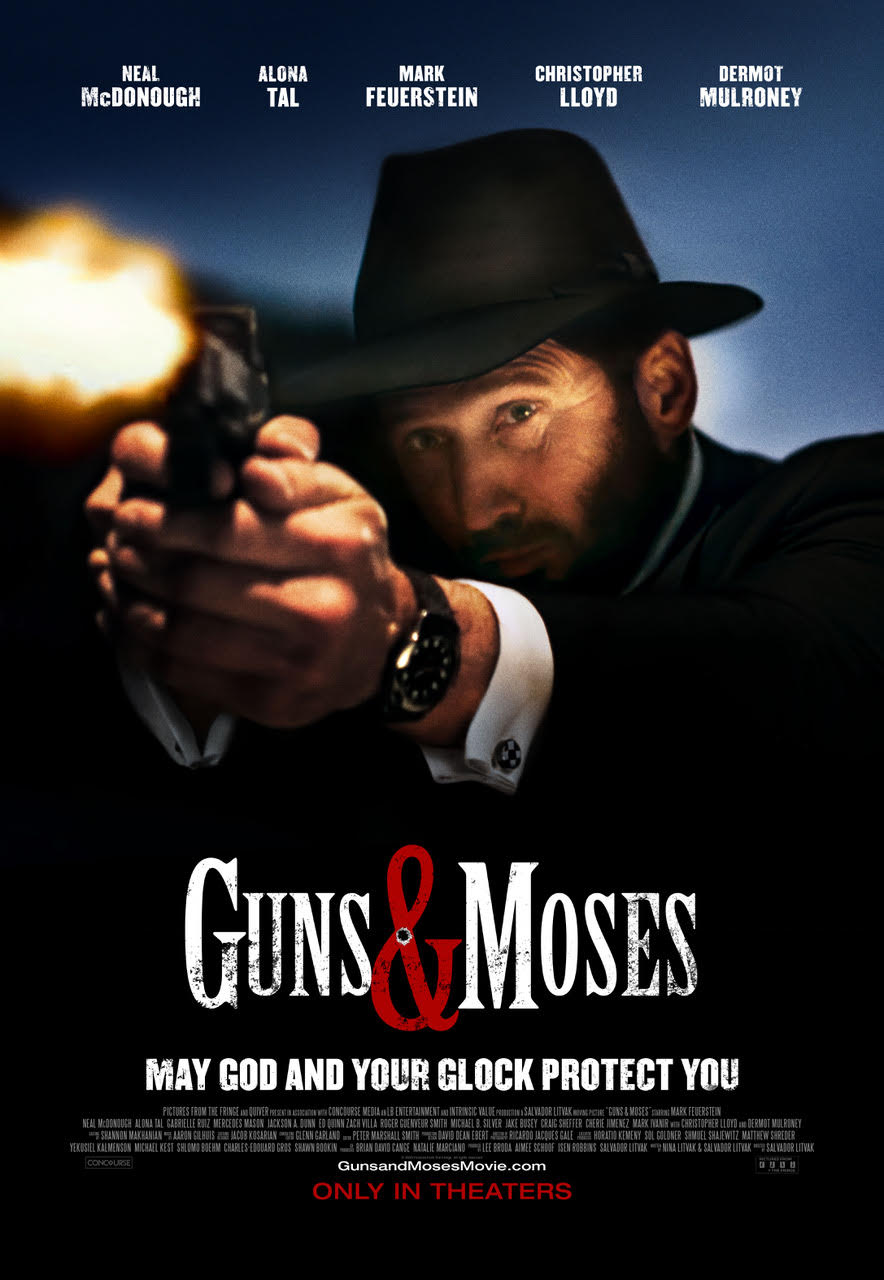

“Guns & Moses” (2025) won’t be a blast for moviegoers looking for a Jewish vigilante who takes out the white nationalist hate group that allegedly attacked his congregation. Set in High Desert, California, with his store-front congregation reeling after an attack during the Jewish Center Annual Gala, Hasidic Rabbi Mo Zaltzman (Mark Feuerstein) plays detective to find out the real perpetrator but ends up in the murderer’s crosshairs. To protect himself and his family, he and his wife, Hindy (Alona Tal), hit the gun range under the tutelage of their head of security, Brenda Navarro (Gabrielle Ruiz). With five children and only a desire for the truth, not revenge, did God make the Zaltzmans for a time such as this?
Feuerstein plays against type as an unassuming, meek and awkward family man unaccustomed to being in the spotlight and hobnobbing with the rich and famous. He nails the delivery of the inspirational moments, but when it is time to get his hands dirty, after a few missteps, he gets a little too smooth, too quickly considering how little action the Rabbi engages in. You will have to wait for almost one hour to get Mo to the movie poster’s coolest shot and notice that the black fedora works just as well as a cowboy hat. The story is more interested in treating him more like an unconventional detective investigating everyone and ministering to the chief suspect, Clay Gibbons (Jackson A. Dunn), and his attempts to cultivate a spiritual human connection with the troubled, misguided youth. If this film was a Christian produced film (Craig Sheffer, a regular player in “The Mark” franchise, appears), and the rabbi was a preacher, it would be Jesus proselytizing time, but the Rabbi is only interested in turning Clay away from a life of hate, not baptism into his faith. The Rabbi is on his own journey to gain self-confidence.
If the Rabbi was not a grown man with five kids, it would be a coming-of-age story. It feels more like a CBS television series crime procedural with a Rabbi and his family taking the lead instead of the cops, and that format would be a better forum for such a sprawling cast of supporting characters in the Rabbi’s life. As a movie, the family’s role feels essential but rushed. The kids actually were adorable. There is also a point where everything goes a bit haywire and to raise tension, the kids are in danger but hustled out of it unceremoniously. Instead of taking a side, “Guns & Moses” hedged their bets, which led to another way where the film felt like an unfulfilled promise. If kids are going to be a part of the action, commit or do not do it at all. Parents who cannot bear watching kids in jeopardy, consider yourself warned.
If you are familiar with the cast’s work outside of “Guns & Moses” or just the CW, you will know immediately who did it and find the film unbearably slow. “Guns & Moses” takes its precious time finding the murderer. It could be the victim’s wife, Liat (Mercedes Mason), the victim’s brother and business associate, Jeff (Michael B. Silver), the victim’s stepson, Koby (Massi Prehoni), or an environmental activist, Sid Barofsky (Paulo Costanzo). Once the culprit is discovered, it allows one of the prior suspects with an impressive combat resume to take center stage, and it was too late to add any momentum to the story. If that person had been cleared earlier, that person probably would have made a better partner than Navarro. I love a badass woman, but Ruiz was a bit too wooden so Navarro had zero camaraderie with the Rabbi though Ruiz was perfect in the initial faceoff flashback with Clay. The two roles could have been conflated so the former suspect’s role could have expanded, but the film seemed to think that the more suspects, the merrier. That character would have outshone the Rabbi and possibly made a better protagonist. Also, it could have been an excuse to throw in a line about terrorism and Israel, which is a mystery left hanging within the story.
One message that can be derived from watching “Guns & Moses” is that Nazis need to set aside their anti-Semitism and stand alongside those they hate to unite and defend their respective communities against corruption in the highest sectors of society. While it is a theoretically laudable campaign for a spiritual leader to stop hate through compassion, which leads to destroying bias on either side, it is a little disturbing because it leads to a whiff of false equivalency between neo-Nazis’ irrational religious prejudice and a Jewish community understandably prejudging supremacists who have an explicit agenda to destroy them. Everyone loves a redemption story but given the historical (the Haavara Agreement) and present-day context of people in power using Shakespearean era anti-Semitic language while claiming to fight anti-Semitism should make anyone a little leery of such alliances as being inauthentic and a Trojan horse. Only God knows the hearts of men, and whether they can change so while optimism and hope are great, it would be dangerous to let someone have your back who keeps trying to stab you in it. The team up should have led to a tantalizing, unexpected pairing that should have made for an exciting denouement but unfolded like an afterthought.
The 2019 synagogue shooting in Poway, California on the last day of Passover, which resulted in the death of one person and injury of three others, inspired married filmmakers, cowriter Nina and cowriter/director Salvador Litvak, to make “Guns & Moses.” You would not know it while watching the movie, but once you do, the movie feels retroactively exploitive. To honor the congregation, they should be centered, not used as a backdrop to tell a standard gumshoe detective story. With a title that plays on the name of a rock group, Guns N’ Roses, the dissonant, but provocative combination of the sacred and profane is perhaps too cavalier a title for such a serious origin story and could be a turn off for the very audience that the Litvaks are trying to court. The marketing targets people who are looking for the next revenge neo-Western flick and want to watch a bunch of Nazis get mowed down like in “Inglorious Basterds” (2009), and this ain’t that. When word of mouth gets out about the actual on-screen story, the ticket sales are going to plummet, and the film will get panned. It should have been marketed differently or at least had less of a catchy title if it was trying to be more somber. To attract devout audiences who prefer to derive a positive lesson more than seeing a sanguine revenge story, the Litvaks should have taken a different approach with the title and centered the victim as a human being as much if not more than the Rabbi. The impact of that person’s death is too light.
Unless moviegoers go into “Guns & Moses” knowing the true inspiration behind the story and the film’s takeaway lesson, to encourage Jewish people to learn defensive handgun training, this movie has a long shot in achieving lasting appeal with audiences. The director’s unexpected, non sequitur post-credit appearance functions as a last-minute gambit to tie the movie into the events that took place on October 7, 2023 at the Gaza envelope in Israel. Again, it may be a sincere reference, but it feels exploitive and will likely further alienate audiences who would not have associated the film without that scene. Again, if the historical event was organically blended into the narrative, then it would be germane, but if a filmmaker must tell audiences what they should intuit from watching the movie, then it is as much of a personal failure for the filmmakers as Christopher Nolan’s attempt to depict three different passages of time in “Dunkirk” (2017) regardless of the overall quality of the project or the audiences’ reception of it. Even if an overall audience does not get what the filmmaker is going for, at least one moviegoer who did not contribute to the film and walked into the theater like a blank slate should.
“Guns & Moses” is a great concept but should have embraced its pulpy detective premise more, still could retain a message of unity and setting aside the politics of hate. It is almost as if the film is unaware of the initial impression that it makes. If the Litvaks do not want to adhere to the action beats of the genre that they chose, a neo-Western which demands graphic violence, instead of overstuffing a movie and giving insufficient action, they should take a stab at a weekly hour-long crime commercial procedural television series on a major network. Then they could achieve those goals. With that said, there is plenty of graphic content in the Torah (Genesis, Exodus, Leviticus, Numbers, which is rife with great movie ideas, and Deuteronomy) so the reservations could be tossed. If they want to get political on the national or international stage, they need to learn how to stop being coy with the bait-and-switch and actually find nuanced ways to tie it into the on-screen story just as they did with Christopher Lloyd’s brief, but memorable appearance as a Holocaust survivor. If they put their money where their mouth is, instead of talking on both sides of it, sure it would lose broad appeal, but then their target audience will find them. It is better to be yourself for a few than fail among many doling out half-measures.