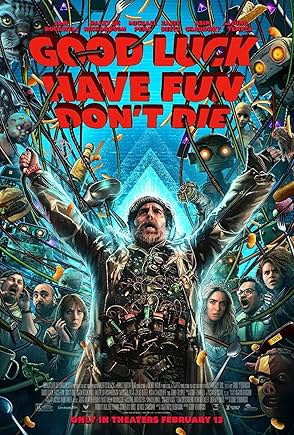

“Good Luck, Have Fun, Don’t Die” (2025) follows a group of eight people who are trying to save the world from AI in the near future. The Man From the Future (Sam Rockwell) recruits seven patrons from Norm’s, a diner chain in California, and they go on a perilous journey to upload a device. The Man has tried this numerous times and is trying to find the right combination of people that will work. Did he make the right choice tonight?
Hurrah, finally, Rockwell does not play a racist character! Rockwell is a charismatic showman who is a natural in front of the camera, and as The Man, even though he looks like a delusional, dangerous man, he carries enough authority to sound credible. He has a theatrical flair with a standup’s timing appropriate for the cinema. It is a rare gift for an actor, so it is a relief to not have a filmmaker weaponize it to transform a toxic character into a relatable everyman. The Man is like a general drafting a hodge podge of troops, and he gets some of the best lines. “Good Luck, Have Fun, Don’t Die” is a hard movie to anchor because the narrative rhythm shifts in an unpredictable way as it fleshes out the supporting characters.
The seven recruits’ screentime vary wildly. Marie (Georgia Goodman), Boy Scout leader, Bob (Daniel Barnett), and vocal Scott (Asim Chaudhry) are the ones who spice up the proceedings but are not central to the plot. Initially it seems as if it is going to alternate between the present and the past of each recruit, but writer Matthew Robinson saves that for the recruits who have famous actors playing them. It would have been nice to get more spotlight for at least one less recognizable character, especially since the present does drag a tad until it reaches the bonkers finale, but it also kept the plot from going stale.
Mark (Michael Peña) and Janet (Zazie Beetz) play high school teachers with relationship issues. They are both uptight, cowed and soft-spoken, which makes them unlikely to be successful and stop the end of the world from happening. Their flashback reveals some of the origins of the obstacles that they will face in the present timeline, specifically zombies or cell phone hypnotized teenagers. If “Good Luck, Have Fun, Don’t Die” has a bit of a mean streak, it is directed at kids being inherently hazardous to the adults in their life for their attraction to technology and how it makes them emotionless and detached from reality. It feels like a Boomer-esque take, especially since they are using tools that their parents give them to facilitate parenting, yet they get the blame as if they are the cause of the end of the world. The Gen Z stare finally made it into the movies! Peña and Beetz are cast against type and are functional, but not memorable as stand out performances.
Juno Temple as a Susan, a mother of a high schooler, gets the strongest flashback that takes the emotional temperature of the world that The Man is visiting. Her segment reveals that it is possible that The Man is wrong, and the world already ended. It is a “Black Mirror”-esque image of what is already happening with people coping in soul killing ways to unimaginable, unnatural horrors with a pristine, slick sheen. Temple is always a disconcerting, unsettling presence in movies (compliment), and “Good Luck, Have Fun, Don’t Die” is wise to know how to use her talents. Dino Fetscher as Blaise, a man who walks her through how to cope with these hazards, is a bright, shiny dystopian genius and is worth the price of admission. Though it would be an abomination and against everything that the movie believes in, if Blaise had a TikTok channel, it would be lit. It felt as if this segment could have been the whole film with a new twist on the Stepford Wife storyline.
Ingrid (Haley Lu Richardson) has the most relatively normal and relatable flashback. She works as a princess at birthday parties for little girls. Sorry guys and theys, the future is still gender normative. She finds love, but like many romantic partners, her partner stops reciprocating her poignant bids for connection to play video games. Sounds pathetic when it boils down to a phrase. She hates technology for a variety of reasons and evokes the best potential for humanity to recover because she possesses the ability to have authentic relationships and a technology free existence. While her storyline is predictable, it is also the story’s emotional core and the key to saving the world. Richardson is a great actor in the way that she brings a no nonsense vulnerability to her roles. See “Columbus” (2017).
Technology is not innately bad. The film exaggerates how it is affecting human relationships and is more aligned with the “Terminator” and “The Matrix” franchises than a rigorous, textured depiction of how it has potential to bring people together for dissemination of knowledge and maintaining connections despite distance and other practical barriers like language differences. “Good Luck, Have Fun, Don’t Die” correctly derides technology as a substitute for reality or disconnection from their surroundings and others. It is a constant gag in the movie which crescendos in the second to last denouement.
Director Gore Verbinski’s realization of Robinson’s story is a smidge derivative during the present-day sequences. While he has been a suitable steward for popcorn flicks, he is not an innovator. His gift is finding the right combos of already existing visual standards to make it more mainstream, which he accomplishes with great aplomb that then makes it almost seem original because of his ability to remix. It feels like a combo of Terry Gilliam, the aforementioned sci-fi franchises, which may be why it has some momentum issues, and “Toy Story” (1995). There is a self-indulgent scene with a twist on the horseman of the apocalypse as a cat hydra creature. The overall aesthetic of the cell phone mind control is evocative of cosmic horror great such as Panos Cosmatos or such mind-blowing films as “The Void” (2017), but it never terrifies, which is why it stays firmly sci-fi. The idea that the smartest human being in the universe is a mash up of child Buddhist monk imagery and basement dwelling kid who has never seen the sun a day in his life in a “The Truman Show” self-aware setup.
“Good Luck, Have Fun, Don’t Die” may be the kind of movie best viewed in a crowd at a theater. I had a screener at home and found myself a bit checked out as the story meandered to get to its destination. Without the ensemble cast’s enthusiasm and commitment, it is challenging not to ask why the characters are not just doing the objective instead of talking about it to run the clock. Every movie does not have to be two hours, and this film needlessly exceeds it. For deriding screen culture, it often feels like a video game in the way that the group traverse the landscape and navigate hazards instead of facing stakes that feel real. It sticks the landing because of its heart without being saccharine or simplistic.