
I received an invitation to attend a screening of “Good Fortune” (2025) or “Black Phone 2” (2025) held on the same evening. I wanted to see both movies, but which would win: my love of Keanu Reeves or horror and completist tendencies? I decided that it was better to pay to see a horror movie featuring a fictional pedophile, child murderer than someone alleged to commit sexual misconduct in 2018. As expected, all the handwringing over what would happen to people’s problematic fave was for naught because no one gets cancelled, and here was more proof. Aziz Ansari writes and directs his first feature film, and while he is no Adam McKay (“The Big Short,” “Vice”), “Good Fortune” is far better than the unabashed imitation, “Dumb Money” (2023), without relying on a bestselling nonfiction book to lean on. Oh, and more importantly, it is laugh out loud funny. Will Ansari’s return to the spotlight be a success or will the box office treat him like a “Tron” sequel?
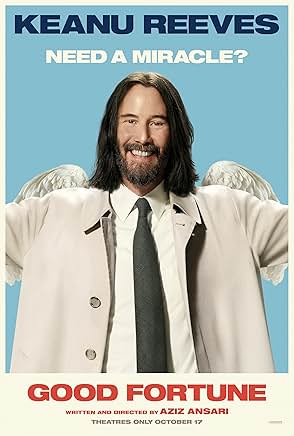
When Gabriel (Reeves), the angel of driving and texting, wants a promotion, he decides to save Arj Ibrahim (Ansari), a guy whose lucky break in getting a job with venture capitalist, Jeff (Seth Rogen) exacerbates his financial situation. Gabriel switches their lives expecting that Arj will recognize how wonderful his life is, but Arj would rather keep Jeff’s. Gabriel gets demoted to being a human until he can get Arj to change his mind and heart. Meanwhile Jeff discovers that all his prior success was not based in merit when he cannot strike it rich in Arj’s life. Each of the three represent a spectrum of human experience proving that no man or celestial being can succeed or remain unafraid in the face of the gig economy. Only Elena (Keke Palmer) finds a way to live her life and fight for a better world.
Reeves is a universally beloved actor, and he does not even have to be physically in a movie to make it a success. Remember when he was the voice of a cat in “Keanu” (2016)? Reeves has played many foul men in films such as “The Neon Demon” (2016), “Knock Knock” (2015), “The Watcher” (2000) and “Much Ado About Nothing” (1993), but because we love him, it is easier to brush those memories aside. He is still acting as Gabriel, an innocent, sweet angel who really does not quite get the human condition at the beginning of “Good Fortune.” He is lucky that his little bit of a pride did not result in a bigger tumble. Gabriel is styled like another famous Reeves role, Constantine, with a more magnetic spin on Cas’ cluelessness in “Supernatural.” As the movie unfolds, Gabriel inches closer to Constantine as he becomes addicted to cigarettes after trying to survive as a human being and realizing that the deck is stacked against anyone who does not come from generational wealth. Gabriel’s scenes with Felipe (Felipe Garcia Martinez) were so good that for a second, I expected that the big twist was that Felipe is God, but no. Through Felipe, Gabriel learns about the value of his heavenly vocation. Reeves’ legendary looks get interwoven into the plot with much too short appearances from Sherry Cola (love her and that statement necklace) and Lakshmi Sundaram, who plays a nurse, in her first film appearance.
As an actor, Ansari is better at being rich in snark than beleaguered and humble. The chemistry with Palmer, who was listed as part of Ansari’s original debut project, “Being Mortal,” that had to be scrapped because of Bill Murray’s alleged sexual harassment on set, was more like friends than anything more. As a writer, he takes the characters to the brink of quotidian, financial oblivion, and unlike most movies, he pulls no punches. Everyone in “Good Fortune” is working hard at multiple jobs and are still at risk of losing what little they have. The theater for the screening was packed, and the reception was rapt. It is hard to paint an accurate picture of the bleak economic state of affairs in this nation without being a Debbie Downer, but Ansari does it. It is not one of those comedies that is leaning on the genre but is really a drama. It is definitely better in a theater where laughing with your fellow movie goers makes it even funnier. If he does pull punches, it is because Arj still has a parent, Saleem (Shoukath Ansari, his real-life dad), who loves him unconditionally and could probably offer some type of lifeline.
As Rogen did in “Dumb Money.” Rogen makes the best affable rich man. Like Palmer, Rogen was also in the cast for “Being Mortal” and ended his offscreen friendship and professional collaboration with James Franco, which lasted from 1999 to 2018 over Franco’s alleged sexual misconduct. Jeff is not the kind of rich guy who wants to tear the wings off flies but is clueless regarding how privileged he is. His best quality is understanding the lesson. When it is Jeff’s turn to be down and out, Rogen is better than Ansari at depicting the struggle. As a director, Ansari prefers to rely on the editing to show the differences in lifestyles of both men. Before the end of “Good Fortune,” it does become a bit of a buddy comedy with all three getting to hang out with each other on the human plane. They have chemistry to spare, and Rogen was probably the strongest asset in making that work.
The message is obvious and heavy handed, but without breaking the fourth wall, “Good Fortune” lays out how the gig economy is harmful, unionization is necessary and well-off people need to do more to protect those who make them succeed. The dialogue may be hilarious, but if the quotes are taken out of context, it would fit in perfectly to a documentary about the financial pressures that Americans face. Elena says, “How can I fight a giant corporation when I’m fighting to get by?” The movie uses fictional names for the businesses, but it is obviously skewering companies like Amazon, Task Rabbit, Home Depot and online food ordering services. Even with all the changes, the production team made it look similar enough to the real world that it is impossible not to recognize the branding. No one is going to pay to watch a documentary like “Union” (2024), but a movie may be what changes hearts since no one wants an angel to be scared about how he is going to afford to eat, sleep and live. It seems intentional than even an angel does not do his job to save a Black woman, and it sends everything reeling in heaven and earth. Plus, the only character who never falters from living their life joyously and still fighting for a better world is Elena.
People are making fair comparisons to films like “It’s a Wonderful Life” (1946), “Trading Places” (1983) or even “Freaky Friday” (2003), but it makes an earlier reference to the Biblical story of Lazarus and the Rich Man, which appears in Luke 16. After death, the Rich Man wants the former beggar to give up heaven to save other rich people, including himself, from living in eternal torment. “Good Fortune” is the earthly equivalent with everyone saving each other, striving to make heaven on Earth and attacking the conditions that make it hell. It is a sidesplitting incisive critique of the mistreatment of the masses and a call to the better natures of the haves before the have nots have had enough.