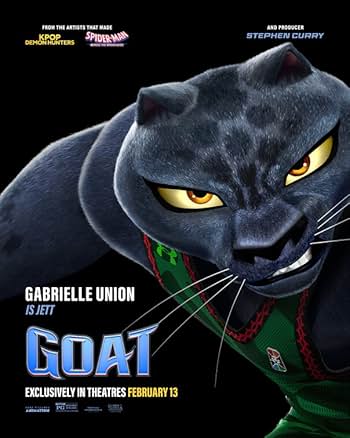

Normally GOAT stands for “Greatest of All Time,” but the title, “GOAT” (2026), additionally refers to the protagonist, Will Harris (Caleb McLaughlin), a little goat with big dreams of playing in the Regionally Organized Animal Roundball league (ROAR) and meeting his hero, Jett Fillmore (Gabrielle Union), a black panther and the real GOAT who plays for Vineland’s Thorns. It is a longshot because ROAR players are the fiercest, largest animals, but Thorns team owner, Florence Everson (Jenifer Lewis), signs him up much to Jett’s displeasure. How will Will change the game? Is it too early to declare “GOAT” the best kids’ movie of the year? Judging from the loud cheers in the audience and tears welling up from some rude person choosing to cut onions in the theater, it does not feel premature.
The actors behind the animated characters make it easy to forget that the screen was showing anthropomorphic animals, not people. McLaughlin is the heart and soul of “GOAT” as the determined goat who is out, but never down despite suffering several bad breaks in life. This movie handles the financial reality of living in poverty and a close community better than most movies. He delivers food for Whiskers Diner, the unofficial fan club of Jett and the Thorns with Carol (Ayesha Curry), the llama owner, as the team’s number one fan. He has two supportive friends, Hannah (Sherry Cola, my all-time fave, recognized her voice immediately), an aardwolf, and Daryl (Eduardo Franco), a capybara, who cheer him on when he doubts his ability to execute his dream and give practical help as well. Frank (the Wayne Knight), a gerbil and Will’s landlord, wants his rent, not a raincheck. When Will catches Florence’s attention, the timing is fortuitous because rock bottom was within reach.
Casting Lewis to play a vain, selfish warthog was brilliant, and though she is only verbally violent, it felt as if she was the natural successor to successful porcines in the kids’ entertainment field. Her fashion sense and unflappability in the face of natural predators made it extra believable that she had the stuff to be a major mogul. Once Will enters this world, “GOAT” shifts from being about Will’s dream and widens to include the fears of his fellow teammates and the hopes of their hometown.
I love cats, and though Jett is fearsome, the comedy and cuteness come whenever she suddenly acts like a housecat whether it is drinking from a pink water bowl and making that cute drinking noise, backing the screen and lifting a leg to clean herself, reacting to getting sprayed with water, making biscuits, purring or listening to meow music. Jett has been in the game since Will was a kid (ha!), but her excellent performance has not resulted in a championship victory. The detailed animation of Jett is gorgeous: the skin of the nose, the shiny fur, the emotive ear movement. Also, during plays, there was a little accent of a roar, not from her, whenever a good move was executed. I did not recognize Union in this role, but in retrospect, that vulnerable and competitive intensity characteristic of her performances makes her the perfect person to voice Jett.
The Thorns’ team is memorable. Lenny Williamson (Stephen Curry) is a giraffe who mentally checked out because of being on so many teams and never advancing, but he still has passion which he redirects elsewhere. Olivia Burke (Nicola Coughlan) is an anxious ostrich who buries her head to get away from social media and all the negativity around her. Archie Everhardt (David Harbour) is a single father rhinoceros who takes care of his twin daughters. Modo Olachenko (Nick Kroll) is an eccentric Komodo dragon with a Slavic accent whose favorite object looks like a Faberge egg, which never hatches so don’t wait for that shoe to drop. If there were three fathers shown taking care of their kids, it would have been a theme. Mothers only appear briefly, and largely are unseen, but their impact is strong. Dennis Miller (Patton Oswalt) is the proboscis monkey coach. The team’s chief nemesis is Mane Attraction (Aaron Pierre), an Andalusian horse and face of the opposing team, Magma.
Jett is a sensitive, complex character because she is not only wounded, but wounding. Her interactions with the public are draining and dispiriting, which makes her feel alone. Her character takes the brunt of public displeasure for the team’s performance, which isolates her, but she brings that outside to the team, which hurts them. She asks for help, but when she receives it, i.e. when Will becomes a team member, she feels threatened and makes his life more difficult. It is a team sport, but she often plays it as if it is not, which makes her more alone because then the team checks out. Her body is aging, and she is running out of time to get validated for her hard work. Will’s role is to break Jett’s pattern, reestablish Jett’s connection with community and her team and embrace the reality of her physical and psychological needs. Will’s dream of playing with the professionals is not solely about finances though that reality is never ignored. The momentum of the story is community and creating it instead of self-aggrandizement. Teamwork makes the dream work, and it takes a village to become champion. One of my personal rules for the workplace is that power is a pipe, not a bank. When power lodges in one place, it is explosive and harmful, but when it is a pipe and flows, it works for everyone. This lesson could be applied in almost every environment.
For most of the creative team behind “GOAT,” it is their first time at the helm of a feature film, and they got nothing but net. Codirectors Tyree Dillihay and Adam Rosette usually work in television or other roles in animated productions, which can be a difficult transition, but their work makes it seem as if they have been directing forever. Chris Tougas’ 2012 book, “Funky Dunks Basketball Beats,” inspired the story, but it does not appear to be in circulation so wise publishers should dust it off and put it back on the shelves with rebranding in sync with the movie. Peter Chiarelli, who wrote “The Proposal” (2009) and “Crazy Rich Asians” (2018), is credited with the story, which likely means that he created the core narrative such as plot, characters and theme and may have done the first draft before the studio went in a different direction. Nicolas Curcio, who mostly has short film or cowriting experience, is given the credit of writing the screen story, which means the person who took the source material and makes it substantively new, but usually is a credit awarded after they proved their contribution. Cowriters Aaron Buchsbaum and Teddy Riley, who only worked as writers previously on a television series, “Fairfax,” likely wrote the final draft that made it onscreen. (Apologies to the Writers Guild of America if I butchered the explanation.)
As someone who does not like sports but did have the basketball brainwashing software installed early in life, I and the audience found the story substantive and supported in the court action. The animation did a great job reflecting the story’s themes visually and in the choreography of the game. Visiting Vineland and other cities with Roarball stadiums did not feel as if it came straight from the human world but was a mix of ecosystem and human. There was lots of lush vegetation while still making the area seem urban and belonging to a certain class. The world building is seamless. The variety of courts were fascinating whether set in a cave, a volcano, a frozen tundra or a jungle like atmosphere. Will’s neighborhood court resembled the NYC neighborhood courts often nicknamed as the asphalt, the blacktop or the cage for the chain link fencing that surrounds the court. It felt very much like home.
Who cares about how I felt? Kids in the audience could not stop baaaaaaing when they left the theater. “GOAT” was such a sweet, moving movie with great music, including a cover and the original “Don’t Dream It’s Over.” It will be a great way to celebrate Valentine’s Day with the whole family. Now that the WNBA is a big deal, Will’s story of admiring and wanting to emulate a woman player is not the fictional part of this story.