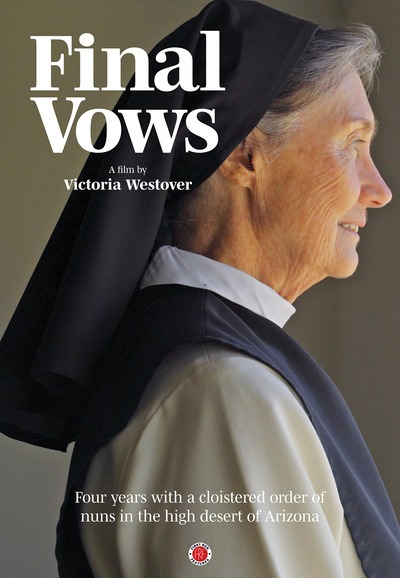

“Final Vows” (2024) is an observational documentary set in Sonoita, Arizona at Santa Rita Abbey, called a monastery even though it is filled with nuns. Director Vicky Westover filmed and interviewed the nuns for four years; thus, capturing their routine. Though one reviewer described them as one of “the most boring documentary characters,” the flip side is that it is one of the most relaxing films that you may ever see and may be as restorative as going away and unplugging for a week. In a dopamine addicted society, this film may be what you need to calm your nervous system.
An observational documentary requires your complete attention so no multitasking and keep your phone far away. “Final Vows” has no narrator and consists of footage taken on the abbey’s grounds to capture the peaceful and active daily routine. Even though the area is described as a desert, it looks lusher and more verdant than expected and inviting with Westover including multiple shots of flowers, trees, walking nuns and the light filled halls, dining room and kitchen. With all the animals coexisting in the shared space, it is impossible not to think of it as a remnant from Garden of Eden. Westover does not identify any of the interviewees unless their name organically comes up in the documentary when people are addressing each other, it appears on table place cards or a tiny plaque mounted on the side door jamb.
Even though the Abbey does not have a lot of sisters, not all of them are interviewed. Sister Victoria, who could be mistaken as related to the actor Katherine Ross, is the elected, self-effacing Mother Superior who oversees everything, including announcing when local wildlife like deer is nearby and running to socialize with them. Disney princesses have nothing on her. Sister Rita, who likens her personal relationship to God as a marriage, functions as the tour guide for Westover and thus the audience. She explains that making and selling altar bread, aka communion wafers, the Body of Christ, finances the Abbey. She rings that alert that their numbers are dwindling so the community is aging without any replacement. Sister Esther is the resident artist playing the piano and discovering her own personal style as a sculptor. Sister Pam, the most recent official black and white photographer, is the tall handywoman who channels the deceased men in her family with creative inspiration on how to maintain the property and receives phone calls from strangers requesting prayer. Sister Hildegard is a newcomer transfer from Kenya via France and Great Britain who was daunted at the prospect of living in the desert but loves her life so much that she cannot help but dance under the trees. Sister Sharon starts in “Final Vows” as a postulant then decides to commit to the community.
Sister Clare, who describes herself as a firebrand, brings up a subtle scene that could almost go unnoticed. The abbey is not just in danger because their numbers are dwindling, but because a proposed Rosemont Mine, which Hudbay Minerals owns, could start open pit mining five miles away, destroy the Santa Rita Mountains, i.e. the view, drain the locals’ water supply and pollute whatever water is left. Westover only spends a few minutes allowing the diegetic sound of the mine to accompany the ordinarily quiet and bucolic long shots of the ground. “Final Vows” is a solid example of the best way to handle environmental concerns in films. If it is at the forefront, people with kneejerk reactions against such a thing will self-select themselves out of watching the film, but the point is the people and their way of life so showing how it would be disrupted is not up for debate. It is kind of hard to argue against a bunch of people who exist to worship God and serve him through living well together. Framed in this way, it is not a political issue, but a human one. Today, there are probably still people who will find a way to discredit them, especially since many Protestants do not believe that Catholics are Christians and a new sect of Catholics (best example is Hillbilly Elegy horrified at a sermon) disavows traditional Catholicism and probably thinks that the Pope is evil. Make it make sense. Even though it consists of less than five minutes of footage, it is a powerful and effective form of advocacy regardless of whether it was intentional. For now, God is answering their prayers because the project is legally stalled. Of course, with Presidon’t in office, the Federal government is no longer obeying the rule of law so the Hand of God may need to find another way to work in our world if He chooses to save them. The state of Arizona has been taken steps to help the project move forward.
Westover may have created the most effective informercial and recruitment tool to get more women interested in joining the Abbey. In a world where older people are not cared for well even if they pay for it, the Abbey shines as a multigenerational community where older people are an essential part of the community, not pathologized as sick or ignored and exiled. One nun, Sister Claire, uses her coffin as a bookshelf, and it cost less than $100. Death and aging are just natural parts of life. It seems like the ideal community with its library, fulfilling work, delicious meals, nature walks and artistic endeavors. Also, it makes a life with God seem like fun, not a chore, which is as it should be. Even though it is hard to explain the contemplative life with words, Westover conveys it when she captures it on “Final Vows.” Though nuns describe interpersonal conflicts almost dissuading them from staying, it still sounds better than the average account of office politics. With the war on women, it may be wise to seek sanctuary with them.
Even though Westover has a lot of access, “Final Vows” still has hallowed ground. During Sister Sharon’s first professed ceremony and Sister Hildegard’s subsequent finally professed. Westover and her camera are not permitted in the room as they normally are. Instead Pam as the official photographer becomes the photographer of the sacred, their collaboration turning her into an unofficial filmmaker, and Westover uses her black and white photographs to reveal what happens behind closed doors and recreate the history of the place with many photographs of the nuns at the beginning of their career. It is not an expository documentary, so there is no comprehensive story about how and why the Abbey was founded.
Like most documentaries, “Final Vows” is not for everyone, but that says more about the viewer than the subject. It is truly refreshing to watch a simple, graceful film that depicts life without the need for bells and whistles. It is a sincere and earnest work that acts as a reminder that not everything from the past is backwards, problematic or dysfunctional. It makes community seem like a balm, not a source of frustration.