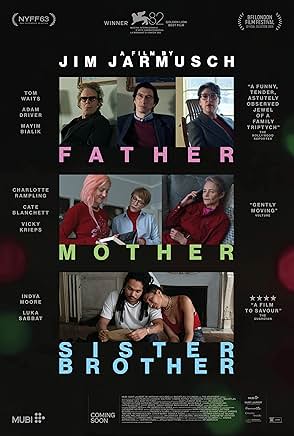

Jim Jarmusch’s latest film, “Father Mother Sister Brother” (2025), is a family anthology consisting of three separate segments that revolve around family visits. Eagle eyed viewers will be interested in comparing the details of each story and discovering common elements. Casual moviegoers will just enjoy the ride. This understated, gentle movie offers an intimate peek into three families’ lives and features a perfect cast. You will not want the movie to end. Casting director Ellen Lewis’ unlikely arrangements makes each segment a revelation. Location scout Benjamin Vasseur makes every setting seem like a character. It is a nice way to ease into the new year with an almost indiscernible increase in momentum that crescendos into a quiet, poignant ode to family enduring.
Shot in in New Jersey, the first segment, titled “Father,” is roughly thirty-seven minutes. Siblings Jeff (Adam Driver) and Emily (Mayim Bialik) visit their Father (Tom Waits) in nowheresville, an isolated location with no visible neighbors. They are uptight and seem to know little about their dad, which may be the intentional dynamic. He seems less troubled at not keeping up with his kids’ lives. They worry about him, but Jeff worries more than Emily. The overall dynamic is awkward, but the environment has a bucolic, rough beauty that eases the tension. Without knowing the film’s premise, it may be easy to mistake Driver and Bialik as partners than siblings, but with more time, their similar clipped, uptight manner makes it seem more obvious. There is no resemblance to their father, but the brother and sister seem relatively close considering.
Set in a Dublin suburb, the second segment, titled “Mother,” is roughly thirty-three minutes. Cinephiles will go crazy over the casting of this segment. Charlotte Rampling plays the perfectly manicured author Catherine Russell, and when you are not impressed with her look, you will salivate over her home. Vicky Krieps plays the wild child daughter, Lilith, who keeps secrets and prefers to impress than be honest though also enjoys harmless ruffling of feathers. Cate Blanchett plays the uptight, rule follower Timothea, nicknamed Tim. The only possible complaint coming from an American so use as much salt as needed: they sounded more Scottish than Irish. The dialogue is less interesting than the physicality of each of these actors and the dynamic that they cultivate between their characters. A simple scene to the bathroom reveals volumes about the real Tim and how she feels about the situation. Everyone is mostly silent around each other and strain to talk, but they strive to keep up appearances that the annual tea ritual is a joyful one, not an obligation to keep up the appearance of connection.
Set in Paris, the final segment, “Sister Brother,” is roughly the same length as the second and stars lesser-known actors: Indya Moore and Luka Sabbat from the television sitcom “Grown-ish” and an earlier Jarmusch film, “The Dead Don’t Die” (2019). They play Skye and Billy respectively, and their relationship is cathartic as a family that appears to actually enjoy each other’s company. Their appearance seems to form a thesis about the point of “Father Mother Sister Brother.” People always go on about family values, but Jarmusch constructs a pair that defies expectations about what makes a healthy family and which values are essential to ensure the unity of the family when there is no longer a homestead or societal imposed convention to keep up appearances. Moore and Sabbat are so easy with each other and never seem like a couple even though they are the cast’s sexiest actors on screen.
“Father Mother Sister Brother” has common themes that feel organic: the act of traveling home, water, showing skateboarders in slow motion being observed as carefree and enjoying their movement on the road for their sake, the communion of eating and drinking, owning a Rolex. The off-screen history influences the siblings’ relationship with each other and their parent. Each family’s wardrobe choices reflect a spectrum of the same taste though each displays it in a unique fashion. Yves Saint Laurent handled the costumes, but it did not feel like an informercial for the fashion house, but organic and lived in thanks to their collaboration with costume designer Catherine George. Each segment includes a view from the car’s front seat. The only demerit is that the car interior scenes seem fake, an easily forgivable and unnoticeable flaw. These shared qualities make each story relatable even if you are dissimilar from every character. Some experiences are universal.
“Father Mother Sister Brother” also revels in the stories’ differences. The story starts with furtive and veiled actions and identities shifting to staging their best selves then ends with people fully at ease in the world, in their own skin and with each other. The location of the family photos reflects the health of the relationship. If they stay on a mantle, untouched and posed, it suggests that it is just for show. If it is on the mantle among beloved objects, it creates the impression of a shrine. If the photos are not framed, but are handled, it reflects love. Mention of the missing family members in each segment depicts how mannered the family is with each other. In one segment, the missing parent is not mentioned, and there is no trace of the person. Every family is unique.
“Father Mother Sister Brother” also includes traits that appear in two out of the three segments: which beverages can be toasted, tea drinkers, eating at home, siblings driving together, unconventional parents, parents who were madly in love, the use of drugs, one sibling doing better than the other, one sibling more invested in their parent, saying “Bob’s your uncle.” People have more in common than expected. There is an element of randomness, but also comfort.
“Father Mother Sister Brother” also has a through line of the children worrying about their parent’s mortality. If the parent is still alive, one sibling will worry about aging. If not alive, they worry about how it happened. There is an inherent loss present in each trip home even when no loss has occurred. It is an inherent aspect of the natural order that a parent should die before their child, and what is left behind is the sibling relationship, which is the true inheritance that parents leave their children with.
Multicolored lights, some with sequin shape sparkles or lines of color like a last show divide each section. Sometimes it looks like an abstraction of the view outside the car’s side windows with trees and elevated electric wires emerging like a Rorschach test from the image. These palette cleansers and the timing of the theatrical release make “Father Mother Sister Brother” feel like a deconstructed holiday movie without any of the usual markers. It is a poignant vibe.