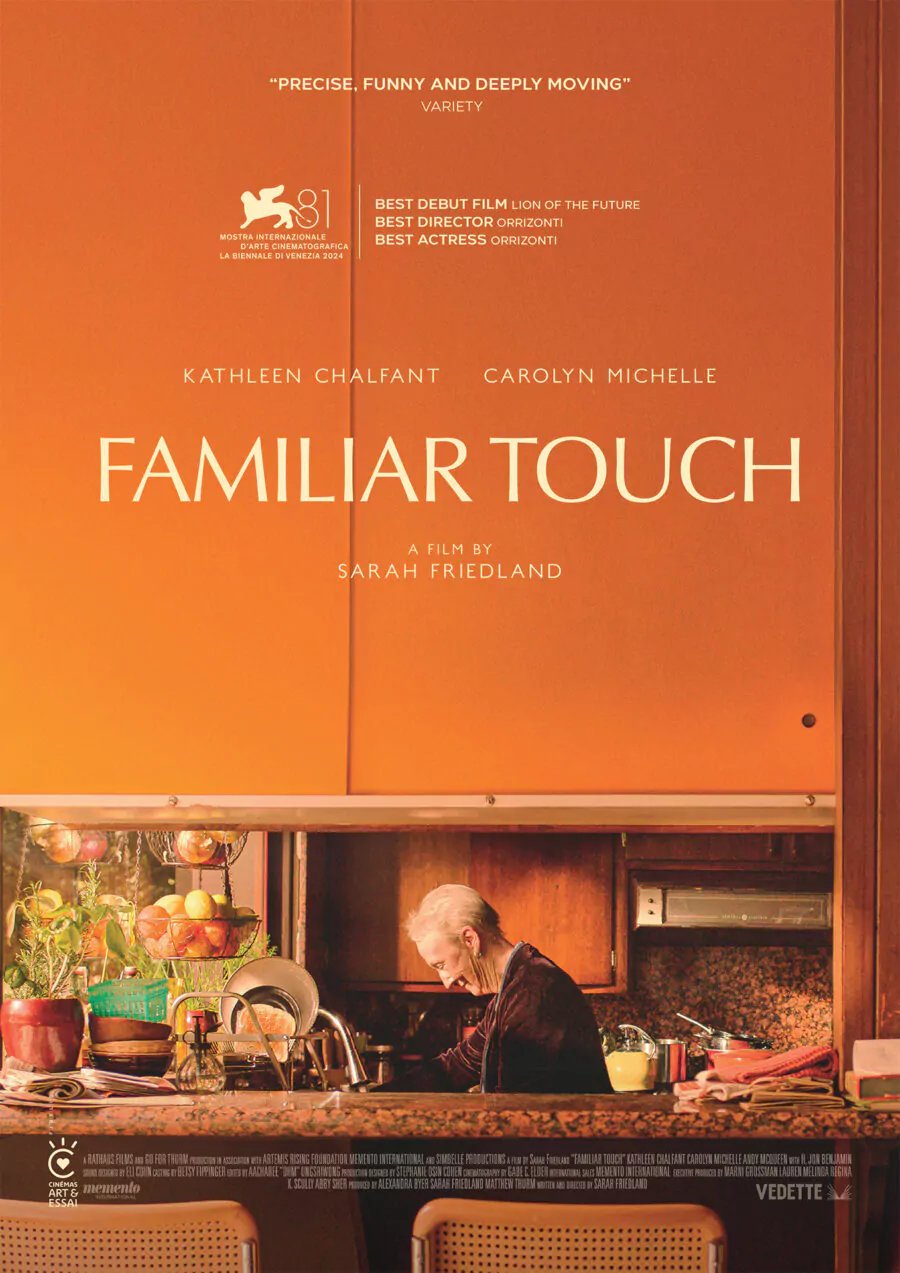

Dedicated “for our elders and those who care for them,” “Familiar Touch” (2024) is a humanistic, optimistic, gentle directorial debut from writer and director Sarah Friedland, which would make a perfect double feature with “The Father” (2020), the gold standard movie told from the perspective of a person with dementia. Ruth Goldman (Kathleen Chalfant) unknowingly reaches a turning point. She has dementia and is adjusting to a life where memory is fleeting. What part of her will survive?
The portrait of Ruth as a woman of dignity and independence is delicate. She is often the ideal patient. The parts of her identity that survive are appealing. She is a cook, reserved and able to calm herself when she gets flustered. No outbursts or cursing. Her caretakers can reason with her when she does show signs of resistance and stubbornness. Chalfant has a patrician’s bearing and an understated majesty in showing the gradual erosion of Ruth’s self. There is a hard core to her like the center of a peach that she grasps and bites into as solace for her memory of home near the denouement.
As an image of positive masculinity, “Familiar Touch” depicts a son, not a father, and it is a bonus that he is a caretaker. Friedland gives some of the best moments to Steve (H. Jon Benjamin) as he reacts to statements that should keep his therapist busy for years to come with an emotional maturity that most people could not exercise naturally in the real world. Honestly, watch this film if only to steal lines and parrot them if you are unfortunate enough to be assigned this bag of rocks. It is in Ruth’s interactions with Steve that it is possible to intuit what kind of wife and mother she was, and the plot twist is that she may be less likable to family than strangers. Benjamin delivers a nuanced and tender depiction of a son shifting as needed depending on the circumstance. He does his best not to impose his own personal agenda on the situation, but it is palpable and heartbreaking how he feels uncomfortable. Also, he is definitely a contender for best dance in a movie.
Brian (Andy McQueen), who tests Ruth’s cognitive state and supervises Vanessa (Carolyn Michelle), describes Bella Vista as a “geriatric country club,” which may explain why Vanessa has so much time to devote solely to Ruth and no other residents. Even if care workers adore the residents, their workload makes it impossible to do this. Vanessa is basically perfect. She can even study on the job to get a better position. Where in America does this movie take place? Is California really this perfect? Everyone who works at Bella Vista is American and English speaking, which may be possible because again, country club, but the people willing to do these jobs are usually immigrants or Americans from cultures that usually value their elders or are willing to pretend like they do so they can make a living, but even they get worn down.
Vanessa and Ruth’s relationship is the cornerstone of “Familiar Touch.” Regardless of the filmmakers’ intent, people who would prefer to befriend the staff instead of fellow residents are disassociating instead of facing facts. Also, a lot of dementia patients cannot form connections because they do not share the same eroding set of memories, which leads to more isolation whereas with the care workers, at least the staff can glean information from interacting with the resident, the files and the visitors. While their intergenerational relationship is caring, it is not a friendship. Ruth unintentionally inflicts a microaggression on Vanessa when she mentions the civil rights movement in an offer to set her up. It is basically like hearing the father in “Get Out” (2017) mention that he would vote for President Obama three times if he could. During their last scene together, it is obvious that their relationship is deep but one-sided. Vanessa is a consummate professional. Have we learned nothing since “Driving Miss Daisy” (1989). A movie does not have to be set in the South in dire historical times to recognize that Ruth needs Vanessa as her human everything, but Vanessa is working. It does not mean that Ruth is a bad person, but a typical one who defaults to thinking that her feelings are mirrored in another’s objective reality.
“Familiar Touch” is less about the characters and their dynamic but about the overall vibe of existence. Friedland as a director is confident and not flashy, a rare and welcome combination. She only uses diegetic sound to tell the story except when she conveys Ruth’s mental state. In one pool sequence, the sound gradually changes to the sounds of childhood. When Ruth is first introduced, she is still at her home in a medium shot, but the primary sound is the speed of her sorting through hangers. As Ruth gets more agitated, she suddenly stops then resumes at a calmer pace to find the outfit that she is looking for. A sliver of mirror for the closet sliding door gives a glimpse of the rest of the room to moviegoers. Later when Ruth is preparing a meal in her kitchen, Friedland takes her time with long shots before switching positions and showing Ruth from a different angle. Places with food, ideally with no one present, is where Ruth is most herself, but even there, the signs of deterioration are present with a single misstep such as putting a slice of toast on the dish rack. The suspense between the preparation of the meal then reappearing seated on the bed getting ready is likely intended to make the audience wonder if she forgot to eat. Friedland is the kind of director who could make a film with no other characters in one location, and it probably would be as good as her debut.
Ultimately “Familiar Touch” pulls punches and is a fairy tale told to moviegoers, and the majority of which will not be fortunate enough to enjoy such accommodations, have caring family or be physically and mentally healthy enough to have relationships. The movie is at its most realistic when she first enters Bella Vista. Ruth is a cluster of contradictions: rejecting her son’s attempt at connection then hurt when he obeys her and leaves, snapping at Vanessa for existing and being awake in an unfamiliar place. Otherwise, it stops at the place where she regresses until she becomes a baby again with occasional flashes of her old self emerging at the least likely times just when cognition is most cruel. Also, the worst part: there will be a point when Ruth looks at food and does not recognize it, which is one reason why people with dementia stop eating. Eventually the body forgets to eat or swallow.