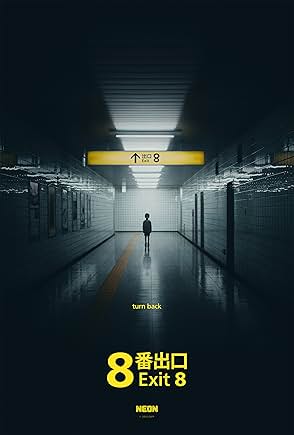

The Finnish horror game series, “I’m on Observation Duty,” inspired KOTAKE CREATE’s 2023 video game, “Exit 8,” which is now adapted into a 2025 movie, with the same title but never feels monotonous or like a video game movie. Think if “Groundhog Day” (1993) was a horror movie, but in a more restrictive location and not like “Happy Death Day” (2017). A Lost Man (Kazunari Ninomiya) is taking the train to work then discovers that he cannot find his way out of the station and is in a seemingly endless loop. Eventually he figures out the rules to getting out, but it requires keen observation. There are also unstated counterintuitive rules, which will teach valuable lessons about making society better and pulling it from the brink of dystopia in spirit to those stuck in the passageway. While the lesson seems obvious, even heavy-handed, not everyone will get it, and those who do may fall along gender lines. Still, anyone scared of repeating a task for an unknown number of times will find this movie truly unsettling regardless of how deep you want to get into the themes.
Even though “Exit 8” is simple, it does a lot with a little. It is amazing that none of the actors lost their minds filming the movie, and if it was not done in chronological order, then they are champs for pacing themselves and knowing which emotions to hit without getting there incrementally. The infinite theme is echoed at multiple levels: Ravel’s “Bolero” (1928), which is repetitive, but increases in intensity over the course of time, the poster of Dutch artist Mauritis Escher ‘s “Möbius Strip II (“Red Ants” for an exhibit from 8.18-_11.8) which features gigantic ants crawling up an enormous 8, the title because eight is an infinite sign standing on its head, opening a door opens up to the past, a social media feed with no end (note the rat with the ear growing out of its back), and the High School girl (Kotone Hanase) who makes the analogy of working and doing the same thing daily as hell.
To escape, one must follow rules that appear on an instruction poster. First, if you find an anomaly, turn back immediately. Second, if you do not find any anomalies, do not turn back. Third, do not overlook any anomalies. Each time the Lost Man succeeds, he moves up a level. Each time he does not, he starts at zero. These rules keep the moviegoers engrossed because they are also trying to catch the anomalies and anticipate whether the Lost Man will advance or fall back. Sometimes the anomaly is so obvious that it is almost as if the space is screaming, “Damn, girl, let me make this obvious for you.” Like the original game, a Kiyosumo-shirakawa Station art installation of diagonal ceiling fluorescent lights appears once. There are occasional signs that explicitly say “Turn back” overhead, but the Lost Man never notices them.
There are eight levels and unspoken rules to encourage good Samaritanism such as how to treat the Boy (Naru Asanuma) when you can get what you want or what to do during a disaster. Depending on how you answer, you could be condemned to that life forever. There appears to be a NPC (non-player character), the Walking Man (Yamato Kochi), who appears at each level then at the end of that round, he stops and looks at his cell phone.
Occasionally the Walking Man soundlessly appears right behind the Lost Man with a huge smile plastered on his face. If you were into the “Smile” franchise, you know how innately terrifying it is. Recent horror is not the only homage at play. KOTAKE CREATE explicitly referenced Stanley Kubrick’s “The Shining” (1980), which also had a yellow movie poster. One muddy water scene echoes the blood cascading impossibly down the hall of the Overlook. Blood drips down the white tiles. Time seems to work differently in that corridor. Better than “Undertone” (2026), the sound design is effective and often terrifying, especially the sound of footsteps, the absence of the sound of footsteps, the Lost Man’s audio perspective. There is also just the conventional terror of the most unstoppable force on Earth: the ear-splitting sound of a baby crying constantly. It would be a spoiler, but it is relevant to the opening scene, which is shot from the Lost Man’s perspective and is foreboding regarding a personal crossroads that he will soon face. “Exit 8” is a psychological horror film.
For the last ten years, Japan’s birth rate is lower than needed to maintain a stable population, but around the world, there is anxiety over people choosing not to have children so it is unsurprising that there is a growing number of movies that encourage marriage, discourage abortion and reframe loser guys as people who need a multitude of chances to get with the program. “Exit 8” is special for not putting the burden on woman (talking to you, “Undertone”) but telling men to get their crap together though young women or teenage girls appear in the passageway, but as part of nightmarish, oneiric imagery than those in need of a lesson. Now a man can be part of a birthing process, which in turn, allows him to be reborn. Hurrah for equality in making people feel guilty. It was not the gender equality that anyone wanted, but it is the one that we are going to get.
Congratulations to “Exit 8” for not giving in to obvious tropes such as asthma not playing as important role as it usually does in horror films or the characters being dead and in purgatory or hell. Unfortunately, it may not escape the biggest trope of all: an English language remake. We rebuke you in the name of Marcel Pagnol. It is perfect the way it is, and if you do not think so, just wait until “Backrooms” (2026) is out because maybe there will be a perfect American complement with no need to ruin a perfect Japanese product. It also would not work in the US because that opening scene’s premise relies on Japanese polite society not ruffling feathers whereas in the US, violence would break out even if there was only a little old lady on the train. Someone would do something even if it was not a man. Also, all the cities that have underground subway trains teeming with people have historically proven time and time again that the average person from these areas does not tolerate bullies. Then the need for a loop to teach the lesson evaporates so an American movie would have to change the initial opening scene completely.
“Exit 8” is great, but likely a one and done deal. It would be wonderful if people who read Japanese could report if there is any significance regarding the signs that say what is outside: Nanbu Park, Mizuse Junior High School, Yonago Temple, Narihira Bldg. and Happongi Crossing. If you are expecting murder and mayhem, keep it pushing, but there is plenty of soul death. Promise!