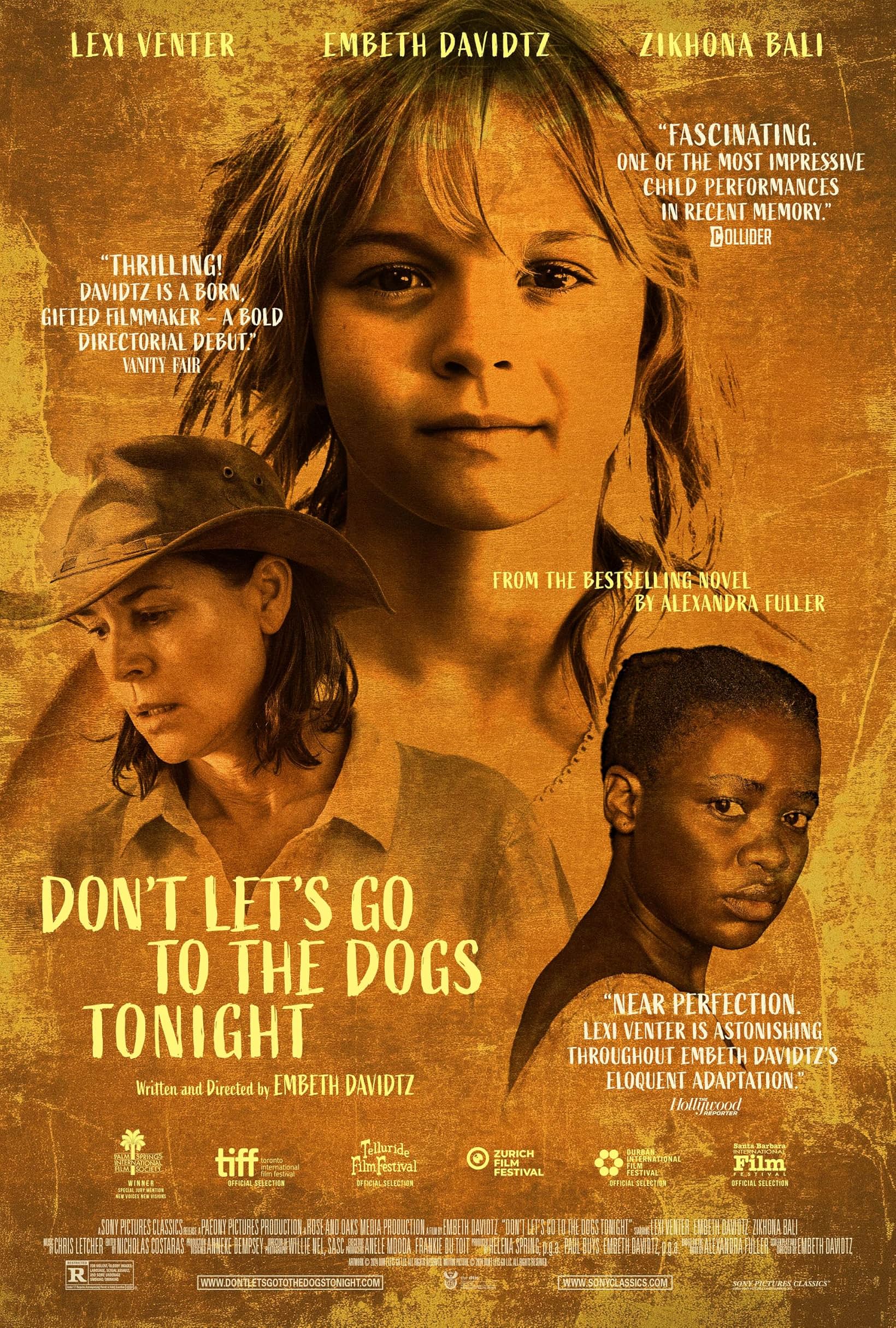

“Don’t Let’s Go to the Dogs Tonight” (2024) partially adapts Alexandra Fuller’s 2001 memoir. Actor, writer and director Embeth Davidtz, who was born in the US to South African parents, solely focuses on the time around the Southern Rhodesian general election from February 14 through March 4, 1980 through the eyes of eight-year-old Bobo (Lexi Venter), the youngest member of the Fuller family, which includes mom, Nicola (Embeth Davidtz), dad, Tim (Rob Van Vuuren), and older daughter, Van or Vanessa (Anina Reed). The Fuller family is depicted as chronically dysfunctional with only the housekeeper, Sarah (Zikhona Bali), Jacob (Fumani Shilubana) and other servants keeping the place vaguely habitable and the kids fed. If you cannot take care of yourself or your children, how can you rule over others? OK, that is not the point of the movie. Will Bobo and her family find a way to accept the changes or choose to die for their home? “Don’t Let’s Go to the Dogs Tonight” is a solid movie, but it is ninety-eight minutes of watching child neglect and may leave people unfamiliar with the accents or historical context more confused or leaving with the wrong impression.
A lot of people watching “Don’t Let’s Go to the Dogs Tonight” thought Rhodesia was another name for South Africa. Rhodesia is currently known as Zimbabwe and is in the southern part of Africa but is not South Africa. The next three paragraphs add some historical context bearing in mind that I am an ignorant American who did some rushed research to come up with a cohesive history that made it make sense to me. If three paragraphs is more information than you would like, the fourth paragraph is the TLDR summary.
In 1889, Queen Victoria chartered the British South Africa Company, which expired in 1924, to govern Rhodesia. Rhodesia was named after Cecil Rhodes, the company’s founder, and included other territories besides modern-day Zimbabwe. (Terror-tories?) Rhodes wanted British colonizers, not the United Kingdom (UK), directly governing the area. If Rhodes could not gain power through treaties, he took it in the First and Second Matabele Wars in the 1890s. After failing to make any profits, a 1922 referendum resulted in white voters electing for Southern Rhodesia to be established in 1923 as a British Crown colony in Southern Africa instead of incorporating into the Union of South Africa, which would later be the Republic of South Africa. See, Rhodesia is not South Africa. This decision was codified in the Southern Rhodesia (Annexation) Order of 1923.
In 1953, to delay calls for independence, the UK created the Federation of Rhodesia and Nyasaland or the Central African Federation, but on January 1, 1964, the UK dissolved it. UK had plans for Rhodesia to remain a single country, but the Southern part was not cool with democracy, i.e. majority rule and racial equality, while the Northern part was. Why is that North-South dynamic a thing? If it happened in a third location, it is a thing. Let me know. So, the UK let the North be independent on October 24, 1964. In 1965, Southern Rhodesia said hell to the no and decided to call itself Rhodesia. Rhodesia declared itself independent from British rule without granting an equal vote to the entire population; thus resulting in a white dominated government in a Black majority country. This declaration violated the 1923 Order, but the UK did not deadname them and respected their choice; however, it was still a rebellion against the government, the British Empire (ha!), and they were an unrecognized state.
Depending on which side tells the story, the Zimbabwe War of Independence, the Rhodesian Civil War, the Rhodesian Bush War or the Second Chimurenfa spanned from July 1964 to December 1979 between the government and Black nationalist forces. After August 1 through 7, 1979, when all the former and present global Commonwealth executive heads met, the British government included and invited Bishop Abel Muzorewa, the head of the only legally recognized Black party, the United African National Council, and leaders of the Patriotic Front, which included Robert Mugabe, to participate in a constitutional conference. The conference took place from September 10 to December 15, 1979 with the UK’s foreign and Commonwealth secretary presiding at Lancaster House, a mansion at the West End of London. The Lancaster House Agreement was signed on December 21, 1979, returned Rhodesia to British rule with the promise of an election under majority rule, i.e. stopped the rebellion from white settlers against the British government and Black majority. The election in “Don’t Let’s Go to the Dogs Tonight” is the election between Muzorewa and Mugabe that everyone agreed to.
TLDR: A British corporation decided they wanted to own a place, failed to make money so hid under the skirts of the British Empire as a colony until the UK realized that indigenous people should have slightly more rights. The Brit colonizers freaked out, started wars and could not even do that right so they kind of relented. In other words, the use of the phrase “terrorism” was used to describe enemy combatants in a war of occupation that the colonizers declared and started. Projection much? Back to the movie!
As an actor, Venter carries a bleak movie, but because the actor is also a child, it feels as if she is in as much danger as her character. Venter as Bobo rides a little motor bike with zero protective gear like a tiny Dennis Hopper. Bobo is clearly full of joy over her freedom with the wind in her hair, a little gun casually strung across her back and handling grenades. Guess the idea for DCF did not come from the Brits? Bobo questions the world because she engages in forbidden contact with the Africans around her. Her parents’ paranoia and racism have not fully soaked in because Sarah treats her like a child (because she is!!!) and tells her stories, which exposes her to African culture and other ways of existing in and interacting with the world. Bobo exists in between worlds because she is basically feral, but occasionally she sees things that innately disturb her even though she does not understand why such as the way that Anton (Albert Pretorius) touches women and girls. She is beginning to realize that just because adults behave a certain way, it should not be equated with model conduct. Bobo is creating an identity for herself, and while the colonizer is an inseparable part of her, the influence of indigenous life alters her approaching the world in solely a high-handed way. It also helps that while she may not be considered African, a scene with her more affluent, suburban grandparents reflects that she is not British.
I have not read the memoir, but I bet that Sarah is a composite character not entirely faithfully rendered in the translation from page to screen. “Don’t Let’s Go to the Dogs Tonight” includes a storyline that people are watching Sarah, and as reprisal for caring for a white child, there could be physical reprisals. Nope. Google is free. In the book, a cook stabs a maid, and while the farm gets raided, this movie storyline legitimizes the Fuller’s family’s delusions, which is shared with the ruling class, of terrorists out for revenge because of race. If it did happen, it did not happen to them or not in the way that it plays out on screen. So, while Sarah is not a mammy character, she exists as a redemptive figure who makes the Fuller family seems less horrible than they are and as a model of how Africans should treat the colonizers: eternal patience, instruction, devotion and kind admonishments. Sarah is contrasted with the other servants who resent Bobo as a symbol of the privilege that robbed them of their dignity and resources, which means being horrified when a person is being mean to a child. Did that happen? Not according to the online summaries that I’ve glanced at. Davidtz puts her thumb on the scale. Not on my watch! If there is a pulled punch, it is the weak, half-hearted attempt to include some false equivalencies, so the Fullers seem less like monsters and somewhat justified in their fears.
This critique of the way that Davidtz constructed Sarah should not be conflated as a complaint against Bali’s performance, which is emotionally nuanced and reflects the inner world of this character. Sarah is saved from not being a magical Negro because Bobo is always interrupting her life. Sarah loves a child who will one day be a danger to her and everyone that she loves if she cannot teach her lessons before Bobo is too old to rebuke. What Davidtz may not get because she does not relate to Sarah as much as the Fullers is that the Fullers are directly harmful to Sarah not because of how other Africans see her, but because they are a literal danger to her. Being around people who see everyone as a terrorist could mean that one of the Fullers or their friends could shoot Sarah. If Anton is sexually harassing white women and girls with impunity, and no one cares, what is he doing to the Black women and girls around him? Because the story is about Bobo and how she sees the world, Davidtz never had to depict Sarah’s fears, but once she did, there is a fundamental misunderstanding of what Sarah was probably afraid of that never had to be inserted, but once invented, was not credible. She was afraid of the Fullers, including Bobo, and what they could do if they did not like anything that she did, including how she fed Bobo, how she dressed her, what she told her. It is only because the parents did not care about Bobo that they did not care about how Sarah was teaching their daughter. Think that I’m wrong. Who do you associate “woke,” “critical race theory” or “DEI” with?
While Davidtz’s writing choices are flawed, Davidtz’s performance is raw, fearless and flawless. If “Don’t Let’s Go to the Dogs Tonight” tries to lessen the impact of such a bad mom, it happens late enough in the film that it is impossible to still not see her as she is: a person who would barely be functional without kids. Also even in the best light, she is still irresponsible at best. The audience’s first impression of Nicola is waking up hung over and hugging an Uzi submachine gun, which is more physical affection than she shows her daughters. Davidtz’s first-time directing is seamless because she mostly shows the world through Bobo’s eyes, which translates to a handheld camera at Bobo’s eye level so obscuring a great part of the world. Bobo realizes that her parents’ marriage is not healthy for the first time when she is hiding under a table, so the audience sees the volatile range of emotions and Bobo’s fear as she sees her parents are messed up.
Van is a riveting foil, and Reed makes a meal out of a morsel with her small supporting role. Unlike Bobo, Van takes great pains with her appearance and adheres to gendered societal norms. She is at least aware of her mother’s flaws and almost uses her appearance to distinguish herself from her family in hopes of having a different fate. Davidtz leaves one moment that feels random as an African teenage boy comes to their patio to deliver news, and she seems to stare at him in an inscrutable negative way so while he remains superficially friendly, he hustles out of there to get out of the range of her gaze soon after making accidental eye contact. She is the opposite of Bobo, but her fate is in many ways worse because Bobo is young enough not to be psychologically wounded whereas Van must bear the blows with silent forbearance. In a harrowing scene, there is a moment where the parents could finally tend to her, but they brush it off, ignore it and never investigate further because it would disrupt their social calendar.
Tim has the capacity to parent but prioritizes his war games then his wife with his kids low on the list. Van Vuuren flips like a switch when Tim no longer enjoys his wife’s antics. It is almost as if you can see him transform from soldier to the head of the house. He is never a good father, and he often crosses the line, but Van Vuuren shows flashes in his eyes like, “Wait, it is one thing for Bobo to strip mounds into a clip, but maybe juggling a grenade is a bad idea? Nah.” It is an understated performance. He is behaving in the ideal way for that society, but the actor inserts just enough wisdom to suggest that given different circumstances such as being raised with less bellicose, racist values, he may have been decent. He loves his wife and child though they all have a damaging way of showing it.
The people who made “Don’t Let’s Go to the Dogs Tonight” love and relate to the Fuller family, which is what makes the movie so powerful. Fuller was writing about her life. Davidtz is familiar with that region and being a minority in a country while holding more political and economic power and possessing freedom of international movement to different countries whenever her family felt the need to do so. The cast is likely from that region. They are intimate players, not outsiders projecting their agenda onto another’s life story. Detractors would not have been able to do as deft a job without criticism when deconstructing the image that some attempt to proliferate today of the poor, persecuted white farmer in need of refugee status because of alleged racial discrimination and threats of violence. That palpable love made it difficult for me to watch because it means that poison tastes like mother’s milk and won’t be spit out. It is a tragedy.
Because “Don’t Let’s Go to the Dogs Tonight” pulls no punches and shows life through the eyes of the child, not through the eyes of the deluded adults around her who think that they are superior because of “breeding,” it filters a dangerous, harmful world through the eyes of love oblivious to how much her parents and their world view also endangers them, not just the people around them. Davidtz shows, does not tell and only pulls punches when depicting Bobo’s memories when she misses someone and reflects on a past not shown entirely on screen. It is a world of nostalgia where looking back leaves a sense of being sullied. It is a bold debut. Too bad no one is going to see it, and those who do may be ill equipped to learn the lessons, intended or otherwise, that this childhood story tells.