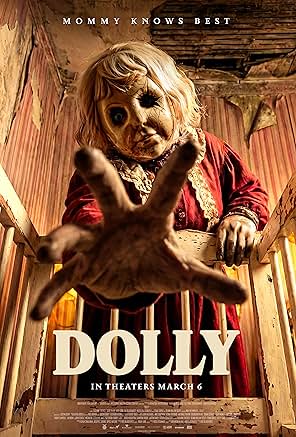

“Dolly” (2025) bravely asks, “What if the killer was not a man?” Nonbinary actor Max the Impaler or Max Lindsey is probably the best part of the movie but still is an insufficient reason to waste eighty-three minutes of your life on a pastiche of horror classics from “The Texas Chain Saw Massacre” (1974), “Friday the 13th” (1980) and “Halloween” (1978). Macy (Fabianne Therese) and Chase (Seann William Scott) go on a hiking trip and come across creepy dolls then an enormous person wearing a porcelain face shaped, head covering mask, Dolly (Lindsey) who seems to have no use for men other than to maim or kill them, but treats Macy as if she is her baby. This feature expands a four minute short, “Babygirl” (2022), but still needed more development before heading to the theater.
I was standing in line at the supermarket when I overheard a woman delightedly describing going on a hike then getting a marriage proposal. As soon as she left, everyone within earshot, including me, said that sounded like a threat, not a way to begin their life, and in an instant, all of us eliminated ourselves as relating in any way to Macy and Chase. Final girls would make a movie interesting without the killer. There is never a point where Macy seemed like anything but fodder though the story requires her to be more. She zigs when she should zag. She is a blank slate of a woman who has a few generic characteristics: she mockingly plays with creepy dolls (dumb and instantly unlikable for messing with someone else’s things); she does not know if she wants to get married (smart); she does not know if she wants to be a stepmom (fair) and she has at least one woman friend or sister, Rachel (Kate Cobb); thus putting her ahead of the protagonist in “Midsommar” (2019). Her worst fear: becoming a monster implicitly like her mother. Apparently, Dolly is like “Hold my beer” and ran straight towards embracing the most fucked up legacy she had.
If a movie wants to explore the ugliest, deviant side of nature, have at it, but in “Dolly,” it feels more like a way to run the clock in a prurient fashion than to say something substantial until the last half hour, which then retroactively makes earlier scenes comprehensible. The implicit ambiguity in “Dolly” is what is Dolly’s deal. Unlike Michael Myers, Dolly is not even evil for evil’s sake with zero explanation needed. In the opening scene, there is mutilation and abuse of a corpse, but Dolly appears to do it out of reverence and love. Dolly is not right in the head, but is it nature or nurture? A poem at the beginning explains Dolly’s backstory “In the woods, a mother cried. And wished for a love, long denied. She soon appeared, a child of grace, ‘Til evil struck with his dark embrace. The girl now hides, behind a mask, To raise her own, long at last.” Words have meaning beyond evoking a demented atmosphere, and while director and cowriter Rod Blackhurst and cowriter Brandon Weavil do reveal the possible events behind the verse, it also just adds to the demented atmosphere and is less enlightening than necessary.
Dolly is in mourning and has decided to live her best life, but she did not always realize that she was a fearsome figure who could wreak her own devastation. Because that epiphany is never shown, but she alternates between delighted child playing with her doll to violent child who would destroy a toy if it misbehaved, it leaves viewers in the dark for too long without a foundation for the story to build upon. She is like Jason for being sympathetic but ultimately too dangerous to rehabilitate. Also, it is implied that she is modeling what she believes is acceptable behavior towards children, so she survived abuse.
Maybe I’m the only one, but I did not assume that Dolly was a woman or a man just because of her clothing or her pastime, and I knew nothing about the actor until after “Dolly” ended. Dolly is big and strong, stronger than most men. Mentally Dolly ‘s interest in Macy never seemed sexual. Though repulsed, Macy never reacts to Dolly’s incursions on her body as if Dolly threatens sexual violence though she is horrified and resists. Blackhurst makes it rapey in the way that he shoots the early scenes, which delays getting to Dolly’s story and making a horror movie that actually adds up to a cohesive whole. His statement seems to be that when the wrong people have children, it is inherently sexually violent: forcing food, body parts or objects into people’s mouths, changing their clothes, not letting them have bodily autonomy, spanking, forcing them into physical proximity. It is Dolly’s way of nurturing that reveals her gender. Mothering is monstrous, and the child’s well-being is irrelevant while the mother’s desires are the priority. Unfortunately, even with her experience with monster moms, Macy never rises for long to the challenge of resisting her.
Horror movies used to have a story, pacing and end on a high note of frenzy, desperation and action. Please stop this trend of believing that sufficiently copying another movie’s visual style is the accomplishment and reward. It is just a gimmick without having a story to hang it on. “Dolly” does not distinguish itself as a unique story other than the monstrous mother theme. It leaves the impression that the goal is shocking the audience. Dolly comes out of the gate giving an unhinged impression, but the problem with starting at ten is that ten starts to feel like one. It is really hard to sustain a level of terror if there is no mystery, and the ensuing result is monotonous and dull. There is no world where it seems plausible that Dolly will not choose violence and weirdness. So when Macy figures out that she is an exception, she seems dumber to not leverage that advantage for as long as she can milk it. (You’ll get why that is a dad pun if you see “Dolly.”) No, she alternates between being the dumbest person alive, resisting then submitting at the worst possible times. If Dolly was not mentally impaired, she would have killed Macy immediately because Macy starts using force before Dolly did and becomes predictable, but Dolly reciprocates with way more strength. Also, instead of just making a clean break for it, Macy tends to dawdle or detour. Laurie Strode would never.
If “Dolly” committed a cardinal sin, it is making Macy’s main motivation like Sauron or Gollum. If it was supposed to be a comedy with a very special episode of “The Bachelor,” then it could work. In the end, Macy borrowed a bit of inspiration from Dolly except over rings and marriage. So much for the mommy theme. Nary a thought, only a few images, are devoted to Chase’s daughter. What was the point of that beginning since there is no parallel universe where it is feasible to imagine that Macy decides to stay in her life. Sloppy, half considered, unsatisfying work. Max the Impaler deserved better. It is only getting a thumbs up because it sustained interest and evoked a strong response compared to other films viewed around the same time.