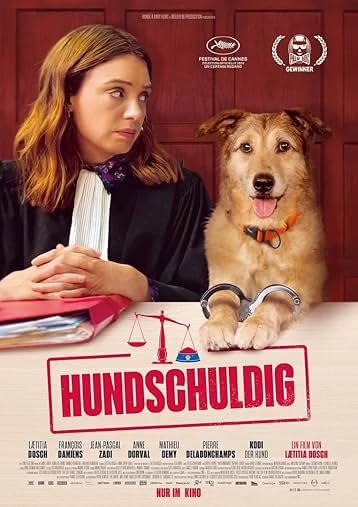

Laetitia Dosch cowrote, directed and stars in “Dog on Trial” (2024) as Avril Lucciani, the patron attorney of lost causes. After promising to stop taking losing cases, Avril immediately takes the case of a dog, Cosmos (Kodi, winner of the “Palm Dog” at the Cannes Film Festival), sentenced to death for biting three people. It is an open and shut case, but Avril decides to fight so he can live. The case becomes a lightning rod for women and animal rights activists, but for Avril, it is so much more. Should a living being be treated like property and punished for not fitting into societal norms and adhering to his canine nature?
My thumb is on the scale for “Dog on Trial.” As a lawyer, I have long been outraged at how the law treats animals like property and inanimate objects without considering the animals’ best interest and desires though I am a hypocrite meat eater. Every living being, including gross flies, has a complex, unknowable interior life, but because they cannot communicate and navigate the world like we do, they do not get a say in their destiny. So the idea of a lawyer trying to change the law through litigation is appealing. As constitutional scholar Paul A. Freund stated, “The Court should never be influenced by the weather of the day, but inevitably they will be influenced by the climate of the era.” With that said, Freund worked in a common law world, which is based on case law created through judicial interpretation, and we are in the worst timeline. The film is set in Switzerland where the legal system is based on the Code Civil Suisse which the Napoleonic Code and German civil code influenced and has been in effect since 1912. To change the law, the Swiss government needs to literally change the law. Believe everyone when Avril is depicted as someone who loses cases.
Avril is a person who enjoys accepting people for who they are and does not often get too worked up over people transgressing against her, but she aggressively believes in respecting others’ autonomy. She also has a great apartment. Normally throwing a kid into the mix to make a single woman protagonist likeable aggravates me, but in this case, Avril’s friendship with her next-door neighbor, twelve-year-old Joachim (Tom Fiszelson), explains her outlook on life. Kids are also treated like their parents’ property, and legal intervention will not make it better, so she figures that allowing her place to be his refuge is the third best option though it is inappropriate. So while she is alarmed at Joachim’s habits, she also does not try to stop him because his survival is more important. There is a scene where she tries to contact the authorities, and Dosch depicts the wait as so long that the surroundings during the call change then she is reprimanded for her tone with no concern expressed about the child. If a lawyer cannot make the system work, no one stands a chance, and once again, manners matter more than actual harm.
Another important scene happens in the supermarket. Men are constantly invading her space or taking groceries from her as if she was picking it for them, not herself. The audio of the scanner beeping begins to resemble a heart monitor gauging her level of interest in each guy. She has a high tolerance for sexual harassment or others encroaching on her person to the alarm of her client and Cosmos’ owner, Dariuch Michovski (François Damiens). When one man finally bites and asks her out, she reluctantly forgoes his offer because she is worried about losing herself in the relationship. Dosch depicts the protagonist as a woman rich in friends, passionate about her job and has an active sex life, but like the dog and the kid, she does not want to be seen as someone who exists to make someone else happy, to serve a function. She wants to be herself.
So the dog becomes a symbol of everyone in society who somehow defied all the breeding and training to still adhere to the rules of nature, the wolf for Cosmos, and is being punished for it. Avril’s fight is for the right to not conform or lose oneself. Does “Dog on Trial” take this concept to extreme levels in the surrounding political discourse? Sure, but have you seen “Eddington” (2025)? It is satirical, ridiculous and overblown, but it also is not because sadly we are living in *checks notes again* the worst timeline. Despite being described as based on true events in a French town, I could not find anything substantiating this claim so if you find it, reach out. There is of course historical precedent for such cases, but as an American lawyer, I would want other animal peers doing the judgment, not people, because it would still be judging an animal by human standards if human beings were involved. Is there a way to make it work according to my logic? No. Leave me alone. I just like animals.
If you criticize Dosch as a filmmaker, I also need you to watch “Ally McBeal” because “Dog on Trial” is far less quirky, far more realistic and not even a little surreal. The hardest scenes to stomach were when Avril decides to pull a Jacob wrestling with the Lord and spend alone time feeding Cosmos knowing that he may literally rip her face off. Absolutely not. A lawyer would not do that. When I heard that someone’s dog bit their child’s face (don’t worry, the child and dog are fine and separated), even I was like, “Welp, is the dog alive?” There is theory and law versus real-life consequences, and a dog is going to dog. He said what he said. Don’t touch me while I’m eating. Got it. There needed to be another way to get Cosmos to the forest to express his yearning for another life.
Were the montages involving opposing counsel, Roseline Bruckenheimer (Anne Dorval), supposed to be a thinly veiled send-up of Bernadette Chirac, who was recently depicted in the fictional “Bernadette” (2023)? Bruckenheimer’s signature color is pink. She is running for election and keeps appearing in the most unlikely areas: on a horse, in an open-air market, magazine covers, and an exercise class. By the end of the trial, she stops appearing with her purse dog and is calling for a doggie genocide. Avril goes on a personal journey of how she wants to practice law with Bruckenheimer as her subconscious foil. Avril starts with overblown rhetoric and wearing the unrequired pompous robes. Eventually Avril’s presentation style becomes more earnest and less gimmicky. It is also important to note that the most realistic part of “Dog on Trial” is the fact that both sides have a point even after sweeping away the polarizing politics. The victim, Lorene Furtado (Anabela Moreira), cannot be dismissed.
“Dog on Trial” is not a comedy per se, and you may cry at the end. It is a great study of characters, interpersonal dynamics and society without being insufferable. Dosch’s film depicts the overall absurdity of the defense without losing sight of the inhumanness of the situation. The runtime is the perfect length. Dosch delivers with a relatable protagonist, and if you can walk away from the film thinking that a dog is only a belonging, not a living being, then you probably should not have one or kids.