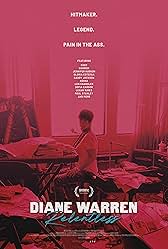

“Diane Warren: Relentless” (2024) should be required viewing for every girl and woman on Earth, every neurodivergent person, and every person who was the only person in the room that believed in themselves, especially if they dealt with abuse. While most celebrity biopic documentaries feel as if they pull punches for access, writer and director Bess Kargman’s sophomore feature retains the gloss and glamor while keeping it real and raw with the down-to-earth songwriter. Bring tissues! The 98th Academy Awards nominated Warren’s song, “Dear Me” for the “Best Original Song” category, which Kesha sings, and it is Warren’s sixteenth nomination.
If you do not think that you know Warren, you do, but you may not connect the name to the song that you love. For me, my favorite Warren song is Toni Braxton’s “Un-break My Heart,” which was number one on the Hot 100 in 1996, but I was into the remix. My ankle was sprained or just beginning to recover, and I saw the song being performed with a wild dance sequence on a crowded stage during some award show. I decided to leave my dorm room and rush to HMV to buy the single then proceeded to play it on repeat, which was a habit that apparently, I share with Warren. A lot of the film feels like the best jukebox ever as it lists many of her famous songs with clips of the videos and information on the performing artist, the year it was released and its many accolades. There are always many accolades.
Warren is the star of this documentary, and she is the perfect example of how most people do not see female presenting people as geniuses, but troublemakers who need to conform. Her guitar teacher would not even teach her how to play so she figured it out, and with the benefit of hindsight, she is clearly gifted. Her worst childhood traits are not being good in school, only caring about music and smoking pot. It is not until late in “Diane Warren: Relentless” that she reveals she has “Asperger’s,” which is now known as autism though she doesn’t detail how she got the diagnosis. Her autism is obvious if you know what to look for (compliment) from the routine, her sense of style, her love of animals, her infinite desire to work and create, and hating small talk. She describes herself in ways that are synonymous with autism: “pain in the ass,” “tenacious as fuck.” Record label consultant Larry Franzin delights in her countercultural behavior. The documentary gets exclusive access to Warren’s living and working spaces, which are as unique and memorable as their owner.
Usually, documentaries featuring celebrity interviews are a naked cynical and irrelevant gambit to get more butts in seats, but in “Diane Warren: Relentless,” it is central to the subject. She has worked with so many famous and talented people, and many of them give exclusive interviews: Cher (whose sauce matches Warren’s sauce), Randy Jackson, Common, Gloria Estefan, Toni Braxton, Jennifer Hudson, Lady Gaga, LeAnn Rimes, Sofia Carson, Paul Stanley, Paloma Faith, and Quincy Jones. Even Beyonce offers some words, but it could be older footage. Some people just appear in the montages in archival footage or so quickly in passing it is impossible to tell if it is exclusive: Becky G, Jon Batiste, Gwen Stefani, and Blanco Brown.
“Diane Warren: Relentless” features more intimate interviews. Only one family member, Michelle Dean, Warren’s niece, appears on screen and gets Carole Warren, Warren’s sister, to talk on speaker phone. Otherwise, her older sisters, Carol and Janice, only appear onscreen in a home video. They were not close because of the age gap. Her childhood friends include Andi Light, Laurie Volpe, who knew Warren since kindergarten, and Cindy Wiener, who credits Warren with rescuing her from a sad life and has worked as her executive assistant for five years. Actor and friend Kathrine Narducci describes her shock when she realized that Warren was the musical equivalent of Picasso. Warren is often depicted taking a trip down memory lane as she visits her childhood home, which she still owns and rents to an appreciative family.
There are interviews with people who are pivotal to her success. Visually it is fascinating that all her friends are fashionable blondes, but all the executive women in her life mirror her matter-of-fact manner, appearance and conversational style. They also share an intimate understanding of her life. Julie Horton, the twenty-year executive vice president of Realsongs: Diane Warren Music Company, explains, “as a child, except for her father, she really knew nothing except coldness, abuse or rejection” Judy Dunitz, Warren’s first attorney, helped Warren make the music empire that made Realsongs: Diane Warren Music Company possible. Fitness trainer Michael Romanelli describes what it looks like from the outside when Warren gets inspired to make a new song.
Notable names in the music industry also appear to talk about how they helped her break into the biz or confide their feelings about the pioneer. Lee Chandler of the Songwriter Showcase at Capitol Records encouraged her when Warren’s dad helped her hustle around Hollywood. Crystal Lujan was a record executive at Rocket Record Company who gave her a shot then worked for her in Artists and Repertoire, aka A&R. Record producer Jack White credits himself with discovering her but is less forthcoming about his standard brand of financial exploitation. Record producer David Foster seems to be the colleague equivalent of a frenemy who fantasizes about what he could do with her talent and resources if they could switch places. He does not name drop, but he relishes describing how certain artists refuse to work with her because she is so difficult. Jerry Bruckenheimer, director of “Armageddon” (1998), and Kathy Nelson, a film music theater, are more balanced in describing her talent and forthcoming about details. Warren would occasionally promise the same song to different singers. Bear in mind that people wring their hands over possibly losing a male genius at the mere threat of accountability if they commit actual (sexual) crimes, but she is annoying and chaotic so she must pay. Clive Davis was her “date” for a few Oscar nights. Mario Luccy appears on camera on a workday along with record producer, Damon Elliott, who seemed more interested in learning about her private life than staying focused on business.
People do not get her, but she gets her, and she makes her own way. Warren explains, “I’m straight. Everyone thinks I’m gay. I don’t care what I am. Whatever. Doesn’t matter. I don’t want to be in a relationship. It’s not for me. It never was.” Her mom, Flora Warren, in an archived ABC interview, describes her daughter’s life as “barren.” Guy Roche, a record producer that she still works with, is her only known romantic relationship, which lasted nine years. Unlike most people who lie and say that they always knew that the now famous person would be great, Warren only gets expressions of concern, not revisionist history. A former childhood neighbor, Beverly, observed Warren’s constant guitar playing and only thought, “Diane, you need to get a life.” Would there be a Warren if she was a wife who would be socialized to prioritize others and would not have a space of her own?
Most people are puzzled, slightly mocking or pitying over how she can write so many love songs without being in love or in a relationship except for two. Michael Anthony, the Chief Creative Officer of Realsongs: Diane Warren Music Company only speaks of her in terms of awe and veneration and makes a rigorous argument regarding how Warren lived a full life as a single successful woman. “Lots of people do not quite understand people on the spectrum. People find them odd and strange and they do not know how to deal with them, but I think it’s part of the genius.” Eric Vetro, her friend and a celebrity vocal coach, understands her on a bone deep level, especially her love for animals, which includes her bird for twenty-eight years, Buttwings, her fifteen-year-old cat, Mouse and her most recent animal companion, a kitten named Rabbit. Ultimately Bonnie Greenberg, a friend and music supervisor, is the ultimate model of friendship because she calls and checks with Warren before spilling the tea about one heartbreaking night at the Oscars. It seems as if Greenberg is not over it yet. She is pissed as if she is personally aggrieved.
“Diane Warren: Relentless” offers a much-needed profile of a woman who lives life on her terms without developmental support or adhering to any gender normative, neurotypical behavior. It also shows how society could have a billionaire in front of them, but if she is a woman, she is still framed as sad, incomplete and missing out because she did not adhere to a heteronormative lifestyle. Are you kidding me?!? If she was a guy, they would call her an eligible bachelor. And they do not see themselves practicing a double standard. People are bonkers. Warren needs to be even more uncompromising and cut some of the fat. Kargman makes excellent points and entertains without being didactic or dull.