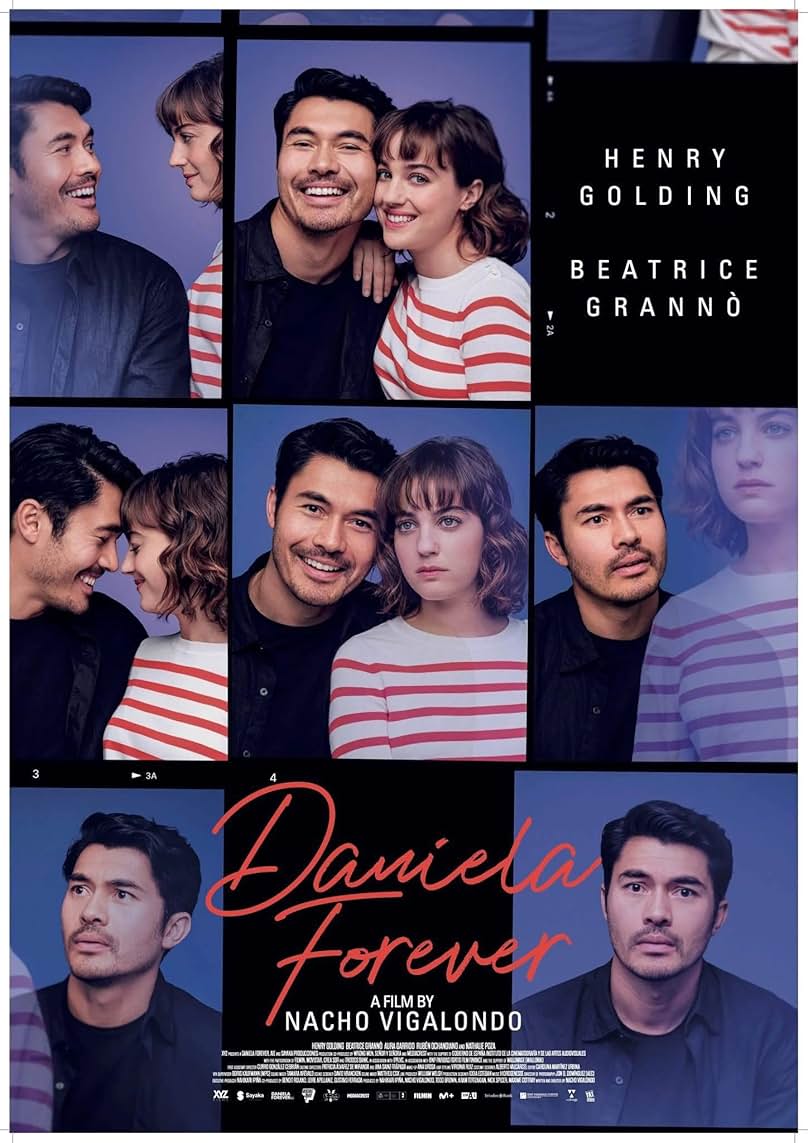

“Daniela Forever” (2024) is set in Madrid. A car hits and kills Daniela Rampa (Beatrice Grannò), an artist. Nicholas (Henry Golding), a DJ, believes that she was the love of his life and has problems moving on so his friend, Victoria (Nathalie Poza), gets him into an experimental clinical trial to try a new drug that helps with depression through the ability to lucid dream, but he does not follow the doctors’ directions and dreams about whatever he wants. He loses control in his waking and sleeping life. Is losing Daniela what is ailing Nicholas or was something fundamental wrong all along?
Writer and director Nacho Vigalondo, who wrote the “Parallel Monsters” segment in “V/H/S Viral” (2014), “Colossal” (2016) and “Paradise Hills” (2019) and directed the first two films, is back, and he is done spoon-feeding his audience. It is not an easy film to understand and maybe it is intentional. There are at least two ways that the story is told. Maybe three. When the image fills the screen, it depicts either a dream or memory. If it is a 4:3 aspect ratio, grainy and analog like an old VHS tape, it is reality. The story is mostly told from Nicholas’ point of view so when he dreams, it is like he is the god of that world, but as “Daniela Forever” unfolds, it becomes clear that even bound within Nicholas’ intended parameters and presumably only existing within his mind, Daniela is an independent person with her own dreams and fears, and Nicholas is often far from her thoughts. Vigalondo seems to be fascinated with themes of men having so much power and control over women and yet without trying, women find a way to resist and have an irrepressible force. If it was a theological debate, Vigalondo’s films would be the crossroads between free will and predestination. God can create, but his creations can live, and life will find a way. It gets confusing because it is unclear whether the bookend scenes are being shown from Nicholas and/or Daniela’s perspective.
Golding is a gorgeous man with a satin voice, but he does not often play a protagonist. “Daniela Forever” requires a broad spectrum of emotions and rests on his shoulders. As much as everyone wants more Golding in their life, his acting skills may not have been warmed up and flexible enough to guide viewers through this film. To determine where and when the action is unfolding, Golding’s physicality and voice need to do as much work as Vigalondo’s visual choices. Golding has a few modes: the depressing mode, exuberant and being sly. It does not feel like there is a lot of transition between these states. It may have been helpful to depict Nicholas more before Daniela died, which is what the opening sequence feels like, but based on the dialogue playing over the scene, a conversation between Nicholas and Daniela reflecting on how they first met, and one character lit as if it is daytime even though all indicators suggest that it is night, which is in the style of Daniela’s art.
Grannò grounds “Daniela Forever” and understood the assignment. Before Daniela utters a word, Grannò can convey to the audience in a second exactly which version of her character is existing in that scene. Without Grannò, there is no movie, and her range is insane because she goes from an “Ex Machina” like creation to a complete person. When Nicholas takes away an aspect of herself whether a memory or a desire, Grannò switches like a remote control working on fresh batteries. She has a real command of her voice and eyes. Because her performance is so perfect, it makes Nicholas seem like more of a monster when he tries to control her. Vigalondo uses a lot of horror and apocalyptic beats, but never quite gives in to one-dimensional dynamics even when it feels warranted.
“Daniela Forever” gets more right than wrong about dealing with the loss of a loved one and the separate type of grief realizing the gap between what you know about that person and the impossible task of ever fully knowing that person, especially when Nicholas realizes that Daniela has a life outside of him. Visually Vigalondo depicts it seamlessly. The 4:3 ratio and flaws in the recording reflect how Nicholas is removed from daily life and how he is not living fully, which is a huge contrast to how full the screen is when Nicholas exists in a world with Daniela even when she is supposed to be just a brain creation. There are points where Vigalondo pulls no punches in showing Nicholas treat her like an object such as when Nicholas summons her, and she materializes embedded in a bookshelf or a television. Yes, living in an oneiric world comes with surreal imagery and wonky logic, but if Nicholas thinks that she is at his beck and call, he is objectifying her so the dream logic of where she materializes, as his entertainment, is the appropriate response. Nothing went wrong. The only way that he can restore her is to put her back on course, in a world where he is not the priority.
“Daniela Forever” is about Nicholas grappling with the epiphany that he is not a good person if he cannot get his way, i.e. get Daniela to prioritize and love him, even if it means that the version of Daniela that he would get is not the true, free will version of Daniela and never will be regardless of what he does. He is a jealous and willing to hurt people. If he cannot have her, no one else can be happy. He becomes a petulant childlike god. Then he gets worse because there is a point where he encounters other people whom he has connections with and is willing to hurt them. If Vigalondo had spent more time fleshing out their friend group, the impact of Nicholas’ actions would seem more serious as if he was willing to kill people to reanimate Daniela, but since the story is told from Nicholas and Daniela’s mindset, they should not play more of a center world and should not be more developed. They are only a step up from NPCs (non-player characters). After “WandaVision” (2021), this concept should not be a heavy lift.
Initially in Nicholas’ dream world, Vigalondo depicts areas that Nicholas does not know as grey, wavy lines like “What Dreams May Come” (1998) but with the nightmarish quality of the animated sculpture above the fireplace in “The Devil’s Advocate” (1997). It is only as the film approaches the denouement that these lines appear threatening. They transform from signifying the unknown to oblivion or an apocalyptic event, which is what death is for ourners and the dead.
S
P
O
I
L
E
R
S
I think that Nicholas committed suicide, and the final scenes of Daniela living a full life is in the afterlife of her own creation. When she remembers Nicholas, she can free him from oblivion, depression, but as equals. I actually think that the opening scene is him entering her world and finally willing to let her take the lead. The drug is not only a dream world but a portal into the beyond. Hey, I’m not terribly confident of my interpretation of Vigalondo’s deliberately ambiguous vision. Vigalondo, reach out and tell me if I got it right, and what you were going for. If you are not Vigalondo, your theories are welcome too.