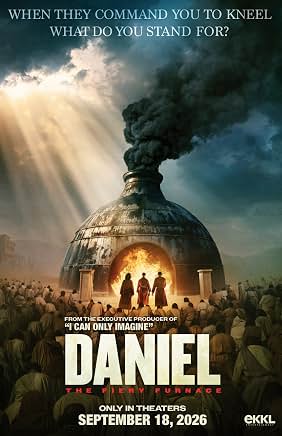

“Daniel and the Fiery Furnace” (2026) is a rough adaptation/interpretation of Jeremiah 20:4, 27 through 29, Daniel 2 through 3, and Matthew 2 from the Bible. Daniel (Mena Massoud) and his three friends, the darker skinned Hananiah (Sunjay Midda), the tallest of them all, Mishael (Adam Lahraoui), and long haired Azariah (Zaki Ali) are friends with prophet Jeremiah (Roberto Zenca) and his sister, Susanna (Sophia Decaro), so they are aware of the prophesies about their future. When Babylonian King Nebuchadnezzar (Elijah Alexander) invades Jerusalem to conquer Judah’s King Jehoiakim (Zachary Coffin), he takes the best and brightest, which includes the four friends, whom he respectively renames as Belteshazzar, Shadrach, Meshach and Abednego after Daniel catches his attention, but that favor endangers them when other members of the court take umbrage that the Hebrew captives were put above the other wise men. Will these four be able to serve God and man or make a choice that will cost them their lives?
If you do not come to this movie with a considerable amount of Biblical knowledge, you may be lost. If you possess that knowledge, then the liberties that Canadian cowriters and codirectors Daniel and Matthew Kooman take with the scripture may distract you from absorbing the movie without itching to get on the internet or flip through the Bible to fact check the revisions while watching the movie. Likely rife with AI images recreating the Babylonian kingdom, it may turn off film purists as AI slop. Still if you stick with it, the last act ties everything together nicely for Christians who are into interpretations of Old Testament references to the Son of Man/angelic appearances as Jesus cameos. Once you get your bearings, it improves with repeat viewings.
As a Jesus follower and film critic, I’m more of a spirit and underlying emotion of the Bible than direct translation of the Bible when watching film that adapt the Bible. I’m also rather attached to Daniel and any Bible figure who had to serve in environments where they were not a part of the majority (Joseph, Esther, Ezra, Nehemiah). Daniel and his three friends were a bunch of nerds, my kind of people, and there was plenty of wiggle room because other than their faithfulness to God and ability to serve with love and devotion to others who did not share their faith and could be quite full of themselves, i.e. not affable, there are not a lot of details about them as individuals. Unfortunately, the Kooman brothers fleshed out the story with more action set pieces, introducing a woman character with an unrealistic arc, inserting purity culture into a story that did not call for it and was actually ahistorical, and borrowing elements from later stories such as Daniel and the lion’s den and changing a miracle into a display of man’s strength and courage.
The Kooman brothers also get some things right. The casting makes everyone look as if they actually are from the Middle Eastern region though sometimes the acting is a bit over the top or too understated. If they had devoted more time to fleshing out the characters, tying together Jeremiah and Daniel’s story could have been a tremendous achievement. One of the most exciting and overlooked ideas in the Bible are the different ways that people can do good and function as God’s chosen ones, especially considering how contemporary Christians flatten and homogenize the idea of God’s people. The Kooman brothers do note that Daniel and Jeremiah are two very different people with different functions at different stages of their life, but it is not a visceral element of the story. Unfortunately, the world building is flashier and more superficial, not about character development and dynamics. Everyone is way too certain in the first act and way more mature than the younger four men were. There is not enough individuation, and in terms of demeanor, all the renown Hebrew characters are predominantly interchangeable. The performances, especially from Midda, inject some humor, joviality and fear, but if you quiz movie goers after “Daniel and the Fiery Furnace” ends regarding which character is which, a betting person would be correct if they guessed that everyone would fail to distinguish and name them.
“Daniel and the Fiery Furnace” is running the clock to the question of whether the four will give in and worship God or try to save their lives and worship the King. The strongest emotional scene is when the four argue about creating an image for the King and whether it would violate their principles. If there were more scenes like that, instead of rushing through the hardship of captivity, the march and acclimation period, or substituting emotional and psychological pain for physical pain, it would have been a stronger story, and the actors seemed up for the challenge. Massoud and Alexander do not get enough scenes together, and their most powerful scene is their discussion before the big day. The Kooman brothers do not trust the audience to appreciate the quieter, dramatic moments between characters. When making Bible movies, they are still movies and must fit in the framework of other movies.
If you follow my work, you know that it is a cinematic cardinal sin to omit the original dialogue, which also has twentieth century historical significance during World War II. This sin is not committed. Ali stands out in this scene facing the King with defiance, and Lahraoui’s fear makes the move bolder. It does not make any sense to have Daniel present during the ceremony otherwise he too would have to obey the edict and bow down to the image or die. So why does “Daniel and the Fiery Furnace” get a waiver? The story emphasizes how striking it is too have three men still standing among a sea of prostrate people. Also, even though the AI is AIing, the embellishment of a bolt of fire coming from heaven and entering the furnace is a great idea that perhaps a director with better practical or special effects could use in the future. The idea of a fire that does not burn and refines appears frequently in the Bible as the Holy Spirit in the New Testament and the burning bush in Moses’ come to the mountain moment. My admonishment still stands: execute the effects that you can afford without looking ridiculous. A lot of the movie stands boldly in the uncanny valley, and it will take frequent movie goers completely out of the experience.
Fortunately for Kooman brothers, a lot of Christians do not fall in that category, and I grade on a curve. Most Christian movies are not about the filmmaking quality. Their target audience is just psyched to have a movie that they can watch without worrying that it is sinful. Also, the last scene explains the identity of the narrator telling the story and ends the story on a high note. There is a post credit scene so do not leave when they start to roll. If you are Jewish and want a faithful representation, it is unlikely that this film will work for you and may verge on blasphemous, but I defer to Jewish reviewers to make the call.